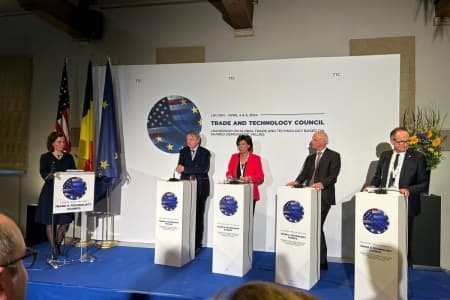
Taking part in the TTC sixth ministerial
News
4 Apr 2024
Transatlantic, Digital, Trade
Taking part in the TTC sixth ministerial

Why is the Trade and Technology Council (TTC) so important to the business community? This is what Susan Danger, CEO, AmCham EU discussed on Thursday, 4 April during a stakeholder discussion as part of the TTC sixth ministerial. Highlighting the stability that the TTC provides, she also emphasised the importance of the transatlantic economy, which is the most integrated economic relationship in the world. To keep up this unique forum's momentum, both Europe and the US must now work on institutionalising the TTC so that it can continue to deliver results.  

Joining Ms Danger on stage was Koen Debackere, General Manager, KU Leuven Research & Development; Peter Chase, Senior Fellow, German Marshall Fund (GMF) and Bart Steukers, CEO, Agoria.      

Related items

Position Paper
16 Jun 2026

Implementing the EU-US Joint Statement

With the EU having formally adopted the tariff reductions agreed under the EU-US Framework Agreement, the two sides now have an opportunity to enter a new phase.

The agreement has the potential to help restore stability and predictability for citizens and businesses on both sides of the Atlantic and provide the basis for continued collaborationbetween the EU and US. The goal should be to bring their shared $9.8 trillion commercial relationship to a more constructive place, focusing on cooperation where interests align.

Transatlantic
Trade tensions
Read more
Read more about Implementing the EU-US Joint Statement
News
16 Jun 2026

European Parliament plenary vote paves way for stronger transatlantic marketplace

Today, the European Parliament took a positive step to bring a degree of predictability to the transatlantic trade and investment climate. With their decision to approve tariff reductions on certain imports from the US, MEPs have demonstrated the EU’s commitment to honouring its side of the EU-US Framework Agreement. 

Given the importance of the $9.8 trillion transatlantic marketplace for jobs and prosperity on both sides of the Atlantic, the EU and the US must now continue down this track, pursuing cooperation based on the Framework Agreement. While AmCham EU opposes tariffs, the EU‑US Framework Agreement provides the most realistic path to de‑escalation in trade tensions and a more constructive relationship. 

With the initial tariff reductions adopted, the EU and the US can move to advance other priorities identified in the August 2025 EU-US Joint Statement. In particular, the two sides should focus on joint action in four areas: tackling shared geopolitical challenges, bolstering supply chain security, strengthening transatlantic digital commerce and striking mutual recognition agreements (AmCham EU has set out these recommendations here). Cooperation in these four areas will bring benefits to American and European businesses alike.    

Transatlantic
Trade tensions
Read more
Read more about European Parliament plenary vote paves way for stronger transatlantic marketplace
News
5 Jun 2026

Tech Sovereignty Package: positive steps for energy resilience, but a risky gamble for digital competitiveness

This week the European Commission unveiled its Tech Sovereignty Package. While the Package’s energy proposals mark a significant step forward for EU energy resilience, the Cloud and AI Development Act (CADA) proposal overlooks the reality of global technology supply chains and introduces significant legal uncertainty and fragmentation for businesses.

The central question for the Tech Sovereignty Package is how to build resilience without undermining competitiveness. Concerns around overdependence on a limited number of providers, the risk of external disruption to service continuity and the long-term position of the EU’s digital industries are all legitimate. However, greater sovereignty will only be sustainable if it is built on a competitive, diverse and innovative digital ecosystem. The technologies that underpin the global digital economy are developed through highly international supply chains, with innovation spread across multiple markets.

Viewed through this lens, the individual proposals in the Package vary in the extent to which they reinforce resilience while preserving openness and competitiveness. In particular, the proposed CADA risks discriminating against providers that rely on global supply chains – both those based in Europe and those in third countries – even where they offer superior resilience.

‘An origin-based approach is too blunt for such a complex global market’, said Malte Lohan, CEO of the American Chamber of Commerce to the European Union, commenting on the Package.

‘A more credible path to achieving greater resilience and control in such an interconnected landscape is to define sovereignty in terms of outcomes: secure and reliable technologies, customer choice, strong safeguards against undue interference and a business environment that supports investment and growth. That points to a risk-based framework where the EU is open to working with trusted partners. This trust should be assessed on the basis of objective standards rather than origin alone’, Mr Lohan added.

Last year alone, US technology firms operating in Europe and their supply chains supported €1.0 trillion in EU GDP, equivalent to 5.4% of total output. The scale of this contribution underscores the need for the EU to preserve an open environment with legal clarity and proportionality in any restrictions or safeguards that would impact commercial operations.

The Package’s Strategic Roadmap for Digitalisation and AI in energy is a positive step that could help unlock the benefits of digitalisation for Europe’s energy needs, enabling faster and more flexible grids. Digitalisation provides new opportunities to strengthen the reliability and resilience of energy systems. If executed well, the roadmap could support the growing demand of Europe’s digital and AI sectors for low-carbon energy.

Ultimately, the importance of the Tech Sovereignty Package extends well beyond the technology sector itself. Manufacturers, healthcare and life sciences, financial services, mobility, energy and retail all increasingly depend on access to advanced digital technologies to innovate and compete. For the Tech Sovereignty Package to support these sectors, it must ensure companies in Europe continue to benefit from economic openness.

Digital
Read more
Read more about Tech Sovereignty Package: positive steps for energy resilience, but a risky gamble for digital competitiveness