Transatlantic Conference 2022

This year’s Transatlantic Conference, themed ‘Shared values, shared impact: the power of the transatlantic relationship’ served to spark dialogues on the importance of a strong and united transatlantic relationship, especially in the context of the war in Ukraine. The conference took place on Thursday, 24 March 2021 and featured speakers from both sides of the Atlantic. As an opening speech, US Secretary of Commerce Gina Raimondo reiterated the importance of a shared response against Russia’s aggression, but noted that the spark of a revitalised transatlantic cooperation had been lit months back.

News
29 Mar 2022
Transatlantic
Transatlantic Conference 2022

This year’s Transatlantic Conference, themed ‘Shared values, shared impact: the power of the transatlantic relationship’ served to spark dialogues on the importance of a strong and united transatlantic relationship, especially in the context of the war in Ukraine. The conference took place on Thursday, 24 March 2021 and featured speakers from both sides of the Atlantic. As an opening speech, US Secretary of Commerce Gina Raimondo reiterated the importance of a shared response against Russia’s aggression, but noted that the spark of a revitalised transatlantic cooperation had been lit months back.

Following Secretary Raimondo’s remarks, Daniel Hamilton and Joseph Quinlan presented the key findings of the Transatlantic Economy 2022 report, the annual survey of transatlantic jobs, trade and investment. This year’s edition features new insights into how the war in Ukraine affects the transatlantic relationship, the impact of the COVID-19 pandemic, prospects for the recovery, global supply chain issues, relations with China and the transatlantic energy economy. Research for the report was conducted independently at John Hopkins University’s School of Advanced International Studies and the Transatlantic Leadership Network, in partnership with the U.S. Chamber of Commerce. You can read the report here or take a look at the Thriving Together platform.

The conference included a series of panel discussions, diving into key priorities for the transatlantic relationship. First off was a conversation focused on how the EU and the US can set global artificial intelligence (AI) standards. The panellists reiterated that transatlantic partners must work to foster AI uptake while balancing trust and innovation. As a final intervention before lunch, Carol B. Tomé, CEO, UPS, outlined some of the key opportunities for EU-US leadership. Over lunch, Mark Gitenstein, US Ambassador to the EU, shared his insights on the state of transatlantic relations in a conversation with Susan Danger, CEO, AmCham EU.

Two sessions followed in the afternoon. A panel addressed the impact of trade on the green transition, including a wide range of issues ranging from how Ukraine’s war is impacting the energy market to how transatlantic partners can jointly work on a WTO-compliant Carbon Border Adjustment Mechanism (CBAM). The final panel of the day focused on the importance of shared values in the EU-US relationship.

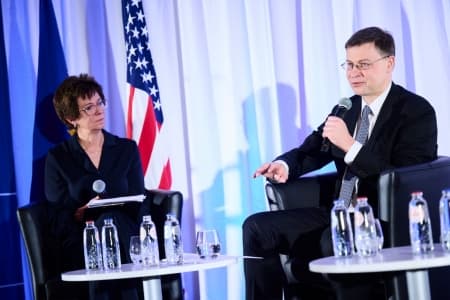
The conference closed with a fireside conversation between Ambassador Katherine Tai, US Trade Representative, and Valdis Dombrovskis, Executive Vice-President for an Economy that Works for People, European Commission. EVP Dombrovksis is also the winner of this year’s Transatlantic Business Award. They covered a range of issues, including the recent transatlantic response to the invasion of Ukraine, the next deliverables for the Trade and Technology Council, ways to further advance the EU-US partnership and the need for overall transatlantic cooperation based on common values.

Related items

News
2 Feb 2026

Highlighting the importance of EU-US cooperation in Lisbon

On Tuesday 27 January, Malte Lohan, CEO, AmCham EU, took part in AmCham Portugal’s Transatlantic Business Summit in Lisbon, Portugal to discuss Europe’s economic resilience in a rapidly changing geopolitical environment. His speech underlined that the EU-US relationship remains the world’s largest and most consequential economic partnership. He also covered the need to strengthen the Single Market, restore Europe’s competitiveness and avoid fragmentation that risks undermining growth. Economic resilience relies on predictability, openness and a stable transatlantic trade and investment environment. 

Transatlantic
Read more
Read more about Highlighting the importance of EU-US cooperation in Lisbon
News
30 Jan 2026

Discussing defence with the US Ambassadors to the EU and NATO

On Thursday, 29 January, AmCham EU hosted a roundtable focused on defence policy with Andrew Puzder, US Ambassador to the European Union and Matthew Whitaker, US Ambassador to NATO. With senior leaders from US companies active in Europe’s defence markets, the discussion focused on the evolving defence policy landscape at the EU and NATO and the importance of transatlantic industrial cooperation in responding to today’s security challenges. Participants exchanged views on how openness of EU regulation, procurement and funding initiatives can better support speed, scale and interoperability among NATO Allies while building on the strengths of the transatlantic defence industrial base. 

Security, defence and space
Transatlantic
Read more
Read more about Discussing defence with the US Ambassadors to the EU and NATO
News
23 Jan 2026

Keeping the implementation of the EU-US deal on course

Ahead of the Committee on International Trade’s (INTA) meeting in the European Parliament on Monday, 26 January 2026, AmCham EU reiterates its call to advance the Commission’s tariff reduction proposals as part of the wider EU-US Framework Agreement. We understand MEPs’ caution following a week of renewed transatlantic tensions, but do not see the tariff reduction proposals as the right avenue for addressing these issues. The Framework Agreement remains the best available option for securing a more positive, productive EU-US trade and investment climate that helps businesses plan ahead.  

As part of the Agreement, the EU and the US made a range of initial commitments. Last September, the US took its first step by updating its tariff schedule on EU products. The two tariff reduction proposals are how the EU shows its commitment to follow suit. This is just the start of the longer-term process of implementing the deal. Later, there will be opportunities to address other issues important to businesses on both sides of the Atlantic. A functioning EU-US economic relationship is critical to millions of American and European businesses and livelihoods.  

Transatlantic
Read more
Read more about Keeping the implementation of the EU-US deal on course