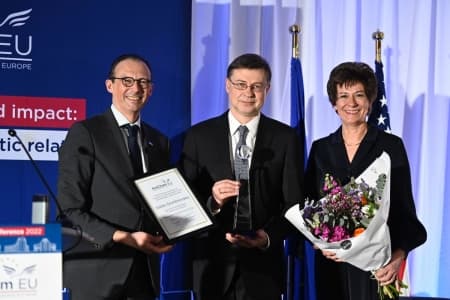
Executive Vice-President Dombrovskis receives AmCham EU Transatlantic Business Award

The American Chamber of Commerce to the EU (AmCham EU) is delighted to announce that Valdis Dombrovskis, Executive Vice-President for an Economy that Works for People, European Commission, was presented with the AmCham EU Transatlantic Business Award.

News
23 Mar 2022
Executive Vice-President Dombrovskis receives AmCham EU Transatlantic Business Award

The award formally recognises the Executive Vice-President’s exceptional efforts to enhance transatlantic cooperation and strengthen the European economy. He has dedicated his career to making sure that Europe is an attractive place for investment and that economic growth benefits citizens.

Most recently, he has stepped into the role of EU Trade Commissioner, in addition to his already large portfolio. In that capacity, he has skilfully navigated the transition between the two US administrations, at a time when trade tensions were a key feature of the transatlantic relationship.

On the European side, working with colleagues, he has played an important role in building back the trust relationships that are required to advance the EU-US agenda. He has worked relentlessly with his counterparts, including Ambassador Tai and Secretary Raimondo, to resolve two major disputes and launch a forward-looking agenda with the Trade and Technology Council.

Susan Danger, CEO, AmCham EU, said: ‘Executive Vice-President Dombrovskis is a staunch supporter of an ambitious EU trade agenda. He has consistently promoted an ‘open’ approach to trade, one that recognises the importance and the significant contributions of foreign investment to the European economy. He has demonstrated continued leadership in defending transatlantic values.’

Related items

News
7 Jul 2026

Branching out with AI

Meta’s open-source Canopy Height Maps helped the European Commission’s Joint Research Centre improve its 2020 Global Forest Cover map, demonstrating how artificial intelligence can strengthen Europe’s ability to monitor forests and advance climate and biodiversity goals. Developed with the World Resources Institute, the maps use Meta’s DINO self-supervised computer vision model to estimate tree height from satellite imagery. This helped researchers apply the five-metre threshold used in many international forest definitions and better distinguish forests from other tree-covered land, including agricultural tree crops. The resulting product, available through the EU Forest Observatory, provides one of the most comprehensive open views of global forest cover. Read more on Invested in Europe.

Digital
Read more
Read more about Branching out with AI
Blog
3 Jul 2026

The transatlantic relationship at 250 years: a shared history and a forged future

Authored by Malte Lohan, CEO, AmCham EU

Transatlantic
Read more
Read more about The transatlantic relationship at 250 years: a shared history and a forged future
News
3 Jul 2026

Advancing skills for Europe’s AI transition

On Tuesday, 30 June, AmCham EU hosted a roundtable exploring strategies for preparing Europe’s workforce for the age of artificial intelligence (AI). Members and policymakers analysed how AI is changing roles across sectors and how employers, governments and education providers can respond. Joined by Idoia Mendia, MEP (ES, S&D) and Mario Nava, Director-General, Directorate-General for Employment, Social Affairs and Inclusion, European Commission, the conversation focused on digital and data skills, as well as expanding AI literacy across organisations. Participants also discussed reskilling and public-private cooperation to support a more inclusive labour market. In addition, members shared best practices from their companies and pointed to the need for policy frameworks that support lifelong learning and skills-based hiring. As AI becomes part of everyday work, Europe must close the skills gap to strengthen competitiveness and prepare people for the future of work.

Social impact, inclusion and skills
Read more
Read more about Advancing skills for Europe’s AI transition