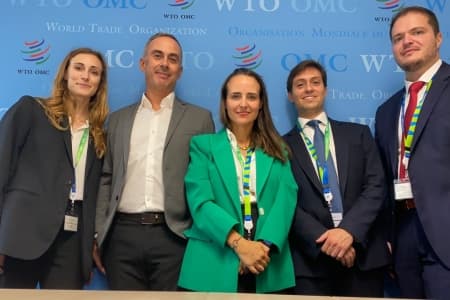
The panel was moderated by Bryce Baschuk, World Trade Reporter, Bloomberg News, and attendees heard from Emanuele Frezza, (UPS Europe) Vice-Chair, Trade Committee and Transatlantic Task Force, AmCham EU; Syahril Syazli Ghazali, Ambassador, Permanent Mission of Malaysia to the WTO; Hiddo Houben, Deputy Head of EU Delegation to the WTO; and Colette van der Ven, Founder and Director, TULIP Consulting. Throughout the event, AmCham EU delegates met with the EU Ambassador to the WTO, João Aguiar Machado, the Deputy Director-General of WTO, Angela Ellard, and Singapore Ambassador to the WTO, Tan Hung Seng, as well as representatives from the US, Indonesia, Canada, Guatemala and Japan.
Fostering global trade and green solutions at the WTO Public Forum
From Wednesday, 13 September to Friday, 15 September, an AmCham EU delegation visited Geneva, Switzerland to take part in the World Trade Organization’s (WTO) Public Forum. During the trip, delegates met with representatives from a wide range of WTO members to discuss the need for an open and rules-based trade system, WTO reform and the extension of the e-commerce moratorium, among other key topics. The trip was capped off with a panel organised by AmCham EU, focusing on the difference between legitimate environmental policies and green protectionism.
Related items
:focal())
News
3 Sep 2026
Engaging with the Mexican Ambassador on stronger trade ties
On Wednesday, 2 September 2026, Malte Lohan, CEO, AmCham EU met with Esteban Moctezuma Barragán, Mexican Ambassador to the European Union, Belgium and Luxembourg, for an introductory meeting to exchange views on the transatlantic business relationship. Discussions focused on opportunities to deepen EU–Mexico economic ties following the signature of the Modernised Global Agreement and interim trade agreement earlier this year. AmCham EU looks forward to continued engagement with Ambassador Moctezuma and to supporting closer EU–Mexico economic cooperation.
:focal())
News
19 Jun 2026
Stressing the importance of open trade in Strasbourg
From Tuesday, 16 to Wednesday, 17 June, AmCham EU travelled to the European Parliament in Strasbourg, France for a series of meetings on EU trade and external affairs policy developments. The delegation engaged with Members of the European Parliament and political group advisers to share business perspectives on the future of the EU-US relationship. Discussions focused on the need to reset transatlantic trade and investment ties, strengthen Europe’s competitiveness and preserve open, rules-based markets. Members also highlighted the importance of avoiding tariffs, reducing regulatory complexity, deepening cooperation on economic security, critical supply chains and digital policy as well as ensuring that resilience measures remain proportionate, predictable and open to trusted partners.
:focal())
News
11 Jun 2026
Highlighting the Single Market’s role in Europe’s competitiveness
On Tuesday, 10 June, Thibaut L’Ortye spoke at EUROPEN’s panel on Global Partnerships and the EU Single Market. The discussion focused on how Europe can strengthen its competitiveness and attractiveness as an investment destination. Mr L’Ortye underlined the importance of external partnerships to support supply chains, particularly in areas such as critical minerals and AI, as well as secondary raw materials. He also highlighted the need for the EU to remain open to international investors while pursuing its economic security objectives.
Policy priorities
Insights and advocacy driving Europe’s policy agenda. Our priorities support growth, innovation and a stronger transatlantic economy.
Membership
Connecting business and policymakers to strengthen the voice of American companies in Europe.