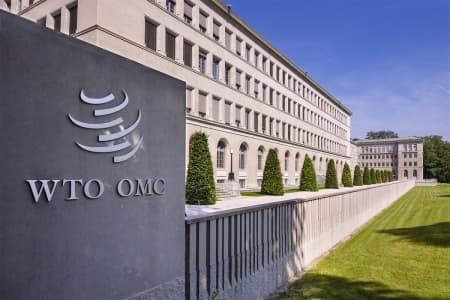
AmCham EU is an ardent supporter of the WTO, as highlighted by Susan Danger, CEO, AmCham EU, in her video message to mark the organisation’s 25th anniversary in 2020. AmCham EU advocates for the revitalisation of its negotiating function, the strengthening of the monitoring role of the secretariat and the reform of the dispute settlement mechanism. With its work to promote an environment of openness, cooperation and coordination within a stable and transparent legal framework, the WTO is a vital organ in our global trading system.
Dr Ngozi Okonjo-Iweala’s appointment makes history at WTO
AmCham EU congratulates Dr Ngozi Okonjo-Iweala on being appointed Director-General of the World Trade Organization (WTO) on Monday, 15 February 2021. Her appointment is historic, as she is the first female and the first African to take up the role. Dr Okonjo-Iweala’s mandate begins at a time of many challenges for the organisation, with its negotiation and arbitration mechanisms increasingly called into question. The confirmation of Dr Okonjo-Iweala as Director-General is an important first step in overcoming these challenges. Her track record in the Nigerian government and the World Bank, coupled with her reformist agenda, speak to her credentials to set in motion a modernising programme that can make the WTO fit for the 21st century. Her role must now be to seek consensus for reform across the breadth of the WTO’s member countries.
Related items
:focal())
Position Paper
16 Oct 2026
Export controls fit for today's economy
The Dual-Use Regulation gives Europe a common framework for economic security, but divergent national implementation is weakening it. The same transaction can be assessed differently depending on the Member State, with guidance on cloud and software-as-a-service transfers remains unclear. Licensing processes, meanwhile, still assume a physical consignment rather than digital workflows, which sits poorly with how integrated global businesses operate. Companies bear the added cost and legal uncertainty, while the security benefit is limited. A single EU-wide approach to intangible transfers and closer alignment with the US and UK would make controls more predictable and let authorities focus on genuine risks. Read how the revision of the Dual-Use Regulation can deliver a harmonised and future-proof framework for Europe.
:focal())
News
30 Mar 2026
MC14: deep concern over e-commerce moratorium deadlock
The American Chamber of Commerce to the EU (AmCham EU) is deeply concerned by World Trade Organization members’ failure to reach agreement on the moratorium on E-Commerce at the 14th Ministerial Conference (MC14) in Cameroon. The absence of an agreement undermines legal certainty for businesses and consumers worldwide. This deadlock further underscores the need for significant WTO reform.
Since its introduction, the moratorium on customs duties on electronic transmissions has played a vital role in enabling the global digital economy by ensuring the smooth cross-border exchange of digital goods and services. In an increasingly digitalised global economy, predictability remains essential for companies of all sizes operating across borders.
WTO members must now renew efforts to re-instate the moratorium at the next General Council meeting as a matter of priority. Delivering such an outcome would strengthen the multilateral trading system and better reflect the realities of modern trade.
:focal())
News
12 Mar 2026
Statement on Section 301 investigations
On Wednesday, 11 March, the United States Trade Representative launched Section 301 investigations into structural production overcapacity against a range of economies, including the European Union. We understand that this decision is part of a larger attempt to stabilise the US tariff system in the wake of the Supreme Court ruling striking down the International Emergency Economic Powers Act (IEEPA) tariffs.
The American Chamber of Commerce to the European Union (AmCham EU) is concerned about the continued uncertainty of the current trade environment. Companies still lack clarity over future tariff rates in both the short- and long-term. We continue to oppose broad-based tariffs as they raise costs for businesses and consumers and disrupt supply chains.
With potential measures against the EU under consideration, AmCham EU calls on the EU and the US to avoid escalation in the trade dispute. The priority must be to restore stability and predictability in transatlantic trade. The deal struck in the summer is not a perfect solution, but it offers the most realistic path forward given political priorities on both sides. We look to the parties to honour their commitments under the EU-US Framework Agreement.
The US Administration rightfully identifies overcapacity as a critical issue in the global economy which also affects the European market. We see the EU as part of the solution, rather than the problem. The EU and the US must work together to tackle the real issue at hand: unfair trading practices from non-market economies.
Policy priorities
Insights and advocacy driving Europe’s policy agenda. Our priorities support growth, innovation and a stronger transatlantic economy.
Membership
Connecting business and policymakers to strengthen the voice of American companies in Europe.