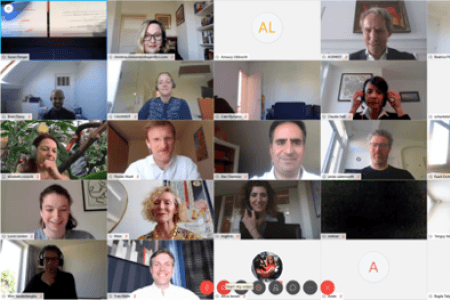
On Tuesday, 21 April 2020, AmCham EU hosted a digital-themed and virtually-based plenary meeting to discuss the European Commission’s recent ‘Shaping Europe’s digital future’ communication, and the strategies to build trust, increase technological innovation and establish a data-driven economy for Europe. The event featured a panel discussion with keynote speakers Petra De Sutter, Member of European Parliament (Greens/EFA, BE), European Parliament and Kim Jørgensen, Head of Cabinet, Executive Vice-President Margrethe Vestager, European Commission. As we are still in the early months of the new legislative mandate, both Ms De Sutter and Mr Jørgensen presented their respective digital priorities and offered perspectives for how the EU can successfully and safely achieve its technological future.
April Plenary: Unlocking Europe's potential in data and digital technologies
On Tuesday, 21 April 2020, AmCham EU hosted a digital-themed and virtually-based plenary meeting to discuss the European Commission’s recent ‘Shaping Europe’s digital future’ communication, and the strategies to build trust, increase technological innovation and establish a data-driven economy for Europe. The event featured a panel discussion with keynote speakers Petra De Sutter, Member of European Parliament (Greens/EFA, BE), European Parliament and Kim Jørgensen, Head of Cabinet, Executive Vice-President Margrethe Vestager, European Commission. As we are still in the early months of the new legislative mandate, both Ms De Sutter and Mr Jørgensen presented their respective digital priorities and offered perspectives for how the EU can successfully and safely achieve its technological future.

Both speakers also took the time to recognise the current circumstances of the global pandemic and the need for flexibility and cooperation to manage COVID-19’s impact on the EU. There was a clear emphasis on how this crisis has put a focus on the need to strengthen the Single Market and for the EU to be more resilient in the future as we adapt to new ways of working. AmCham EU has highlighted similar views, which can be found in the recently published statement on how solidarity, the Single Market and international cooperation are crucial to overcoming the crisis and need further action to support the EU’s response and economic recovery.
The event was held with over 100 AmCham EU member company participants, and was moderated by Claudia Selli, Member-at-Large, AmCham EU Board and Chair of the AmCham EU Digital Economy Committee (AT&T Inc.). AmCham EU also welcomed seven new members as part of its Plenary meeting who have joined the association in recent months. These are: Amazon.com Inc., Bristol-Myers Squibb, Broadcom Inc., Johnson Controls, Jones Day, NBCUniversal, and Reed Smith LLP.
For questions, please contact Edward Haynes, Policy Adviser (EHA@amchameu.eu).
Related items
:focal())
Choose France, choose the future
Cisco is strengthening France’s role in the global digital economy with the launch of its Global AI Hub, announced at the 2025 Choose France Summit. The hub will focus on secure, energy-efficient artificial intelligence (AI) infrastructure, innovative cooling solutions for data centres and support for the startup ecosystem. To address future workforce needs, Cisco will also train 230,000 people in France over the next three years through its Networking Academy, covering fields such as cybersecurity, data science and AI. Building on nearly 400,000 individuals already trained in France, this investment supports Cisco’s EU-wide commitment to train 1.5 million people by 2030. Read more on Invested in Europe.
:focal())
Cybersecurity Act review: AmCham EU calls for greater industry engagement and evidence-based certification criteria
The European Commission’s proposal to revise the Cybersecurity Act (CSA2) comes at the right moment, as Europe faces an evolving range of cyber threats. With its measures to reinforce ENISA and make harmonisation the key to a more resilient Single Market, the proposal brings the Act closer to the realities of today’s fast-moving cybersecurity ecosystem.
However, the Commission’s proposal still fails to go far enough on providing a platform for more active industry engagement. It rightly formalises existing structures but falls short of creating mechanisms that allow for regular expert-level exchanges and meaningful industry feedback into the CSA2 framework, building on lessons learned from the past years. Such exchanges are essential, given industry’s role as a front-line defender against cyber threats.
Now, as the file moves to the European Parliament and the Council of the EU, the co-legislators must ensure certification schemes under the CSA2 remain based on technical criteria. The EU’s cybersecurity needs should be a matter for sober, technical analysis. AmCham EU therefore supports the proposal's structural distinction between technical certification and non-technical supply chain risks. Maintaining this separation prevents restrictive requirements that limit choice, reduce competition and slow innovation.
The same approach is necessary for the proposal’s provisions to secure critical infrastructure under the new ‘Trusted ICT Supply Chain Framework’ (Title IV). These measures must also be underpinned by an objective, evidence-based approach to ‘non-technical risks’. At the same time, measures involving restrictions on data transfers must be aligned with international agreements to avoid unintended disruptions to global operations.
Ultimately, US companies share the EU’s commitment to securing the region’s digital resilience. AmCham EU members invest heavily in security and stand ready to support the delivery of a framework that keeps Europe open, secure and competitive.
:focal())
Irish-made AI
Developing advanced artificial intelligence (AI) capabilities is central to Europe’s digital ambitions. With a new €175 million investment, Workday is reinforcing this priority by establishing an AI Centre of Excellence in Dublin. Building on its long-standing research and development presence, the company will expand product development and create more than 200 specialised roles. Workday is also deepening its commitment to skills, partnering with national training networks and universities to equip employees with cutting-edge AI expertise. Through these collaborations, Workday is helping to drive innovation, strengthen Europe’s digital competitiveness and support the next generation of AI talent. Discover more on Invested in Europe.
Policy priorities
Insights and advocacy driving Europe’s policy agenda. Our priorities support growth, innovation and a stronger transatlantic economy.
Membership
Connecting business and policymakers to strengthen the voice of American companies in Europe.