On Wednesday, 2 February, AmCham EU hosted Jose W. Fernandez, Under Secretary for Economic Growth, Energy and the Environment, US Department of State. The meeting focused on a number of issues impacting transatlantic partners, including trade, supply chain security, energy and environment. The Under Secretary travelled to Brussels for a range of meetings with senior EU officials.
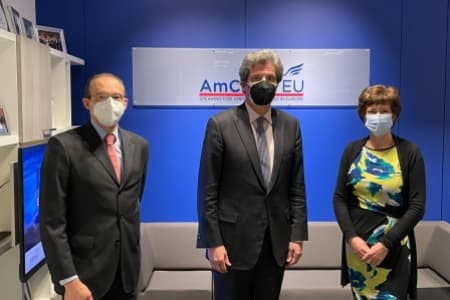
AmCham EU hosts US Under Secretary Jose W. Fernandez
On Wednesday, 2 February, AmCham EU hosted Jose W. Fernandez, Under Secretary for Economic Growth, Energy and the Environment, US Department of State. The meeting focused on a number of issues impacting transatlantic partners, including trade, supply chain security, energy and environment. The Under Secretary travelled to Brussels for a range of meetings with senior EU officials.

Related items
:focal())
Trilogue breakthrough unlocks implementation of EU-US Framework Agreement
AmCham EU is relieved to see the European Parliament and Member States reach an agreement on the tariff reduction proposals linked to the EU-US Framework Agreement. The co-legislators’ compromise is a critical step for businesses that rely on a stable transatlantic trade and investment relationship.
The EU‑US commercial relationship is the largest in the world. It supports millions of European and American jobs and underpins deeply integrated value chains on both sides of the Atlantic. While AmCham EU opposes broad-based tariffs, given political priorities on both sides of the Atlantic, the EU-US Framework Agreement still provides the most realistic path to a workable and more constructive transatlantic trade and investment environment that helps businesses plan and grow in an increasingly volatile global context. The trilogue agreement is a sign that the EU is honouring its commitments under the deal.
Member States and the European Parliament must now formally confirm this outcome at the earliest possible opportunity. Completing this process will allow the EU and the US to move beyond tariffs and advance the broader cooperation set out in the Joint Statement, including on critical supply chains, non‑market practices and economic security.
:focal())
Building the transatlantic relationship directly in DC
From Monday, 20 to Wednesday, 22 April, AmCham EU joined the AmChams in Europe network for a delegation visit to Washington, DC. As part of the programme, delegates met with representatives from the US Department of Commerce, the US Department of State, congressional offices and the US Chamber of Commerce. AmCham EU specifically also engaged with the Office of the United States Trade Representative, US Members of the House and staffers, the EU Delegation to the US, the European Parliament Liaison Office and other business organisations.
Discussions focused on the implementation of the EU-US Framework Agreement and its role in supporting a more predictable transatlantic trade and investment relationship. The deal remains the most realistic route to a more constructive climate for companies operating across the Atlantic. The EU-US strategic partnership on critical minerals points to the potential for further EU-US cooperation in areas that benefit businesses on both sides of the Atlantic.
:focal())
EU-US critical minerals agreement: mutually beneficial transatlantic cooperation in action
The new EU-US strategic partnership on critical minerals marks a positive step forward for the transatlantic relationship, demonstrating how EU-US cooperation can deliver benefits for businesses on both sides of the Atlantic. Critical minerals sit at the heart of modern technologies and industrial value chains, essential to products like semiconductors and future energy technologies. This strategic partnership will help provide American and European companies with a more secure supply of these inputs. More broadly, the agreement can support the EU and US economies in reducing strategic dependencies in global critical minerals trade – a shared challenge.
Beyond critical minerals, the strategic partnership points to an opportunity for a new chapter in EU-US cooperation built around shared economic and strategic priorities. The two sides have a greater impact when using their combined weight to address shared challenges. Pursuing the kind of cooperation outlined in the strategic partnership should be a priority as the two sides build on the August 2025 EU-US Joint Statement, with further opportunities for coordination on issues such as securing industrial supply chains for AI development, tackling non-market trading practices and bolstering transatlantic cyber resilience.
Policy priorities
Insights and advocacy driving Europe’s policy agenda. Our priorities support growth, innovation and a stronger transatlantic economy.
Membership
Connecting business and policymakers to strengthen the voice of American companies in Europe.