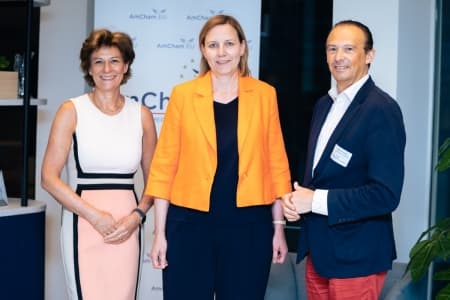
AmCham EU hosts its 2023 Annual General Meeting

On Tuesday, 20 June, AmCham EU held its Annual General Meeting (AGM), where we had the honour of welcoming Ilze Juhansone, Secretary-General, European Commission for a keynote speech for a second year in a row. During the internal session, members reviewed last year’s accomplishments and discussed plans for the organisation in 2023 and beyond.

News
20 Jun 2023
AmCham EU hosts its 2023 Annual General Meeting

The AGM also featured the presentation of the Lizanne Scott Staff Excellence Award, which is given to a member of the secretariat who has demonstrated outstanding work over the last year. The recipient of the 2023 Lizanne Scott Staff Excellence Award is Laura Escobar Díaz, Content Adviser. Congratulations!  

Read our Annual Report 2022 to see all the highlights from the past year! 

Related items

News
5 Jun 2026

Celebrating Gala 2026

Updates
Read more
Read more about Celebrating Gala 2026
News
5 Jun 2026

Maltese start-up Medilert wins AmCham EU Youth Entrepreneurship Award 2026

Social impact, inclusion and skills
Read more
Read more about Maltese start-up Medilert wins AmCham EU Youth Entrepreneurship Award 2026
News
5 Jun 2026

Tech Sovereignty Package: positive steps for energy resilience, but a risky gamble for digital competitiveness

This week the European Commission unveiled its Tech Sovereignty Package. While the Package’s energy proposals mark a significant step forward for EU energy resilience, the Cloud and AI Development Act (CADA) proposal overlooks the reality of global technology supply chains and introduces significant legal uncertainty and fragmentation for businesses.

The central question for the Tech Sovereignty Package is how to build resilience without undermining competitiveness. Concerns around overdependence on a limited number of providers, the risk of external disruption to service continuity and the long-term position of the EU’s digital industries are all legitimate. However, greater sovereignty will only be sustainable if it is built on a competitive, diverse and innovative digital ecosystem. The technologies that underpin the global digital economy are developed through highly international supply chains, with innovation spread across multiple markets.

Viewed through this lens, the individual proposals in the Package vary in the extent to which they reinforce resilience while preserving openness and competitiveness. In particular, the proposed CADA risks discriminating against providers that rely on global supply chains – both those based in Europe and those in third countries – even where they offer superior resilience.

‘An origin-based approach is too blunt for such a complex global market’, said Malte Lohan, CEO of the American Chamber of Commerce to the European Union, commenting on the Package.

‘A more credible path to achieving greater resilience and control in such an interconnected landscape is to define sovereignty in terms of outcomes: secure and reliable technologies, customer choice, strong safeguards against undue interference and a business environment that supports investment and growth. That points to a risk-based framework where the EU is open to working with trusted partners. This trust should be assessed on the basis of objective standards rather than origin alone’, Mr Lohan added.

Last year alone, US technology firms operating in Europe and their supply chains supported €1.0 trillion in EU GDP, equivalent to 5.4% of total output. The scale of this contribution underscores the need for the EU to preserve an open environment with legal clarity and proportionality in any restrictions or safeguards that would impact commercial operations.

The Package’s Strategic Roadmap for Digitalisation and AI in energy is a positive step that could help unlock the benefits of digitalisation for Europe’s energy needs, enabling faster and more flexible grids. Digitalisation provides new opportunities to strengthen the reliability and resilience of energy systems. If executed well, the roadmap could support the growing demand of Europe’s digital and AI sectors for low-carbon energy.

Ultimately, the importance of the Tech Sovereignty Package extends well beyond the technology sector itself. Manufacturers, healthcare and life sciences, financial services, mobility, energy and retail all increasingly depend on access to advanced digital technologies to innovate and compete. For the Tech Sovereignty Package to support these sectors, it must ensure companies in Europe continue to benefit from economic openness.

Digital
Read more
Read more about Tech Sovereignty Package: positive steps for energy resilience, but a risky gamble for digital competitiveness