The power of local suppliers: more than shipping partners

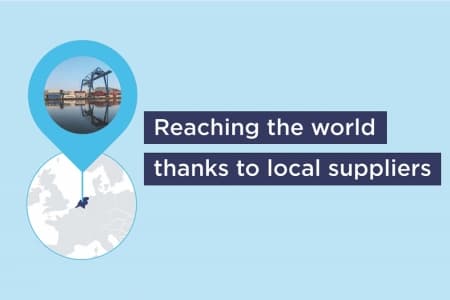
The Van Berkel Group is located in Veghel, a town in the North Brabant region of the Netherlands. The company, founded in 1955 as a family company in agriculture, has expanded and diversified into many new sectors. In 2003, Van Berkel Logistics was established, with shipping services starting up in 2005, in the form of container transportation by barge from Veghel to Rotterdam and Antwerp. Read how Van Berkel managed to grow exponentially and leverage the power of exports by collaborating with Mars. 

News
23 Feb 2022
The power of local suppliers: more than shipping partners

The Van Berkel Group is located in Veghel, a town in the North Brabant region of the Netherlands. The company, founded in 1955 as a family company in agriculture, has expanded and diversified into many new sectors. In 2003, Van Berkel Logistics was established, with shipping services starting up in 2005, in the form of container transportation by barge from Veghel to Rotterdam and Antwerp. Read how Van Berkel managed to grow exponentially and leverage the power of exports by collaborating with Mars. 

Back then the company would ship 3000 containers per year. Fast forward to 2020, and that figure sits at 52 000 per year. The family company has grown to 210 employees across the whole group, with 90 employees dedicated to its logistics branch. Van Berkel’s collaboration with Mars began in 2013. Mars represents an important client for the logistics company, with orders for around 5000 container shipments per year. Of these, 60% are ‘deep sea’ shipments across the globe, versus 40% ‘short sea’ locations. However, Van Berkel’s partnership with Mars goes beyond simply shipping. Van Berkel is integrated into Mars factory proce, and the ‘make and ship’ principle ensures that whatever Mars produces can go directly into a container, which will be shipped on demand. Van Berkel’s service offering also encompasses quality control of containers. Thanks to Van Berkel’s logistics services, Mars products are able to reach consumers around the world who can enjoy the familiar taste of their renowned confectionery.

Acknowledgement: Michel van Dijk, Director, Van Berkel Logistics

The success story of global trade also lies in strong partnerships between companies of all sizes. Find out more about European ecosystems connecting small businesses with larger American companies. 

Related items

News
13 Feb 2026

Leaders and industry meet in Antwerp to address Europe’s competitiveness challenge

Senior business leaders gathered in Antwerp, Belgium to convey a clear message on the state of Europe’s industrial base and the urgent need to restore the continent’s competitiveness. The discussions underscored that the drivers of declining competitiveness are well understood and that decisive action is now required, notably through a systemic reduction of administrative burden, completion of the Single Market and measures to ensure lower energy prices.  

Taking place on Thursday, 11 February, the forum brought together political leaders including Bart De Wever, Prime Minister, Belgium; Emmanuel Macron, President, France; Friedrich Merz, Chancellor, Germany and Ursula von der Leyen, President, European Commission. 

Malte Lohan, CEO and Job Boonstra, Senior Policy Adviser, AmCham EU joined the exchange alongside senior executives from across sectors, reinforcing industry’s call for coordinated policy action to enhance Europe’s competitiveness and investment environment. 

Industry
Read more
Read more about Leaders and industry meet in Antwerp to address Europe’s competitiveness challenge
Position Paper
11 Feb 2026

An effective, competitive and quality-driven Public Procurement Directive

The revision of the Public Procurement Directive (PPD) is a critical opportunity to unlock the full value of public procurement for European competitiveness and resilience. A simpler, more consistent and quality-driven framework would strengthen market access, attract a wider range of bidders and enable public buyers to select best-in-class solutions. 

The revision should prioritise practical ‘how to buy’ reforms, including digitalisation, standardised templates and reusable documentation, to reduce administrative burdens and increase participation. In parallel, ‘what to buy’ reforms should focus on transparent and verifiable criteria that reward performance, security and life-cycle value while avoiding unnecessary complexity that risks reducing competition. 

Learn how, if designed effectively, the PPD can support innovation, resilience and better outcomes for public buyers across the EU. 

Competition
Read more
Read more about An effective, competitive and quality-driven Public Procurement Directive
News
10 Feb 2026

Call to double down on the Single Market to restore Europe’s competitiveness 

Industry
Read more
Read more about Call to double down on the Single Market to restore Europe’s competitiveness