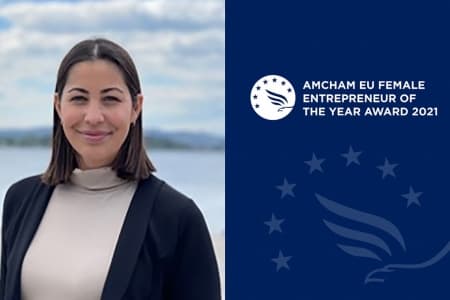
Ms Wathne is a 26-year-old entrepreneur, mother of two and innovation student at Kristiania College Oslo. She impressed the jury with her ambition to tackle a key issue for the aquaculture industry as well as her drive to make her start-up and team thrive. Paramate develops sensors and connected software that enable fish farmers to monitor the level of hydrogen sulfide on their land-based farms, preventing outbreaks of the toxic gas and promoting better management of resources and the environment.
Susan Danger, CEO, AmCham EU, said: ‘Underrepresented groups, including women, have been hit hardest by the impacts of the Covid-19 pandemic. By creating this Female Entrepreneur of the Year Award as part of our annual Youth Entrepreneurship Award scheme, our hope is to support the dreams and ambition of young women. Female entrepreneurs will be key contributors to a speedy recovery and Europe’s long-term prosperity. Representation matters and I am proud we can help Maria inspire the next generation of female entrepreneurs.’
Salvatore Nigro, CEO, JA Europe, added: ‘Entrepreneurship shapes futures, changes lives for the better and contributes to developing the next generation of Europeans, which we call Gen-E. We are delighted that, thanks to the support of AmCham EU, we give this opportunity to young female entrepreneurs such as Maria.’
Maria Wathne, CEO, Paramate, said: ‘My goal is to show women that even when you are a mother, a partner, a student and a colleague, you can do it. I am all of the above, and still make the time to develop our start-up. I am very grateful to JA Europe, JA Norway and AmCham EU for the opportunity and look forward to developing myself personally and professionally through the mentorship.’
The international jury was composed of Anna-Michelle Asimakopoulou, Member of the European Parliament; Luciana Broggi, SVP and Global Head of Routes-to-Market, HP Inc; Daniel Carrera, President, UPS Europe; Susan Danger, CEO, AmCham EU; Michael Lally, Minister Counsellor for Commercial Affairs and Senior Commercial Officer, US Mission to the EU; Vitaliy Rusakov, President, Fastening Systems and Head of the European Region, Howmet Aerospace.
Since 2013, AmCham EU has collaborated with JA Europe on the AmCham EU Youth Entrepreneurship Award which aims to encourage and support the entrepreneurial mindsets of young Europeans. The winner will be offered several hours of mentorship over a 12-month period from a number of senior executives from AmCham EU’s member companies who will coach, encourage and offer their time, expertise and advice.
About AmCham EU
AmCham EU speaks for American companies committed to Europe on trade, investment and competitiveness issues. It aims to ensure a growth-orientated business and investment climate in Europe. AmCham EU facilitates the resolution of transatlantic issues that impact business and plays a role in creating better understanding of EU and US positions on business matters. Aggregate US investment in Europe totalled more than €3 trillion in 2020, directly supports more than 4.8 million jobs in Europe, and generates billions of euros annually in income, trade and research and development.
About JA Europe
JA Europe is the largest non-profit in Europe dedicated to preparing young people for employment and entrepreneurship. JA Europe is a member of JA Worldwide® which for 100 years has delivered hands on, experiential learning in entrepreneurship, work readiness and financial literacy. JA creates pathways for employability, job creation and financial success. Last school year, the JA network in Europe reached almost 4 million young people across 40 countries with the support of nearly 100,000 business volunteers and over 140,000 teachers/educators.
About Gen-E 2021
Gen-E is Europe’s largest Entrepreneurship Festival and a celebration of youth entrepreneurship and of the achievements of Europe’s students, who showcase their cutting-edge business ideas and are recognised with prestigious awards and special prizes. Gen-E is all of us – Boomers, Gen X, Millennials and Gen Z – Europeans who believe in the importance of Education, Entrepreneurship and Employment. The ones who choose action over stagnation and see every challenge as an opportunity. A new Generation of Entrepreneurs, of heroes who change things and challenge the world for the better. Gen-E is organised by JA Europe, and this year hosted virtually by JA Lithuania.
:focal())
:focal())
:focal())