New study: COVID-19 set to test the resilience of the transatlantic economy

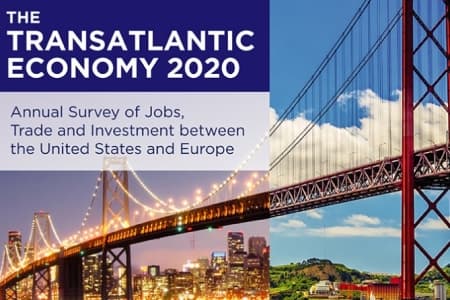
A new study on the transatlantic economy stresses the impact the ongoing COVID-19 pandemic will have on both the European and US economies. The current crisis adds to existing economic and political instability, which, in turn, challenges the world’s largest marketplace. Despite mounting uncertainty, the 2020 report emphasises that the fundamentals of the transatlantic relationship remain strong, and will likely play a role in the economic recovery to come. 

Susan Danger, CEO, AmCham EU, said: ‘We need the US and the EU to work together, with the entire global community, to ensure a coordinated approach to the health emergency caused by COVID-19 and its ripple effects on the economy. Bold action from governments is critical to protect citizens’ health and shield our economies from the impact of a global recession.’ She went on to say: ‘Today’s crisis demonstrates the continued importance of transatlantic cooperation.’

To download the study, please click here.


News
25 Mar 2020
Trade, Transatlantic
New study: COVID-19 set to test the resilience of the transatlantic economy

The Transatlantic Economy 2020 study highlights how the EU-US relationship remains the largest of its kind in the world. The transatlantic economic partnership generates over €5 trillion in commercial sales a year and accounts for half of total global personal consumption. No place in the world attracts more US foreign direct investment (FDI) than Europe. During the past decade, Europe attracted 57.5% of total US global investment – more than in any previous decade.

The research was conducted independently by Daniel Hamilton and Joseph Quinlan for the Foreign Policy Institute at Johns Hopkins University's School of Advanced International Studies and commissioned by the American Chamber of Commerce to the EU (AmCham EU) and the U.S. Chamber of Commerce.

This year’s edition features inserts on the effects of Brexit on the transatlantic relationship, Chinese investment in North America and Europe, the transatlantic energy economy, and an in-depth analysis of FDI flows from the US to Europe. It also includes individual profiles for 30 European countries and all US states.

The data is also available on Thriving Together, an online platform that showcases the deep ties that bind Europe and the United States, including numbers from The Transatlantic Economy 2020. Visit the platform: thrivingtogether.eu.


Related items

News
20 May 2026

Trilogue breakthrough unlocks implementation of EU-US Framework Agreement

AmCham EU is relieved to see the European Parliament and Member States reach an agreement on the tariff reduction proposals linked to the EU-US Framework Agreement. The co-legislators’ compromise is a critical step for businesses that rely on a stable transatlantic trade and investment relationship. 

The EU‑US commercial relationship is the largest in the world. It supports millions of European and American jobs and underpins deeply integrated value chains on both sides of the Atlantic. While AmCham EU opposes broad-based tariffs, given political priorities on both sides of the Atlantic, the EU-US Framework Agreement still provides the most realistic path to a workable and more constructive transatlantic trade and investment environment that helps businesses plan and grow in an increasingly volatile global context. The trilogue agreement is a sign that the EU is honouring its commitments under the deal.  

Member States and the European Parliament must now formally confirm this outcome at the earliest possible opportunity. Completing this process will allow the EU and the US to move beyond tariffs and advance the broader cooperation set out in the Joint Statement, including on critical supply chains, non‑market practices and economic security. 

Transatlantic
Trade tensions
Read more
Read more about Trilogue breakthrough unlocks implementation of EU-US Framework Agreement
News
30 Apr 2026

Building the transatlantic relationship directly in DC

From Monday, 20 to Wednesday, 22 April, AmCham EU joined the AmChams in Europe network for a delegation visit to Washington, DC. As part of the programme, delegates met with representatives from the US Department of Commerce, the US Department of State, congressional offices and the US Chamber of Commerce. AmCham EU specifically also engaged with the Office of the United States Trade Representative, US Members of the House and staffers, the EU Delegation to the US, the European Parliament Liaison Office and other business organisations.

Discussions focused on the implementation of the EU-US Framework Agreement and its role in supporting a more predictable transatlantic trade and investment relationship. The deal remains the most realistic route to a more constructive climate for companies operating across the Atlantic. The EU-US strategic partnership on critical minerals points to the potential for further EU-US cooperation in areas that benefit businesses on both sides of the Atlantic.

Transatlantic
Read more
Read more about Building the transatlantic relationship directly in DC
News
24 Apr 2026

EU-US critical minerals agreement: mutually beneficial transatlantic cooperation in action

The new EU-US strategic partnership on critical minerals marks a positive step forward for the transatlantic relationship, demonstrating how EU-US cooperation can deliver benefits for businesses on both sides of the Atlantic. Critical minerals sit at the heart of modern technologies and industrial value chains, essential to products like semiconductors and future energy technologies. This strategic partnership will help provide American and European companies with a more secure supply of these inputs. More broadly, the agreement can support the EU and US economies in reducing strategic dependencies in global critical minerals trade – a shared challenge.

Beyond critical minerals, the strategic partnership points to an opportunity for a new chapter in EU-US cooperation built around shared economic and strategic priorities. The two sides have a greater impact when using their combined weight to address shared challenges. Pursuing the kind of cooperation outlined in the strategic partnership should be a priority as the two sides build on the August 2025 EU-US Joint Statement, with further opportunities for coordination on issues such as securing industrial supply chains for AI development, tackling non-market trading practices and bolstering transatlantic cyber resilience.

Transatlantic
Read more
Read more about EU-US critical minerals agreement: mutually beneficial transatlantic cooperation in action