COVID-19 has been more than a health crisis. It affected societies and economies at their core. To mitigate the impacts of the pandemic, the French Presidency is focusing on constructing a union that trusts science, fights discrimination and secures a prosperous future for the next generation. In this context, the 27 ministers for health are meeting to discuss the EU’s ambitious healthcare agenda. Learn more about the priorities of American companies in Europe for healthcare policy.
Mitigating the health, social and economic crises
COVID-19 has been more than a health crisis. It affected societies and economies at their core. To mitigate the impacts of the pandemic, the French Presidency is focusing on constructing a union that trusts science, fights discrimination and secures a prosperous future for the next generation. In this context, the 27 ministers for health are meeting to discuss the EU’s ambitious healthcare agenda. Learn more about the priorities of American companies in Europe for healthcare policy.

On 10 February, France will welcome health ministers in Grenoble for an informal meeting. To strengthen the EU’s public health policies and ensure a smooth economic recovery, the French Presidency will focus on promoting responsiveness, coordination and solidarity.
AmCham EU supports the EU's efforts to overcome the impact of the pandemic and ensure a sustainable recovery. Our member companies have outlined the following priority areas to boost employment, improve social policy, strengthen healthcare systems and protect consumers:
Antimicrobial resistance (AMR): Tackling this threat should be a top priority. AMR is responsible for 33,000 deaths per year in the EU. If left unchecked, it could overtake cancer as the leading cause of death in the bloc by 2050.
Beating Cancer action plan: Cancer is among the leading causes of premature death in the EU. The social and economic cost of non-communicable diseases is significant.
Digitisation of health: European approaches to data must foster a life sciences ecosystem that can capitalise on innovative health technologies. The European Health Data Space provides an opportunity to leverage the European digitalisation of healthcare.
Health Emergency and Preparedness Response Authority (HERA): HERA is necessary to ensure coordinated responses by the EU to tackle cross-border health threats.
Health technology assessment (HTA): In the light of the compromise reached on the HTA Regulation, Member State should retain the autonomy to make decisions regarding pricing and reimbursements (P&R). The scope of the Regulation should be limited to joint clinical assessments for pharmaceutical products.
Integrated approach to life sciences: A holistic approach bringing together patient organisations, healthcare professionals, industry and policymakers will provide patients with the maximum benefits.
Gender balance: Equality between men and women can be fostered by using evidence to underline the need for gender-friendly policies and demonstrating that female leadership leads to concrete economic benefits.
Modernisation of EU consumer law: Awareness of consumer rights needs to be higher among traders and consumers to avoid insufficient compliance and high fines. The European Commission should set the tone for the harmonisation of consumer rights for all goods and services.
Workforce size expansion: Gender, age, origin, social background, sexual orientation or health condition should never become barriers to success and well-being. The participation of all individuals in the workforce will lead to considerable social and economic gains.
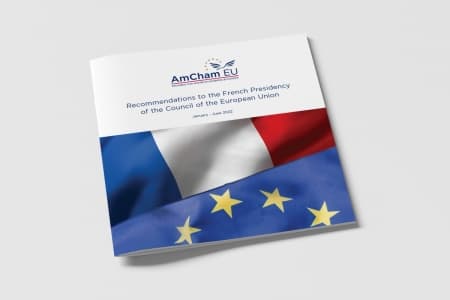
As the EU recovers from the pandemic, regulatory initiatives should continue to focus on areas aiming to address the COVID-19 crisis, rebuild Europe’s economy around the twin transitions of environmental protection and digitalisation as well as create an enabling environment for businesses to address emerging challenges.. Read AmCham EU’s set of recommendations to the French Presidency here
Related items
:focal())
No further delays: the EU-Mercosur FTA is vital for a stronger Europe
The European Council’s decision to postpone its vote on concluding the EU-Mercosur free trade agreement (FTA) is a missed strategic opportunity that threatens the EU’s credibility as a reliable partner. After more than 20 years of negotiations, the EU is once again delaying one of its most ambitious and strategic trade agreements.
The EU-Mercosur FTA’s economic benefits are clear. At a time when strengthening competitiveness, economic growth and partnerships should be paramount, the FTA provides access to a market of 284 million consumers – reducing tariff and non-tariff barriers and supporting integrated supply chains.
Beyond its economic benefits, the EU-Mercosur FTA is also an important geopolitical tool. It would anchor a long-term strategic partnership with a key region and reinforce the EU’s role as a credible advocate of rules-based trade. Amid heightened geopolitical rivalry, postponement weakens the EU’s standing and its ability to conclude ambitious FTAs elsewhere.
The EU cannot afford further delays. The EU-Mercosur FTA is vital for the region’s competitiveness, resilience and global credibility. The European Council must promptly return to this file and conclude this FTA in January.
:focal())
STEMming the skills gap
By 2035, high-tech roles will make up a significant share of employment across the EU, yet many young people still lack the digital skills needed to succeed. Amazon is helping bridge this gap through initiatives in Poland and Spain. In Warsaw, the company supports STEM Kindloteka, a modern hub offering young people free, interactive workshops in coding, robotics and virtual reality. In Spain, Amazon is working with the Ministry of Education, Vocational Training and Sports to train 500,000 students in digital and technological skills by 2027. These efforts strengthen Europe’s talent pipeline and support long-term competitiveness. Learn more about Amazon’s commitment to digital skills development on Invested in Europe.
:focal())
The secret ingredients to inclusion
On Monday, 8 December, AmCham EU hosted a lunch to mark the International Day of Persons with Disabilities. Held at 65 degrés, a Brussels-based restaurant that employs staff with disabilities, the event highlighted the value of inclusive workplaces. The lunch provided an opportunity for business representatives to exchange with EU stakeholders on how the private sector is advancing inclusion. Discussions also focused on how collaboration between public institutions and businesses can foster equal opportunities and promote a more accessible and inclusive society for all.
Amongst others, Andriana Sukova, Deputy Director-General, Directorate General, Employment, Social Affairs and Inclusion, European Commission and Didrik de Schaetzen, Secretary General, ALDE Party joined the discussion.
Policy priorities
Insights and advocacy driving Europe’s policy agenda. Our priorities support growth, innovation and a stronger transatlantic economy.
Membership
Connecting business and policymakers to strengthen the voice of American companies in Europe.