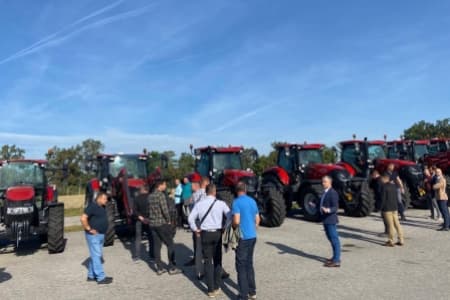
Despite the country's 100,000 hectares of orchards, 90% of farmers in Bosnia and Herzegovina use outdated equipment, limiting productivity and sustainability. To address these challenges, CNH’s Sustainable Development Initiatives division partnered with equipment seller Case IH, importer Motoremont and local nonprofit Spektar to provide farmers with modern tractors with precision farming technology, carbon-filtered cabs and GPS support. In addition, the project included training sessions on sustainable chemical use and precision farming for farmers and university students. As a result, orchard owners' practices have become more efficient and environmentally conscious. Building on the success achieved in Bosnia and Herzegovina, CNH now aims to expand the initiative to Serbia. Learn more on Invested in Europe.
Farming for the future
Related items
:focal(807x343:808x344))
What the EU can do to overcome uncertainty in agri-food
At the European Food Forum’s Navigating US Tariffs: Impact on European Food and Drink Trade, Economy and Future Relations, Edouard Coppieters, Senior Policy Adviser, AmCham EU, spoke about the new reality in which US agri-food companies operate. Taking place on Thursday, 9 April, he outlined the continued growth of EU-US agri-trade and the need for the EU to continue to diversify its trade partners, welcoming the recent announcement of deals with Australia and India. Alongside Brando Benifei, MEP (IT, S&D), he noted that tackling the uncertainty created by tariffs is essential and that to this end, the Framework Agreement between the EU and US is a needed stable basis. Although tariffs bring uncertainty, the EU must not lose sight of the predictability steps it can take to ensure it remains competitive and attractive to potential new trading partners.
:focal())
Delivering simpler, science-based rules for Europe’s agri-food sector
The EU’s agri-food regulatory framework is fragmented and lacks predictability. The Food and Feed Safety Omnibus is a chance to address these shortcomings by reducing delays, improving consistency and easing compliance burdens that limit market access.
Uncertainty discourages investment and slows the uptake of new solutions. A more proportionate approach can improve legal certainty and support more consistent implementation across Member States. At the same time, maintaining a science-based, risk-based approach to trade measures is necessary to safeguard food security and avoid supply disruptions.
:focal())
Discussing competitiveness in the agri-food sector in Barcelona
At the Alimentaria Conference in Barcelona, Edouard Coppieters, Senior Policy Adviser, AmCham EU, spoke about placing competitiveness at the centre of the European agri-food ecosystem. Taking place on Tuesday, 24 March, he outlined the role of simplification and Better Regulation principles in ensuring a stable agri-food supply chain and supporting the sector’s competitiveness. He noted that the sector operates within an international trade environment and that stakeholders across the value chain face challenges in adapting to the current legislative framework. He emphasised the need to simplify operations within the Single Market and ensure that legislation is fit for purpose rather than a box-ticking exercise. Aurélie Dufour, Europe Sustainability Engagement and Regulation Lead, Yum! Brands and Dirk Jacobs, Director-General, FoodDrinkEurope also joined the panel.
Policy priorities
Insights and advocacy driving Europe’s policy agenda. Our priorities support growth, innovation and a stronger transatlantic economy.
Membership
Connecting business and policymakers to strengthen the voice of American companies in Europe.