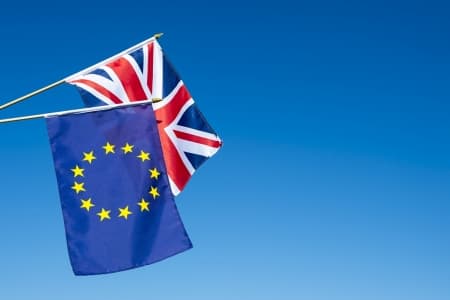
EU-UK Trade and Cooperation Agreement: European Parliament vote brings further certainty

The European Parliament formally gave consent to the Trade and Cooperation Agreement, which sets out the terms of the future relationship between the EU and the UK. This deal is a strong building block towards an ambitious partnership across the Channel. While the agreement conditionally came into force on 31 December 2020, the vote brings further certainty for companies operating across the Channel as the temporary implementation period was scheduled to end later this week.

News
27 Apr 2021
Trade
EU-UK Trade and Cooperation Agreement:  European Parliament vote brings further certainty

The European Parliament formally gave consent to the Trade and Cooperation Agreement, which sets out the terms of the future relationship between the EU and the UK. This deal is a strong building block towards an ambitious partnership across the Channel. While the agreement conditionally came into force on 31 December 2020, the vote brings further certainty for companies operating across the Channel as the temporary implementation period was scheduled to end later this week.

The European Parliament’s consent also creates a renewed opportunity for the EU and the UK to focus on their future relationship. Our members hope to see both sides maximise the potential for intense cooperation on areas of mutual interest, including resolving some of the outstanding issues related to the implementation of the Northern Ireland Protocol and the new barriers to trade and investment that will arise over time.

Susan Danger, CEO, AmCham EU, stated: ‘The vote of the European Parliament reminds us that the success of the future EU-UK partnership will be judged on its impact on citizens and companies. There is a need for both sides to build trust and advance their trade and investment relationship.’ She went on to say: ‘Cooperation and joint solutions are vital to resolve the outstanding issues related to the Northern Ireland Protocol. In addition, the complexity of new customs and VAT requirements has created a lot of confusion for consumers, which adversely affects smaller companies trading across the Channel. Decisions should be taken to allow consumers to access cross-border services where possible. With the global pandemic ongoing, it is critical to focus on the best outcomes for citizens and the economy.’

American companies are heavily invested in both the EU and the UK. Europe receives 60 percent of all US foreign direct investment (FDI), out of which one quarter is located in the UK. The supply chains of AmCham EU’s member companies are highly integrated across the Channel, as they have used the UK as a springboard to the Single Market for many years.

###

About AmCham EU

AmCham EU speaks for American companies committed to Europe on trade, investment and competitiveness issues. It aims to ensure a growth-orientated business and investment climate in Europe. AmCham EU facilitates the resolution of transatlantic issues that impact business and plays a role in creating better understanding of EU and US positions on business matters. Aggregate US investment in Europe totalled more than €3 trillion in 2020, directly supports more than 4.8 million jobs in Europe, and generates billions of euros annually in income, trade and research and development.

For further information, please contact Thibaut L’Ortye, Associate Director of Public Affairs (TLO@amchameu.eu; +32 2 289 10 39).

Related items

News
22 Dec 2025

No further delays: the EU-Mercosur FTA is vital for a stronger Europe

The European Council’s decision to postpone its vote on concluding the EU-Mercosur free trade agreement (FTA) is a missed strategic opportunity that threatens the EU’s credibility as a reliable partner. After more than 20 years of negotiations, the EU is once again delaying one of its most ambitious and strategic trade agreements.

The EU-Mercosur FTA’s economic benefits are clear. At a time when strengthening competitiveness, economic growth and partnerships should be paramount, the FTA provides access to a market of 284 million consumers – reducing tariff and non-tariff barriers and supporting integrated supply chains.

Beyond its economic benefits, the EU-Mercosur FTA is also an important geopolitical tool. It would anchor a long-term strategic partnership with a key region and reinforce the EU’s role as a credible advocate of rules-based trade. Amid heightened geopolitical rivalry, postponement weakens the EU’s standing and its ability to conclude ambitious FTAs elsewhere.

The EU cannot afford further delays. The EU-Mercosur FTA is vital for the region’s competitiveness, resilience and global credibility. The European Council must promptly return to this file and conclude this FTA in January.

Read more about No further delays: the EU-Mercosur FTA is vital for a stronger Europe
News
27 Nov 2025

Advocating for open, rules-based trade in Strasbourg

On Tuesday, 25 and Wednesday, 26 November 2025, AmCham EU travelled to the European Parliament in Strasbourg, France. Over the two-day programme, the delegation met with nearly a dozen MEPs and advisors for an exchange on the future of EU trade policy. Discussions centred on the importance of transatlantic cooperation, the ratification of the EU-Mercosur agreement and the implementation of the EU-US Framework Agreement. Members underlined the need for an ambitious EU trade agenda that ensures market access, reduces tariff and non-tariff barriers and strengthens the resilience of European industry. The delegation also called for a swift adoption of the Commission’s proposal on tariff reduction on US industrial goods and reiterated the importance of a pragmatic, forward-looking transatlantic agenda that promotes predictability and economic security.

Read more about Advocating for open, rules-based trade in Strasbourg
News
1 Oct 2025

Examining where transatlantic trade goes from here with POLITICO

At the POLITICO Competitive Europe Summit, Malte Lohan, CEO, AmCham EU reiterated the need for swift implementation of the EU-US Framework Agreement and renewed its call for greater simplification of EU rules. Mr Lohan expressed cautious support for the deal, noting its role in avoiding damaging escalation and restoring a degree of predictability. He also underscored the importance of reducing regulatory burdens, highlighting simplification as a strategic priority for competitiveness. With the priority now on timely tariff reductions, regulatory cooperation and simplification, find out how our members see the deal evolving

Mr Lohan was joined by Matthias Jørgensen, Head of Unit, USA and Canada, Directorate-General for Trade, European Commission and Jovita Neliupšienė, EU Ambassador to the US 

Trade
Transatlantic
Read more
Read more about Examining where transatlantic trade goes from here with POLITICO