Discussing key issues with SEC Commissioner Crenshaw
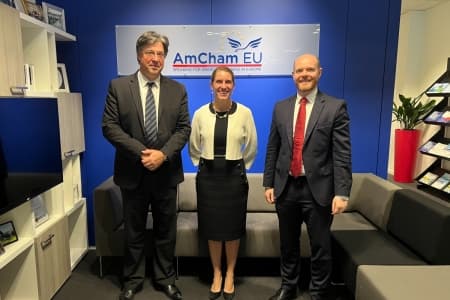
On Thursday, 20 October, AmCham EU hosted a roundtable discussion with Caroline A. Crenshaw, Commissioner, US Securities and Exchange Commission. The conversation focused on corporate sustainability reporting, sustainability due diligence and upcoming regulations in the financial services sphere.
Related items
:focal())
Making the case for the transatlantic relationship in Washington, DC
From Monday, 28 September to Thursday, 1 October 2026, AmCham EU led a delegation of members to Washington, DC to bring the views of the business community to policymakers in Congress and the administration. Discussions showed that both sides value the stability the Turnberry framework agreement brings. While parts of the agreement remain to be implemented, meetings pointed to the possibility for cooperation on economic security. Implementation will continue to need dialogue between the two sides, which is expected to carry on after the mid-term elections.
:focal())
Turnberry Deal has brought a degree of predictability to transatlantic trade and investment, anniversary survey finds
:focal())
Integrating the EU nexus approach into CS3D guidance
The European Commission’s forthcoming guidance on the Corporate Sustainability Due Diligence Directive (CS3D) should:
allow companies to voluntarily prioritise chains of activities with a meaningful connection, which should be further defined in the guidance, to the EU or based on a global risk-based approach in cases where companies have global integrated supply chains;
recognise that companies may face conflicting or overlapping legal requirements between EU and third-country legislation, particularly in relation to information gathering, audits, data transfers, supplier disengagement and cooperation with authorities;
clarify how companies should document and manage circumstances in which third-country law restricts or prevents a due diligence measure;
recognise interactions with competent local authorities, regulatory inspections, permits, licences and other official approvals as potentially relevant sources of due diligence information; and
protect companies from liability where they have followed a reasonable, documented and good-faith process, including where another stakeholder might have prioritised risks or selected due diligence measures differently.
If these measures are included in the guidance, they would help the CS3D deliver meaningful and effective due diligence, rather than an exhaustive mapping of every global business relationship. Flexibility, proportionality and legal certainty can help companies progressively develop credible global systems while directing resources towards the most significant risks and the areas where they have the greatest ability to achieve positive outcomes.
Learn more in our contribution and paper.
Policy priorities
Insights and advocacy driving Europe’s policy agenda. Our priorities support growth, innovation and a stronger transatlantic economy.
Membership
Connecting business and policymakers to strengthen the voice of American companies in Europe.