AmChams in Europe webinar on the COVID-19 crisis and economic recovery

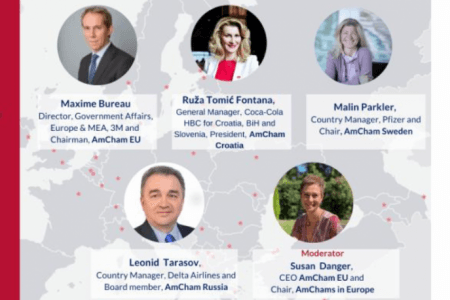
Last week, on Friday, 3 July, the AmChams in Europe network hosted the second live webinar on the topic of The COVID-19 crisis and economic recovery – How is business across Europe and Eurasia responding to these challenges? The discussion during the panel focused on the current reality for business around the world as well as the steps needed for economic recovery. 

The panelists included 4 members from AmChams across Europe and wider Europe:

  • Maxime Bureau, Director for Government Affairs & Sustainability for Europe, the Middle East and Africa, 3M and Chairman, AmCham EU. 

  • Malin Parkler, Country Manager, Pfizer, Chair, AmCham Sweden; 

  • Leonid Tarasov, Country Manager, Delta Airlines, Board member, AmCham Russia; 

  • Ruza Tomic Fontana, General Manager, Coca-Cola HBC for Croatia, Bosnia-Herzegovina and Slovenia, President, AmCham Croatia.

The event was moderated by Susan Danger, CEO of AmCham EU in her capacity as Chair of AmChams in Europe.

News
8 Jul 2020
AmChams in Europe  webinar on the COVID-19 crisis and economic recovery

The panelists detailed the challenges and opportunities for their companies and their respective countries in the face of the pandemic. One word was repeated by every single panelist: trust. Panelists concluded that due to the current situation there is a lack of predictability and certainty, therefore, the role of every employer, government, business and every citizen is to work towards the common goal of strong economic recovery.

We would like to thank all the panelists for the engaging discussion and AmCham Slovenia as the AmChams in Europe Secretariat for hosting this event. 

Related items

News
27 Jul 2026

Turnberry Deal has brought a degree of predictability to transatlantic trade and investment, anniversary survey finds

Transatlantic
Read more
Read more about Turnberry Deal has brought a degree of predictability to transatlantic trade and investment, anniversary survey finds
Position Paper
24 Jul 2026

Integrating extraterritoriality into CS3D guidance

The European Commission’s forthcoming guidance on the Corporate Sustainability Due Diligence Directive (CS3D) should:

  • allow companies to voluntarily prioritise chains of activities with a meaningful connection, which should be further defined in the guidance, to the EU or based on a global risk-based approach in cases where companies have global integrated supply chains;

  • recognise that companies may face conflicting or overlapping legal requirements between EU and third-country legislation, particularly in relation to information gathering, audits, data transfers, supplier disengagement and cooperation with authorities;

  • clarify how companies should document and manage circumstances in which third-country law restricts or prevents a due diligence measure;

  • recognise interactions with competent local authorities, regulatory inspections, permits, licences and other official approvals as potentially relevant sources of due diligence information; and

  • protect companies from liability where they have followed a reasonable, documented and good-faith process, including where another stakeholder might have prioritised risks or selected due diligence measures differently.

  • If these measures are included in the guidance, they would help the CS3D deliver meaningful and effective due diligence, rather than an exhaustive mapping of every global business relationship. Flexibility, proportionality and legal certainty can help companies progressively develop credible global systems while directing resources towards the most significant risks and the areas where they have the greatest ability to achieve positive outcomes.

Learn more in our contribution and paper.

Corporate sustainability
Read more
Read more about Integrating extraterritoriality into CS3D guidance
News
22 Jul 2026

Banking Competitiveness Report: Single Market integration and openness must drive reform

The European Commission’s Banking Competitiveness Report comes at a critical moment for Europe’s investment agenda. Closing Europe’s investment gap requires a banking sector able to mobilise capital at the scale the Savings and Investments Union demands. This is dependent on a Single Market that is not only competitive and integrated but open for all banks operating in the EU to act as facilitators of investment. The report provides a window of opportunity to anchor that openness at the centre of the competitiveness agenda.

The report correctly identifies a set of barriers holding back Europe’s banking competitiveness, both in the regulatory framework and in the way that framework is supervised. Undue complexity and divergent national implementation continue to raise the cost of financing for European households and businesses, underlining the need for an ambitious banking omnibus that simplifies rules and delivers greater consistency across the EU. At the same time, the report is right to call for a more proportionate, risk-focused supervisory culture that examines whether burdensome practices are weakening the attractiveness of Europe’s banking ecosystem. A new banking competitiveness agenda should build on both priorities: simpler, more coherent rules and supervision that enables internationally active banks to support investment.

Internationally active banks, including third-country groups with a substantial European footprint, are central to delivering this agenda. These institutions channel global capital to European companies, underpin the liquidity and depth of EU capital markets and help international investors finance opportunities in Europe. Europe remains a strategic market for these firms, and their investment demonstrates confidence in European growth, European companies and European opportunity.

The test of genuine integration is whether a banking group can serve customers across the Single Market without rebuilding its operations in each Member State. The report recognises that divergent national application of EU rules discourages banks from offering pan-European services and consequently results in costly duplication and regulatory burden across jurisdictions. A more competitive framework would enable European and international institutions to thrive in Europe, offering clients choice and a full suite of payment and banking services across the Single Market.

Coherent implementation will determine whether these reforms enhance competitiveness. Where the framework adapts international standards to EU specificities, the test should be whether the result preserves a level playing field for banks competing in global markets and remains consistent with the standards those banks apply across jurisdictions.

Financial services
Read more
Read more about Banking Competitiveness Report: Single Market integration and openness must drive reform