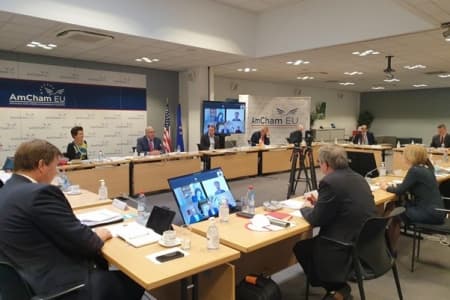
The Executive Council of AmCham EU held their annual Fall Plenary with top officials for the very first time in a hybrid format. The group brings together senior business executives responsible for the European operations of some of AmCham EU’s member companies and is chaired by Chris Delaney, President, EMEA, Goodyear. Discussions over the two days focused on the economic recovery and resilience, European Green Deal, Fit for 55, the transatlantic relationship and COP26.
AmCham EU Executive Council holds plenary with top EU officials
The Executive Council of AmCham EU held their annual Fall Plenary with top officials for the very first time in a hybrid format. The group brings together senior business executives responsible for the European operations of some of AmCham EU’s member companies and is chaired by Chris Delaney, President, EMEA, Goodyear. Discussions over the two days focused on the economic recovery and resilience, European Green Deal, Fit for 55, the transatlantic relationship and COP26.

On Monday, 25 and Tuesday, 26 October the group met with:
Adina Vălean, Commissioner, Transport, European Commission
Ambassador David O'Sullivan, Senior Counsellor, Steptoe & Johnson (Previously Ambassador of the European Union to the United States)
Ambassador Michael Clauss, Permanent Representation of Germany to the EU
Angela Paolini Ellard, Deputy Director-General, World Trade Organisation
Kelly Adams-Smith, Chargé d'Affaires, US Mission to the European Union
Margaritis Schinas, Vice-President, Promoting our European Way of Life, European Commission
Myron Brilliant, Executive Vice-President and Head of International Affairs, US Chamber of Commerce
Read more about the Executive Council.
Related items
Guiding the next generation of leaders
On Wednesday, 25 March, Malte Lohan, CEO, AmCham EU spoke at the EU-US Young Leaders Summit in a seminar organised by Fulbright and the German Marshall Fund, focused on business leadership in times of economic disruption. Mr Lohan underlined that companies are operating in an increasingly complex environment, shaped by geopolitical tensions and diverging EU and US policy approaches. He also stressed the importance of a strong transatlantic economy and called for a pragmatic approach that supports cooperation and avoids further fragmentation.
:focal())
EU-US deal: European Parliament reaches position on tariff reductions
Today the European Parliament adopted its negotiating position on proposals to reduce tariffs on certain imports from the United States, in line with the July 2025 EU-US Framework Agreement. The Parliament’s vote clears the way for trilogues to finalise these proposals.
Reacting to the vote, Malte Lohan, CEO, AmCham EU, welcomed the Parliament’s decision as a necessary step towards a more predictable transatlantic marketplace: ‘The Parliament today has taken a decision that helps put the EU-US trade and investment relationship back on track. It is the right signal for businesses that have been stuck in limbo over the past year.’
‘AmCham EU opposes broad-based tariffs. However, given political priorities on both sides of the Atlantic, we still see the Framework Agreement as the most realistic route to securing a more constructive EU-US trade and investment climate’, Mr Lohan added. ‘We call on the Parliament and Member States to conclude trilogues swiftly. Once the tariff reductions are approved, the EU and the US can get back to advancing the cooperation the Framework Agreement envisages on a range of areas that benefit European and American businesses alike. We look to both sides to continue honouring their commitments throughout this process.’
:focal())
Preserving transatlantic trade in uncertain times
On Tuesday, 24 March, AmCham EU hosted Leopoldo Rubinacci, Deputy Director-General, Directorate-General for Trade, European Commission, to discuss the changing landscape of transatlantic trade in a context of rising protectionism and uncertainty. The meeting was timely as Transatlantic stakeholders eagerly wait for the European Parliament vote on Thursday, 26 March, on the EU-US Framework Agreement. The discussion also looked at differences in areas such as tariffs, industrial policy and market access, and how these affect businesses operating across the Atlantic. The importance of continued dialogue and cooperation to manage these challenges and avoid further disruption to global trade was also highlighted.
Policy priorities
Insights and advocacy driving Europe’s policy agenda. Our priorities support growth, innovation and a stronger transatlantic economy.
Membership
Connecting business and policymakers to strengthen the voice of American companies in Europe.