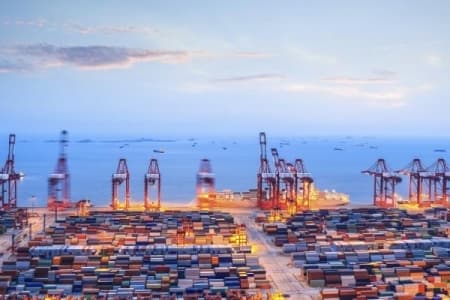
Brussels – On Wednesday, 25 March 2020, the American Chamber of Commerce to the EU (AmCham EU) sent a letter to Commissioner Paolo Gentiloni, Stephen Quest, Director General of DG TAXUD and Philip Kermode, Director, Customs (TAXUD.A), DG TAXUD, calling for a coordinated response with the Member States to the COVID-19 crisis on customs border management and flow of commercial goods.
AmCham EU calls for additional border management measures during the COVID-19 health crisis
Brussels – On Wednesday, 25 March 2020, the American Chamber of Commerce to the EU (AmCham EU) sent a letter to Commissioner Paolo Gentiloni, Stephen Quest, Director General of DG TAXUD and Philip Kermode, Director, Customs (TAXUD.A), DG TAXUD, calling for a coordinated response with the Member States to the COVID-19 crisis on customs border management and flow of commercial goods.

In these extraordinary times, the supply chain and delivery services play a pivotal role in ensuring that time-critical shipments are delivered in time to those who need them.
While recognising and commending the continued efforts by the European Commission to ensure the continued flow of goods within Europe, AmCham EU is calling on DG TAXUD to provide additional measures to coordinate the response between the Member States and ensure a free flow of goods between EU Members States and to third countries.
Operational continuity for road, rail, sea and air transport operations is essential to deliver critical medical supplies, ensure ongoing food security and where the transport of consumer goods from e-commerce activities serve as the only means of sales as retail stores have been ordered to close.
To this end, AmCham EU called for urgent measures and guidelines with regard to:
Flexible transit arrangement including transit guarantees that would reduce the amounts to be guaranteed per the EU’s New Computerised Transit System (NCTS), an extension to the 2/3-day window to discharge transit documentation and flexible cancellation options;
Simplified customs entry at presentation of goods, reduced inspections and paperwork as well as postponed processing of full customs declarations and supplementary entries;
Facilitation of customs warehousing and flexible solutions for blocked bonded goods, and an extension of the current 90-day limit on the temporary storage of goods; and
An extension of the Single Transport Contract (STC) for road movements in light of current and potential air travel restrictions.
AmCham EU believes that such coordination is necessary for supply chains to deliver essential goods during this ongoing health crisis.
The US business community stands ready to discuss these issues in more detail.
For more information, please contact Chloé Morice, Policy Adviser (CMO@amchameu.eu).
Related items
:focal())
Increasing certainty around the €150 customs duty de minimis threshold
The Commission’s proposed transitional rules to anticipate the removal of the €150 customs duty threshold risk creating distortions and unnecessary complexity. As discussed at the Trade Contact Group in January 2026, the current approach could undermine simplification efforts and lead to an uneven playing field between businesses involved in low-value distance sales.
Co-legislators should consider targeted changes to address these risks. In particular, the temporary €3 duty and the use of the H7 simplified customs declarations should apply consistently to all distance sales below €150. H7 data requirements for simplified procedures should also remain proportionate and not exceed those of the standard H1 dataset. Finally, changes to the definition of the customs declarant should be avoided where they may create legal uncertainty or increase fraud and liability risks.
Find out more about why a proportionate and legally sound approach is essential for a workable de minimis transition.
:focal())
EU-Mercosur vote: a self-inflicted setback to Europe's strategic interests
The European Parliament’s decision to refer the EU-Mercosur free trade agreement (FTA) to the Court of Justice adds a further delay to one of the EU’s most important and long-running trade initiatives.
Commenting on the vote, Malte Lohan, CEO of AmCham EU, said: ‘Today’s vote by the European Parliament to refer the EU-Mercosur agreement to the Court of Justice is a self-inflicted setback for Europe’s economic interests and geopolitical relevance at a moment when the EU can least afford it.
After 25 years of negotiations, this should have been Europe stepping forward as a global trade leader and champion of win-win partnerships. It was an opportunity to strengthen Europe’s global position, diversify supply chains and open new opportunities in a fast-growing market of 284 million people.
Instead, this vote has chosen - yet again - delay.
Europe’s credibility as a trade powerhouse is now on the line. The EU must move decisively to get this agreement back on track.’
The EU-Mercosur FTA will deepen economic ties, reduce barriers to trade and strengthen long-term engagement with a key region. How this process now unfolds will be critical not only for the agreement itself, but also for confidence in the EU’s broader trade agenda.
:focal())
European business associations celebrate the signature of EU-Mercosur FTA
Today marks a historic milestone with the signing of the EU-Mercosur Trade Agreement, creating the biggest trading block in the world. European business – represented by more than 28 associations across a wide range of sectors – warmly welcomes this signature. It sends a strong and timely signal that the EU remains open and is committed to rules-based global trade. In a time of global uncertainty, this agreement is a key growth booster.
By opening access to over 270 million consumers via the elimination of trade barriers and the removal of tariffs on over 90% of EU exports, the agreement provides the thrust European companies need to export, invest, and grow, as well as to diversify their supply chains, sourcing essential products and raw materials from Mercosur. By 2040, according to DG Trade’s calculations, the agreement is expected to add 77.6 billion euros to the EU GDP, resulting in a 39% increase in EU exports to Mercosur.
With the agreement now signed, the ball is firmly in the court of the European Parliament in ensuring rapid ratification. We therefore call on Members of the European Parliament to give their consent and allow Europe’s engine of economic growth and prosperity to be switched on and move ahead decisively. After over 25 years of negotiations, we are finally in sight of the finish line. We cannot afford to wait any longer.
Policy priorities
Insights and advocacy driving Europe’s policy agenda. Our priorities support growth, innovation and a stronger transatlantic economy.
Membership
Connecting business and policymakers to strengthen the voice of American companies in Europe.