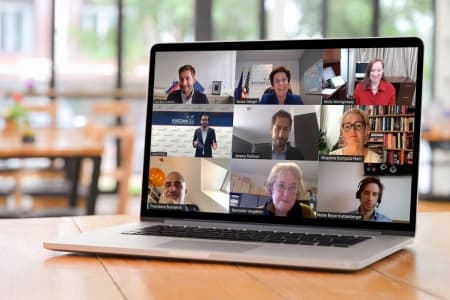
Data has become the primary driver of our digitalised economy, and it impacts every facet of our lives. In fact, it is estimated that by the end of 2021 alone,60% of the global GDP will be digitalised. Knowing this, AmCham EU hosted the 9th edition of its annual Transatlantic Digital Economy Conference on Thursday, 28 October. This year’s event featured discussions on how private and public entities can channel the power of data to fuel Europe’s digital decade and foster transatlantic ties.
Trust, cooperation and optimism- the transatlantic digital economy
Data has become the primary driver of our digitalised economy, and it impacts every facet of our lives. In fact, it is estimated that by the end of 2021 alone,60% of the global GDP will be digitalised. Knowing this, AmCham EU hosted the 9th edition of its annual Transatlantic Digital Economy Conference on Thursday, 28 October. This year’s event featured discussions on how private and public entities can channel the power of data to fuel Europe’s digital decade and foster transatlantic ties.

The conference, sponsored by Facebook, featured a keynote speech from Mark Boris Andrijanič, Minister for Digital Transformation, Republic of Slovenia. After an introduction from Susan Danger, CEO, AmCham EU, the Minister talked about how governments can use the power of data.
The opening speech was followed by a panel discussion on how the EU can best frame data management and regulation moderated by Jeremy Rollison (Microsoft), Vice-Chair of the Digital Economy Committee, AmCham EU. The panel featured Malte Beyer-Katzenberger, Team Leader, Data Policy and Innovation, DG Connect, European Commission, Francesco Buonarroti, IT Vice-President and Chief Information Officer, Janssen EMEA (Johnson & Johnson), Miapetra Kumpula-Natri, Member of the European Parliament (FIN, S&D) and Reinhilde Veugelers, Senior Fellow, Bruegel.
As a closing keynote speaker, Molly Montgomery, Deputy Assistant Secretary for European and Eurasian Affairs, US Department of State, gave a speech on transatlantic cooperation in the data space and in the context of the Trade and Technology Council (TTC).
Not only is data essential for the transatlantic alliance, but it will be a key pillar for achieving the EU’s ambitions for a ‘digital decade’. This conference served as a valuable lesson of how we must use - based on the ongoing positive momentum - the opportunities that arise to harness the power of data on the basis of trust, cooperation and optimism.
If you want to find out more about the role of data in the digital age, you can read our latest blogpost hereor watch our interviews with Rosa and Nutrinomics, two data-driven start-ups.
Related items
:focal())
Closing the skills gap to restore Europe’s competitiveness
On Tuesday, 24 February, AmCham EU hosted Stefan Olsson, Deputy Director-General, Jobs, Skills and Social Policies, Directorate-General for Employment, Social Affairs and Inclusion, European Commission to discuss how closing the skills gap can strengthen Europe’s competitiveness. As shortages across sectors continue to affect productivity, investment and innovation, participants reflected on progress one year after the launch of the Union of Skills and the importance of sustained public-private cooperation. The discussion explored how Europe can build a future-ready workforce to support the green and digital transitions while addressing labour market mismatches. Aurelia Takacs (Cisco), Chair, Social Impact, Inclusion and Skills Committee, AmCham EU moderated the discussion and examined practical policy solutions to strengthen skills development, improve labour market alignment and support inclusive economic growth.
:focal())
Choose France, choose the future
Cisco is strengthening France’s role in the global digital economy with the launch of its Global AI Hub, announced at the 2025 Choose France Summit. The hub will focus on secure, energy-efficient artificial intelligence (AI) infrastructure, innovative cooling solutions for data centres and support for the startup ecosystem. To address future workforce needs, Cisco will also train 230,000 people in France over the next three years through its Networking Academy, covering fields such as cybersecurity, data science and AI. Building on nearly 400,000 individuals already trained in France, this investment supports Cisco’s EU-wide commitment to train 1.5 million people by 2030. Read more on Invested in Europe.
:focal())
Aligning EU securitisation rules with global markets
The European Parliament’s November 2025 draft report on revitalising EU securitisation strengthens the Commission’s proposal by pushing further simplification, but it overlooks a central flaw in the framework: the misalignment between EU and non‑EU securitisations that continues to restrict EU investors’ access to global markets. Investor access should depend on whether sufficient information is available for due diligence, not on the use of a specific reporting template.
MEPs can make this fix by removing the template‑based verification requirement in Article 5(ii)(e) and anchoring investor due diligence in a clear, substance‑based ‘sufficient information’ standard. When combined with the Parliament’s encouraging simplification proposals, this targeted fix would lower operational costs, enable proportionate due diligence and strengthen market depth – all without weakening core safeguards.
Policy priorities
Insights and advocacy driving Europe’s policy agenda. Our priorities support growth, innovation and a stronger transatlantic economy.
Membership
Connecting business and policymakers to strengthen the voice of American companies in Europe.