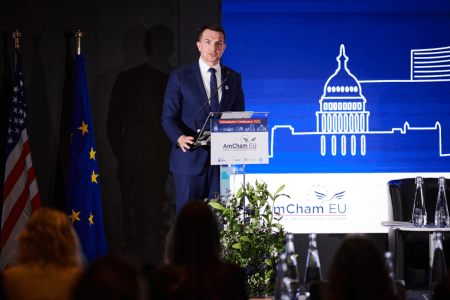
This year’s Transatlantic Conference put the spotlight on how the EU and US can strengthen their partnership amid rising global uncertainty. Taking place on Tuesday, 18 March, the event brought together industry leaders, policymakers and experts from both sides of the Atlantic to discuss the key challenges shaping transatlantic relations. From trade and investment to emerging technologies and defence cooperation. While the waters may be choppy, the discussions made one the clear - the need for continued transatlantic alignment to maintain competitiveness and security in an increasingly fragmented world.
The event opened with Liam Benham (Boeing), Chair, AmCham EU and Malte Lohan, CEO, AmCham EU, setting the stage for a critical discussion on how the EU and US can reinforce their partnership in a rapidly evolving geopolitical landscape. They emphasised the need for renewed transatlantic engagement to navigate economic, technological and security challenges.
The conference continued with the presentation of The Transatlantic Economy Report 2025 by Daniel Hamilton, Senior Fellow, Foreign Policy Institute, SAIS, Johns Hopkins University, and Joseph Quinlan, Senior Fellow, Transatlantic Leadership Network. The report underscored the enduring strength of EU-US trade and investment ties, while highlighting the need for continued cooperation to address economic pressures and geopolitical challenges. Thibaut L’Ortye, Senior Director, Public Affairs, AmCham EU moderated the session.
In the first panel, Marjorie Chorlins, Senior Vice-President, European Affairs, US Chamber of Commerce; Leopoldo Rubinacci, Deputy Director-General, Directorate-General for Trade, European Commission and Luisa Santos, Deputy Director General, BusinessEurope, tackled the fractures in the EU-US economic relationship and explored ways to restore trust and cooperation. They emphasised the resilience of the transatlantic relationship, highlighting how political shifts are disrupting economic cooperation and underlining the mutual benefits of fostering a stable investment climate. The discussion was moderated by Aylin Lusi (UPS), Chair, Operations Group and Board Member, AmCham EU.
Next, Brando Benefei, MEP (S&D, IT) and Chair, European Parliament Delegation for relations with the United States and Jovita Neliupšienė, EU Ambassador to the United States, addressed the challenges posed by deepening political divisions on both sides of the Atlantic, highlighting the importance of maintaining open and continuous dialogue. They looked at the critical role of institutional engagement in sustaining effective transatlantic cooperation and underscored the strength of the EU-US economic relationship.
Afterwards, Timothy Hogan, Senior Vice-President, Global Policy and Public Affairs, Pfizer; Eva Maydell, MEP (EPP, BG) and Vice-Chair, European Parliament Delegation for relations with the United States and Fabian Zuleeg, Chief Executive and Chief Economist, European Policy Centre discussed the accelerating global technological race and explored how the EU and US could preserve their competitive edge. The panelists emphasised the role that businesses can play in strengthening transatlantic relations and why the EU needs to look globally for like-minded partners. The panel was moderated by Barbara Moens, EU correspondent, Financial Times.
In the second fireside chat, Julia Friedlander, CEO, Atlantik-Brücke, and Dr Benedikta von Seherr-Thoß, Managing Director, Peace, Security and Defence, European External Action Service, discussed the importance of maintaining a strong and united transatlantic defence partnership amid rising geopolitical tensions. They highlighted the necessity of balancing European strategic autonomy with transatlantic interoperability, stressing the importance of overcoming procurement barriers and aligning defence industrial policies. The conversation was moderated by Majda Ruge, Senior Policy Fellow, European Council on Foreign Relations.
Rounding out the Conference was Adam Szłapka, Polish Minister of EU Affairs, who highlighted the linked nature of security and competitiveness. Minister Szłapka emphasised that simplifying regulations within the Single Market is essential to fostering business growth and attracting investment, leading to enhanced security and resilience within the EU.
:focal())
:focal())
:focal(2191x1962:2192x1963))