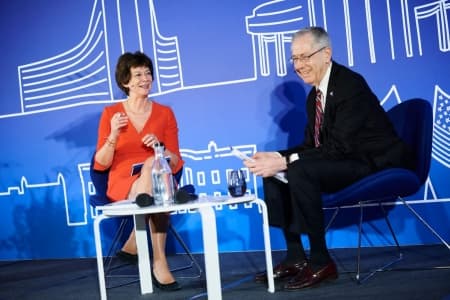
This year’s Transatlantic Conference, ‘Thriving together: uniting in the face of global challenges’ put industry and institutions in the same room to discuss the importance of a strong and united transatlantic relationship, especially on the green and digital transitions. The conference took place on Wednesday, 22 March 2023 and featured speakers from both sides of the Atlantic. As an opening video, Gina Raimondo, US Secretary of Commerce, underlined the importance of keeping the transatlantic dialogue open through forums like the Trade and Technology Council. Michael Miebach, CEO, Mastercard, then expanded on why the focus should be on innovation, sustainability and inclusion to keep the EU and US competitive.
Transatlantic 2023: in review
This year’s Transatlantic Conference, ‘Thriving together: uniting in the face of global challenges’ put industry and institutions in the same room to discuss the importance of a strong and united transatlantic relationship, especially on the green and digital transitions. The conference took place on Wednesday, 22 March 2023 and featured speakers from both sides of the Atlantic. As an opening video, Gina Raimondo, US Secretary of Commerce, underlined the importance of keeping the transatlantic dialogue open through forums like the Trade and Technology Council. Michael Miebach, CEO, Mastercard, then expanded on why the focus should be on innovation, sustainability and inclusion to keep the EU and US competitive.

The conference included a series of panel discussions, diving into key priorities for the transatlantic relationship. First off was a conversation focused on how the EU and the US can navigate the difficult external environment. The panellists focused on transatlantic cooperation and the need to collaborate with industry in addressing shared issues. Afterwards, the conversation turned to the transatlantic economy. The speakers explained how to continue economic growth, the EU and US have to find global solutions to shared challenges.
Following the initial panel discussions, Daniel Hamilton and Joseph Quinlan presented the key findings of the Transatlantic Economy 2023 report, the annual survey of transatlantic jobs, trade and investment. This year’s edition features new insights into what impact energy transformations have had on the transatlantic partnership. The report also draws attention to trends like global supply chain issues and the need to diversify, relations with China and transatlantic data flows.
After the lunch and networking session, Mark Gitenstein, US Ambassador to the European Union, took to the stage to give his perspective on how the relationship between both sides of the Atlantic is deeper and stronger than ever before. Before moving on to the final panel discussions, we heard a message from Vimal Kapur, President and Chief Operating Officer, Honeywell. By giving examples from his company, attendees were able to see the role that business plays in making policy decisions a reality.
Centring around energy cooperation, one of the larger sessions of the day shed light on why brining green energy production to Europe and the United States is a process that should start now. The final conversation of the conference covered how industry can stay competitive during the green transition and the role governments can play in easing the transformation.
The conference closed with a few words from Zeger Vercouteren (J&J), Chair, AmCham EU who added that despite challenges, the EU and US are each other’s greatest partners and the transatlantic relationship continues to prove its strength.
Related items
:focal())
Irish-made AI
Developing advanced artificial intelligence (AI) capabilities is central to Europe’s digital ambitions. With a new €175 million investment, Workday is reinforcing this priority by establishing an AI Centre of Excellence in Dublin. Building on its long-standing research and development presence, the company will expand product development and create more than 200 specialised roles. Workday is also deepening its commitment to skills, partnering with national training networks and universities to equip employees with cutting-edge AI expertise. Through these collaborations, Workday is helping to drive innovation, strengthen Europe’s digital competitiveness and support the next generation of AI talent. Discover more on Invested in Europe.
:focal())
Council vote clears way for landmark EU-Mercosur free trade agreement
EU Member States’ decision to approve the EU-Mercosur free trade agreement is a major victory for the EU’s free trade agenda. For companies in the EU, the agreement promises to support deeper integration of value chains and facilitate access to a market of 284 million consumers. This will contribute to more resilient and diversified supply chains, including access to critical raw materials essential for the EU’s economic security and industrial growth.
AmCham EU praises the European Commission for its work with Member States to ensure the deal benefits all sectors of the EU economy. By concluding Mercosur’s first trade agreement with a major global partner, the EU demonstrates its commitment to open and rules-based trade. The European Parliament must now approve the agreement without delay, so that – after 25 years of negotiations – businesses and citizens can start benefiting from this deal.
Reacting to the news, Malte Lohan, CEO, AmCham EU, stressed the importance of the agreement: ‘The Council’s decision is a timely one. In today’s world, the EU needs to boost its economic competitiveness and maintain its free trade leadership. The EU-Mercosur agreement ticks both boxes’.
‘The business case is clear; the geopolitical case is clear. It is now the Parliament’s job to see the agreement across the finish line’, he added.
:focal())
No further delays: the EU-Mercosur FTA is vital for a stronger Europe
The European Council’s decision to postpone its vote on concluding the EU-Mercosur free trade agreement (FTA) is a missed strategic opportunity that threatens the EU’s credibility as a reliable partner. After more than 20 years of negotiations, the EU is once again delaying one of its most ambitious and strategic trade agreements.
The EU-Mercosur FTA’s economic benefits are clear. At a time when strengthening competitiveness, economic growth and partnerships should be paramount, the FTA provides access to a market of 284 million consumers – reducing tariff and non-tariff barriers and supporting integrated supply chains.
Beyond its economic benefits, the EU-Mercosur FTA is also an important geopolitical tool. It would anchor a long-term strategic partnership with a key region and reinforce the EU’s role as a credible advocate of rules-based trade. Amid heightened geopolitical rivalry, postponement weakens the EU’s standing and its ability to conclude ambitious FTAs elsewhere.
The EU cannot afford further delays. The EU-Mercosur FTA is vital for the region’s competitiveness, resilience and global credibility. The European Council must promptly return to this file and conclude this FTA in January.
Policy priorities
Insights and advocacy driving Europe’s policy agenda. Our priorities support growth, innovation and a stronger transatlantic economy.
Membership
Connecting business and policymakers to strengthen the voice of American companies in Europe.