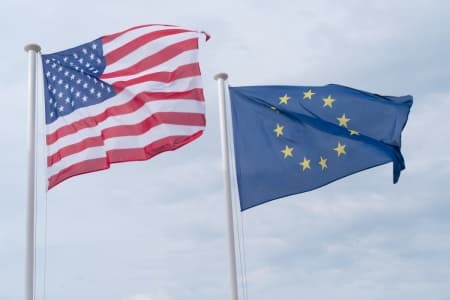
On Saturday, 4 July, the US marks 250 years as a nation built on the right to life, liberty and the pursuit of happiness. As Americans at home and abroad celebrate this important milestone, it is an apt moment for Europeans to reflect on their own role in the story of the US. From having shaped the political ideals that are at the heart of modern democracies to becoming a global technological and cultural force, the EU and the US can be proud of all that our shared history has inspired across the world.
This relationship is underpinned by the $9.8 trillion transatlantic economy and the 16 million jobs it supports. However, it was never a given that the ‘Old World’ and the ‘New World’ would forge the largest, most consequential economic relationship on earth. There were periods when wars, economic crises and political shifts kept Europeans and Americans from seeing eye to eye. Yet over time, Europe and the US ultimately found ways of moving forward together, united by aligned interests and shared goals for the future.
Over the centuries, what we achieved together reflects the work not only of political leaders but of ordinary, enterprising citizens, who started businesses and expanded their horizons. They were essential to building the partnership, one transaction and one contract at a time. If we were to rewind to 1776, business owners from Boston and Philadelphia to Berlin and Paris would be familiar with some of the challenges transatlantic business currently faces: shifting policies, supply chain disruptions and uncertainty about what comes next. What might surprise them, however, is the sheer depth and breadth of the partnership in 2026 and its impact on not only Europe and the US but the rest of the world.
The depth of the economy
In the 18th century, crossing the Atlantic took weeks, often making the ocean more of a barrier to trade than a link. ‘Trade’ meant raw and manufactured goods slowly and dangerously sailing on ships between Europe and the nascent US. Merchants could only have dreamed of the $6.4 billion that Europe and the US now trade every single day. With the advent of high-speed transport and the digital economy, every value chain in our economies is shaped by transatlantic commerce. And services have become critical to that. In fact, the EU and the US are the two largest traders of services in the world and are each other’s most important services trading partners.
Important as it is, trade now makes up the smaller part of the $9.8 trillion transatlantic economy: $7.5 trillion comes from selling locally to each other’s markets through our respective foreign subsidiaries, a testament to how deeply integrated the EU-US partnership is. Today, there are 5.3 million employees of European companies in the US and a further 4.6 million employees of US companies in Europe.
The stakes of the partnership
The transatlantic relationship has evolved almost beyond recognition in the last 250 years – giving citizens on both sides of the ocean a myriad reasons to celebrate. It has enabled Europe and the US to grow, innovate and project influence together in a way that would have been impossible alone.
Looking back at the rich shared history of Europe and the US over the past 250 years also provides vital perspective: the undisputed gains for businesses and citizens cannot be taken for granted. The international system is anchored in the transatlantic relationship; the current tensions, rapid technological change and global instability further underscore its vital importance to the world. If businesses and governments grow complacent and fail to maintain the EU-US partnership, the next 250 years could see the relationship lose its ability to protect and nurture the things we hold dear.
This anniversary is the right moment to celebrate America’s role in the world and to recognise how far we’ve come as partners in building our shared destinies. It must also remind us that what the EU and the US have created together is precarious and requires wise and continuous political stewardship from both sides for a prosperous future.
American companies will continue to play their part in bringing the EU and the US together for our shared benefit in a rapidly changing world. On behalf of AmCham EU and our 165 member companies, we congratulate the US on everything it has achieved over the last 250 years, and we join in the celebration of all that we have accomplished together.
:focal())
:focal(2191x1962:2192x1963))
:focal())