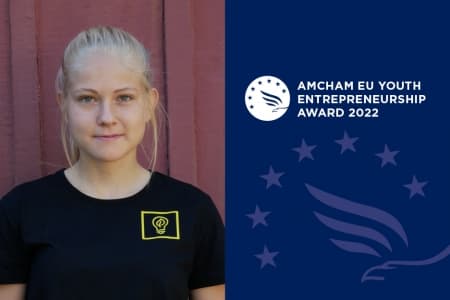
Swedish start-up Energy Effective Solutions wins AmCham EU Youth Entrepreneurship Award 2022

The American Chamber of Commerce to the European Union (AmCham EU) and Junior Achievement Europe (JA Europe) are delighted to announce that Energy Effective Solutions, a Swedish start-up, is the winner of the tenth AmCham EU Youth Entrepreneurship Award. This year’s edition was dedicated to women entrepreneurs, for the third time in a row. Ida Norström, Founder and CEO, won the hearts and minds of the jury with her ambition to grow her business into one of Europe’s largest electricity companies and lead the transition to a modernised electricity industry. An inspiring young business leader, Ida Norström started her career at fourteen years old only and had already completed an apprenticeship before finishing high school.

News
15 Jun 2022
Swedish start-up Energy Effective Solutions wins  AmCham EU Youth Entrepreneurship Award 2022

Energy Effective Solutions programs and installs diverse, energy-efficient electrical projects that range from automated control systems to solar cells and electric car chargers. Ida Norström identified the growth potential stemming from consumer demand in sustainable solutions and has developed a team that is skilled and able to take advantage of this trend. The choice of Energy Effective Solutions is also meant to encourage young people to engage in this sector that is crucial for the EU and the world.

The distinguished jury included Kelly Adams-Smith, Deputy Chief of Mission, US Mission to the EU; Daniel Carrera, President, UPS Europe; Chris Delaney, President EMEA, Goodyear Europe; Susan Danger, CEO, AmCham EU; Eva Maydell, Member of the European Parliament; Martin Jetter, Senior Vice President and Chairman, IBM Europe; and Gilles Thiebaut, Senior Vice President and Managing Director, HPE Northern Western Europe. The jury members had the difficult task of choosing a winner amongst three Junior Achievement Europe alumnae: Auguste Kaknevičiūtė, Founder and CEO of ONE 100 from Lithuania; Gry Larsen, CEO and owner of Pakkeriet Hadsund from Denmark; and Ida Norström, Founder and CEO of Energy Effective Solutions from Sweden.

As she received the award, Ida Norström, Founder and CEO, Energy Effective Solutions, said: ‘It is an honour to receive this prize and I look forward to starting the mentorship programme with such inspiring business leaders, as I take my company to the next level.’

Susan Danger, CEO, AmCham EU, said: ‘As we celebrate the European Year of Youth, I am thrilled to honour emerging women leaders. Entrepreneurship plays a key role in growing our economy and providing new opportunities to all segments of society. AmCham EU looks forward to mentoring and supporting Ida Norström to help her innovative company do both.’

Diana Filip, Deputy CEO, JA Europe, added: ‘Every multinational business we know today, started with the vision and ambition of individuals, who passionately and relentlessly worked to make their idea a reality. We are very thankful to AmCham EU and its members for supporting our JA alumnae in their entrepreneurial accomplishments.’

The AmCham EU Youth Entrepreneurship Award was launched in 2013 to recognise young people who have chosen to become entrepreneurs and to foster entrepreneurship in Europe. The initiative is supported by AmCham EU's Executive Council and organised in collaboration with JA Europe. Each finalist is presented with a monetary prize toward their start-up. In addition, all finalists will also receive mentorship from top European CEOs of AmCham EU member companies. AmCham EU also makes a contribution to the three local JA Europe organisations, recognising their contributions to fostering entrepreneurship at local level.

###

About AmCham EU

AmCham EU speaks for American companies committed to Europe on trade, investment and competitiveness issues. It aims to ensure a growth-orientated business and investment climate in Europe. AmCham EU facilitates the resolution of transatlantic issues that impact business and plays a role in creating better understanding of EU and US positions on business matters. Aggregate US investment in Europe totalled more than €3.4 trillion in 2021, directly supports more than 4.9 million jobs in Europe, and generates billions of euros annually in income, trade and research and development.

About JA Europe

JA Europe is the largest organisation in Europe dedicated to preparing young people for employment and entrepreneurship. JA Europe is a member of JA Worldwide® which for 100 years has delivered hands on, experiential learning in entrepreneurship, work readiness and financial literacy. JA creates pathways for employability, job creation and financial success. Together we work in 41 countries in Europe, offering 4 million learning experiences every year in core programmes and inspiring millions more through online events and activities. JA Worldwide was nominated for the Nobel Peace Prize 2022. For the fourth year in a row, JA Worldwide was selected in 2022 as a top-ten global NGO by thedotgood (formerly NGO Advisor).

Related items

News
27 Jul 2026

Turnberry Deal has brought a degree of predictability to transatlantic trade and investment, anniversary survey finds

Transatlantic
Read more
Read more about Turnberry Deal has brought a degree of predictability to transatlantic trade and investment, anniversary survey finds
Position Paper
24 Jul 2026

Integrating extraterritoriality into CS3D guidance

The European Commission’s forthcoming guidance on the Corporate Sustainability Due Diligence Directive (CS3D) should:

  • allow companies to voluntarily prioritise chains of activities with a meaningful connection, which should be further defined in the guidance, to the EU or based on a global risk-based approach in cases where companies have global integrated supply chains;

  • recognise that companies may face conflicting or overlapping legal requirements between EU and third-country legislation, particularly in relation to information gathering, audits, data transfers, supplier disengagement and cooperation with authorities;

  • clarify how companies should document and manage circumstances in which third-country law restricts or prevents a due diligence measure;

  • recognise interactions with competent local authorities, regulatory inspections, permits, licences and other official approvals as potentially relevant sources of due diligence information; and

  • protect companies from liability where they have followed a reasonable, documented and good-faith process, including where another stakeholder might have prioritised risks or selected due diligence measures differently.

  • If these measures are included in the guidance, they would help the CS3D deliver meaningful and effective due diligence, rather than an exhaustive mapping of every global business relationship. Flexibility, proportionality and legal certainty can help companies progressively develop credible global systems while directing resources towards the most significant risks and the areas where they have the greatest ability to achieve positive outcomes.

Learn more in our contribution and paper.

Corporate sustainability
Read more
Read more about Integrating extraterritoriality into CS3D guidance
News
22 Jul 2026

Banking Competitiveness Report: Single Market integration and openness must drive reform

The European Commission’s Banking Competitiveness Report comes at a critical moment for Europe’s investment agenda. Closing Europe’s investment gap requires a banking sector able to mobilise capital at the scale the Savings and Investments Union demands. This is dependent on a Single Market that is not only competitive and integrated but open for all banks operating in the EU to act as facilitators of investment. The report provides a window of opportunity to anchor that openness at the centre of the competitiveness agenda.

The report correctly identifies a set of barriers holding back Europe’s banking competitiveness, both in the regulatory framework and in the way that framework is supervised. Undue complexity and divergent national implementation continue to raise the cost of financing for European households and businesses, underlining the need for an ambitious banking omnibus that simplifies rules and delivers greater consistency across the EU. At the same time, the report is right to call for a more proportionate, risk-focused supervisory culture that examines whether burdensome practices are weakening the attractiveness of Europe’s banking ecosystem. A new banking competitiveness agenda should build on both priorities: simpler, more coherent rules and supervision that enables internationally active banks to support investment.

Internationally active banks, including third-country groups with a substantial European footprint, are central to delivering this agenda. These institutions channel global capital to European companies, underpin the liquidity and depth of EU capital markets and help international investors finance opportunities in Europe. Europe remains a strategic market for these firms, and their investment demonstrates confidence in European growth, European companies and European opportunity.

The test of genuine integration is whether a banking group can serve customers across the Single Market without rebuilding its operations in each Member State. The report recognises that divergent national application of EU rules discourages banks from offering pan-European services and consequently results in costly duplication and regulatory burden across jurisdictions. A more competitive framework would enable European and international institutions to thrive in Europe, offering clients choice and a full suite of payment and banking services across the Single Market.

Coherent implementation will determine whether these reforms enhance competitiveness. Where the framework adapts international standards to EU specificities, the test should be whether the result preserves a level playing field for banks competing in global markets and remains consistent with the standards those banks apply across jurisdictions.

Financial services
Read more
Read more about Banking Competitiveness Report: Single Market integration and openness must drive reform