
Statement on EU foreign subsidies proposal

With yesterday’s proposal for a regulation on foreign subsidies, the European Commission seeks to address foreign subsidies which risk distorting the EU internal market and undermine a level playing field. The American Chamber of Commerce to the EU (AmCham EU) supports the Commission’s efforts to strengthen the resilience and competitiveness of the Single Market and find the appropriate balance between fair competition and open trade when addressing non-EU subsidies.

News
5 May 2021
Competition
Statement on EU foreign subsidies proposal

However, AmCham EU cautions against an overly broad application that may be disproportionate to the Commission’s goals. To promote growth, investment and trade, the rulebook should be balanced and proportionate. The new toolkit should be used to address the distortive effect of subsidies available in non-market economies with well-funded state-owned enterprises and little oversight of state aid. The proposed mechanisms, as currently drafted, may impose significant additional compliance efforts on companies who already act transparently, while still not gathering necessary information and adequately targeting genuinely distortive practices.

Ultimately, unintentional targeting of international companies whose home jurisdiction share the EU’s open market principles risks to undermine foreign investment in the EU economy currently in need of a fast and sustainable recovery post-COVID-19. For example, requiring prior notification of foreign subsidies received up to three years prior to notification will create additional burdens on non-EU companies and could hamper legitimate foreign investment in Europe.

AmCham EU is pleased that some initial concerns with the White Paper appear to have been addressed, for instance the addition of relevant thresholds to ex-ante tools are welcome. These offer clarity with regard to the applicability of measures to mergers, acquisitions and procurement processes. Further dialogue is necessary to refine this new proposal which offers an opportunity to develop appropriate solutions to distortive market practices and to building a strong Single Market fit for a sustainable and digital age. AmCham EU calls on the Commission, Council and Parliament to address genuine distortions in a targeted and proportionate manner, whilst avoiding negative consequences for jobs, trade and investment. To achieve these goals alignment with international partners will be critical. AmCham EU looks forward to our continued engagement with the EU institutions and the Member States.

For more information, please read our response to the Commission’s White Paper on foreign subsidies.
Related items

News
19 Nov 2026

Making the Foreign Subsidies Regulation fit for purpose

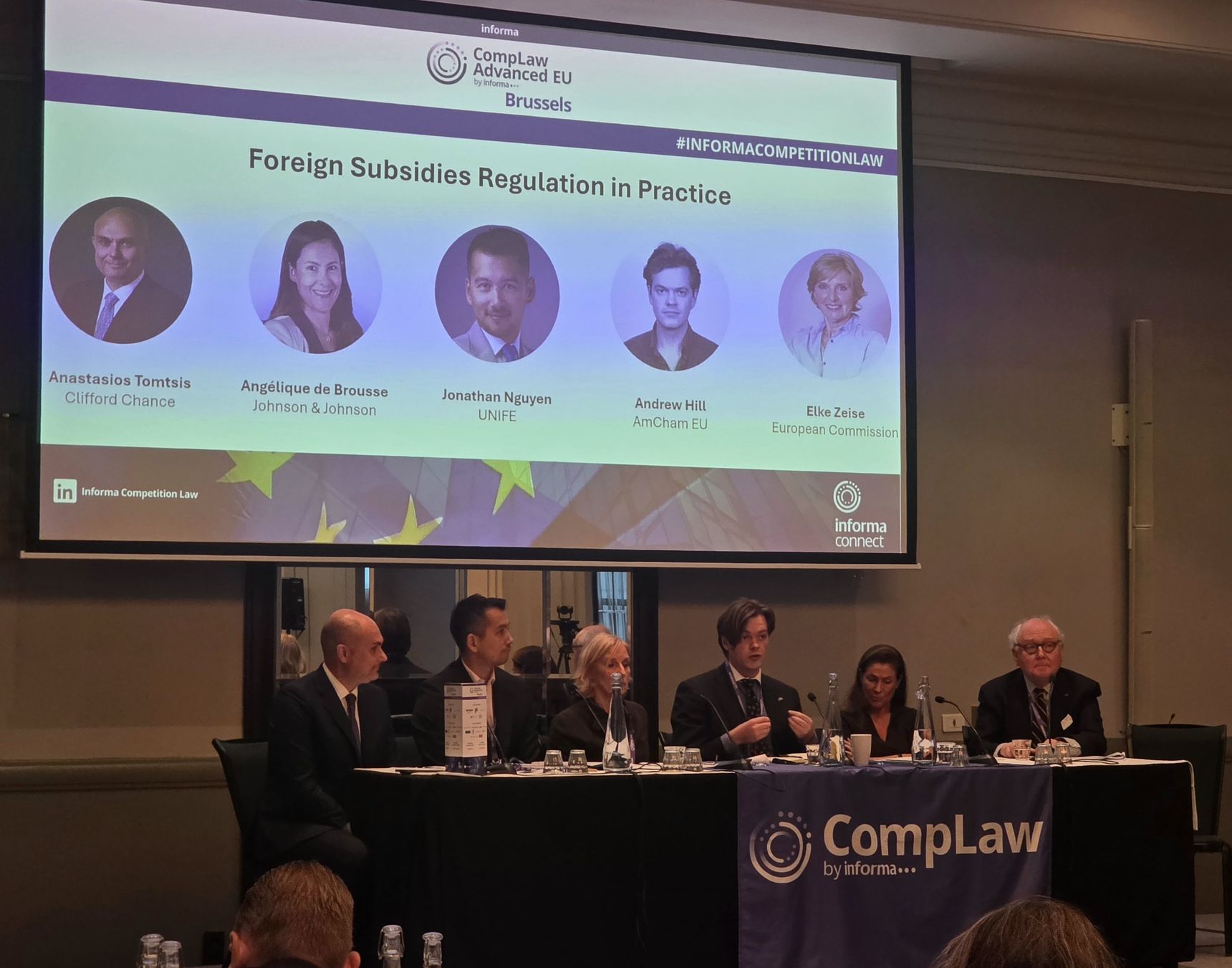
On Wednesday, 18 November, Andrew Hill, Senior Policy Adviser, AmCham EU, represented the organisation at the CompLaw: Advanced EU conference in Brussels. Joining a panel on how the Foreign Subsidies Regulation (FSR) works in practice, Mr Hill stressed the need for a more proportionate and risk-focused approach to the FSR. With potential changes to EU public procurement rules on the horizon that could restrict market access for companies not covered by international agreements, such as the Government Procurement Agreement (GPA), he highlighted the importance of adapting the FSR to reflect new enforcement realities and avoid unnecessary regulatory burdens. Streamlining the FSR would help the EU address genuine market distortions while preserving an open and predictable business environment. Learn how a proportionate FSR can support a stronger, more predictable business environment in Europe.

Competition
Read more
Read more about Making the Foreign Subsidies Regulation fit for purpose
Position Paper
20 Jul 2026

Supporting competitiveness, innovation and investment through the Merger Guidelines

The revised Merger Guidelines1 (‘Guidelines’) should ensure that the EU merger control framework supports competitiveness, innovation and investment while preserving legal certainty, predictability and effective competition. The Guidelines should remain firmly anchored in the significant impediment of effective competition (SIEC) test, apply resilience and scale considerations in a headquarters-neutral and effects-based manner, and provide clearer analytical and evidentiary standards for resilience assessments and the new theories of harm.

The Guidelines should recognise the benefits of scale where these deliver demonstrable advantages for EU consumers, apply the innovation shield consistently across all acquirers, maintain appropriate safe harbours and ensure a balanced and symmetrical assessment of harms and benefits. The Guidelines should also strengthen predictability across overlapping transaction review regimes and provide greater certainty for both EU and non-EU investors. Together, these refinements would help ensure that merger control contributes to competitiveness, innovation and economic growth while maintaining a transparent and proportionate enforcement framework.

Competition
Read more
Read more about Supporting competitiveness, innovation and investment through the Merger Guidelines
Blog
3 Apr 2026

FSR compliance: ​complexity undermining competitiveness​

The EU proposed the Foreign Subsidies Regulation (FSR) in 2021 to address foreign subsidies distorting the Single Market. Operating as a screening instrument behind merger control, it requires companies to notify the European Commission of foreign financial contributions (FFCs) they may receive when participating in public procurement or mergers and acquisitions activity. Preventing FFCs from distorting the Single Market is an important goal – and one that must be achieved without creating its own disruptions.

Competition
Read more
Read more about FSR compliance: ​complexity undermining competitiveness​