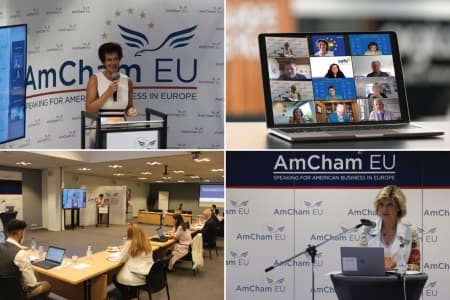
Risk communication is of utmost importance to the agri-food industry – especially when it comes to differentiating ‘hazards’ from ‘risks’. That was the key takeaway from AmCham EU’s sixth Agri-food Risk Roundtable, held on Wednesday, 8 September. This year’s edition focused on how risk assessment and management should be amplified by solid risk communication to generate sound risk perception. The roundtable brought together policy makers from both sides of the Atlantic, industry representatives, NGOs and academia to share best practices regarding different models of risk perception in the food and agriculture sector.
Risk communication holds the key to sustainable agri-food
Risk communication is of utmost importance to the agri-food industry – especially when it comes to differentiating ‘hazards’ from ‘risks’. That was the key takeaway from AmCham EU’s sixth Agri-food Risk Roundtable, held on Wednesday, 8 September. This year’s edition focused on how risk assessment and management should be amplified by solid risk communication to generate sound risk perception. The roundtable brought together policy makers from both sides of the Atlantic, industry representatives, NGOs and academia to share best practices regarding different models of risk perception in the food and agriculture sector.

Introductory remarks from AmCham EU’s CEO, Susan Danger, Matjaž Guček, Director-General and Chief Veterinary Officer, Ministry of Agriculture, Forestry and Food, Slovenia and Clay M. Hamilton, Associate Administrator, Foreign Agricultural Service, U.S. Department of Agriculture emphasised the important role that partnerships and common goals will play in developing effective risk communication to help unlock innovation and promote more sustainable food systems.
The discussion was divided into two panels, the first of which focused on the role of risk assessment and management in enhancing the sustainability of food systems. The second focused on sustainability considerations in the decision-making process. Both panels were moderated by Marie-Cécile Damave, Head of Innovation and International Affairs, Agridées, who navigated the exchange between the distinguished panelists that shared views on how to build trust and confidence in food systems on both sides of the Atlantic between consumers, producers, regulators and industry.
AmCham EU aims to promote sustainable production and consumption through better regulation, trade and international cooperation in line with the EU’s Farm to Fork Strategy. For more on our work on the agri-food sector, read our blogpost on risk communication in the agri-food sector and check out our position paper on the EU’s Farm to Fork Strategy.
Questions about the event or AmCham EU’s work on agri-food issues? Contact Nadia Allen, Senior Policy Adviser (NAL@amchameu.eu)
Related items
:focal())
No further delays: the EU-Mercosur FTA is vital for a stronger Europe
The European Council’s decision to postpone its vote on concluding the EU-Mercosur free trade agreement (FTA) is a missed strategic opportunity that threatens the EU’s credibility as a reliable partner. After more than 20 years of negotiations, the EU is once again delaying one of its most ambitious and strategic trade agreements.
The EU-Mercosur FTA’s economic benefits are clear. At a time when strengthening competitiveness, economic growth and partnerships should be paramount, the FTA provides access to a market of 284 million consumers – reducing tariff and non-tariff barriers and supporting integrated supply chains.
Beyond its economic benefits, the EU-Mercosur FTA is also an important geopolitical tool. It would anchor a long-term strategic partnership with a key region and reinforce the EU’s role as a credible advocate of rules-based trade. Amid heightened geopolitical rivalry, postponement weakens the EU’s standing and its ability to conclude ambitious FTAs elsewhere.
The EU cannot afford further delays. The EU-Mercosur FTA is vital for the region’s competitiveness, resilience and global credibility. The European Council must promptly return to this file and conclude this FTA in January.
:focal())
Environmental Omnibus proposal would simplify regulatory landscape
The European Commission’s Environmental Omnibus proposal is a positive first step towards reducing the administrative and regulatory burdens on businesses operating in the EU. Key measures such as streamlining permitting, simplifying industrial emissions reporting, removing the SCIP database and easing Extended Producer Responsibility schemes would help create more efficient and harmonised processes across the EU. Additionally, the proposal’s indication of upcoming work on the Circular Economy Act and the swift implementation of the Packaging and Packaging Waste Regulation would further support a simplified regulatory environment.
By improving efficiency and predictability, the proposal would help foster a stable, investment-driven market in Europe and reinforce the case for sustainable practices. To fully deliver on the potential to reduce burdens for business, co-legislators must now move the Environmental Omnibus across the finish line. AmCham EU stands ready to serve as a resource in their efforts. These simplification initiatives in environmental regulation are crucial to maintaining Europe’s global standing as a hub for business and innovation.
The Environmental Omnibus proposal is part of the Commission’s simplification agenda and follows its proposed Chemicals Omnibus, which introduced related environmental simplifications in July 2025. These important initiatives continue to drive efforts to cut red tape, reduce regulatory burdens and enhance the EU’s competitiveness.
:focal())
Omnibus and the EU’s drive for simplification
On Tuesday, 9 December, AmCham EU hosted a discussion on the Food and Feed Omnibus and its role in simplifying Europe’s agri-food legislation. The conversation explored how a more coherent, innovation-friendly framework can reduce complexity and ease the administrative burden across the value chain. The discussion also underlined the importance of aligning regulation with scientific and technological progress, while reinforcing Europe’s competitiveness and strategic autonomy. Effective collaboration between policymakers and industry remains essential to ensure the Omnibus delivers practical improvements for operators throughout the agri-food sector.
During the panel, participants heard from Tyler Babcock, Senior Agricultural Attaché, US Mission to the European Union; Dr Eugene Kevin Foley-Friel, Agriculture Attaché, Permanent Representation of Ireland to the European Union and Astrid Sofie Vestergaard Nielsen, Food Attaché, Permanent Representation of Denmark to the European Union. The discussion was moderated by David Mills (Mondelēz International), Chair, Communications Group; Member of the Board of Directors and Vice-Chair, Agriculture & Food Committee, AmCham EU.
Policy priorities
Insights and advocacy driving Europe’s policy agenda. Our priorities support growth, innovation and a stronger transatlantic economy.
Membership
Connecting business and policymakers to strengthen the voice of American companies in Europe.