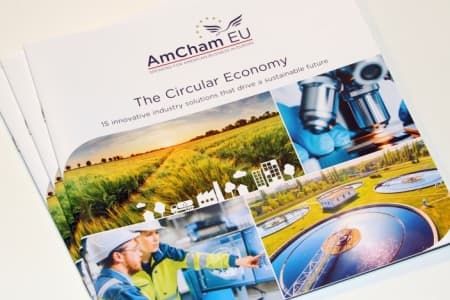
The discussion addressed how the circular economy can boost the EU’s sustainability efforts and improve its resilience in terms of retaining its resources. We also outlined our member companies’ best practices in circularity, which are also outlined in our brochure ‘The Circular Economy: 15 innovative industry solutions that drive a sustainable future’. Leah Charpentier (First Solar), Chair, Environment Committee, AmCham EU moderated the discussion.
Reflections on Europe's circular economy
On Wednesday 20 May, AmCham EU hosted an event on 'Reflections on Europe’s circular economy and what comes next', where we welcomed Marius Vašcega, Head of Cabinet to Commissioner Virginijus Sinkevicius, European Commission as a guest speaker. The event was an opportunity to discuss the European Commission’s objectives with regard to the Circular Economy Action Plan released on Wednesday, 11 March and how this fits in with the European Green Deal and the EU’s economic recovery plan in the context of COVID-19.
Related items
:focal())
Position Paper
2 Jul 2026
Industry calls for stable and evidence-based implementation of the Single-Use Plastic Directive
Together with nine other associations, AmCham EU has signed a joint statement on the evaluation of the Single-Use Plastic Directive (SUPD), calling on EU institutions to avoid reopening the Directive. A revision at this stage would create uncertainty for operators and could also increase costs and deepen fragmentation across the Single Market. Several SUPD provisions are not yet in place. Data on implementation remain limited, making it too early to assess whether the Directive is meeting its objectives. The statement also underlines the need to address gaps in transposition and enforcement. It warns against overlaps with EU legislation such as the Ecodesign Regulation, the Packaging and Packaging Waste Regulation and the Circular Economy Act. Learn how the EU can support certainty and the Single Market in the joint statement.
:focal())
News
27 May 2026
The Circular Economy Act: a silver bullet for harmonisation?
On Wednesday, 27 May, AmCham EU hosted Paulina Dejmek Hack, Head of Cabinet for Jessika Roswall, Commissioner for Environment, European Commission, for a discussion on the upcoming Circular Economy Act. Moderated by Luca Ibelli (Procter & Gamble), Vice-Chair, Environment Committee, AmCham EU, the exchange explored how the Act can support Europe’s wider simplification agenda by reducing fragmentation and strengthening competitiveness. Participants also discussed the importance of a harmonised framework grounded in a clear business case, ensuring circular economy policies help companies operate effectively across the Single Market.
:focal())
News
29 Apr 2026
Revision of the Classification, Labelling and Packaging Regulation: Following a balanced Report, trilogues must secure simplification
Today, the European Parliament adopted its Omnibus VI report, including the revision of the Classification, Labelling and Packaging (CLP) Regulation, by 540 votes to 60. The outcome supports a more streamlined framework by easing the regulatory burden on value chains that rely on chemicals and sending a positive signal of the EU’s commitment to reducing unnecessary complexity.
With the Council’s position agreed in November 2025, the Parliament’s report marks the final step before trilogues, which will conclude negotiations on the targeted revision of the CLP Regulation.
The report largely aligns with the Commission’s simplification agenda and strengthens the CLP Regulation’s overall workability, especially with regards to:
Transition periods, setting 18 months following classification updates and allowing digital contact information to be updated on the label in line with suppliers’ regular update cycles. This better reflects supply chain realities.
Advertising and distance sales requirements, appropriately excluding business-to-business settings while ensuring consumers remain protected; and
Label legibility requirements, with more proportionate minimum font sizes and rules on background contrast, spacing and overall layout. However, further simplification is still needed to ensure sufficient flexibility for businesses.
While the report represents a constructive step forward, trilogues should address remaining constraints and clarify language that is currently difficult to interpret, including further simplification on font sizes and advertising requirements in business-to-consumer settings. These negotiations should draw on the more proportionate approaches of the Commission and the Council.
Maintaining a strong focus on simplification will be key to further alleviating administrative burdens and strengthening the EU’s resilience and competitiveness.
Policy priorities
Insights and advocacy driving Europe’s policy agenda. Our priorities support growth, innovation and a stronger transatlantic economy.
Membership
Connecting business and policymakers to strengthen the voice of American companies in Europe.