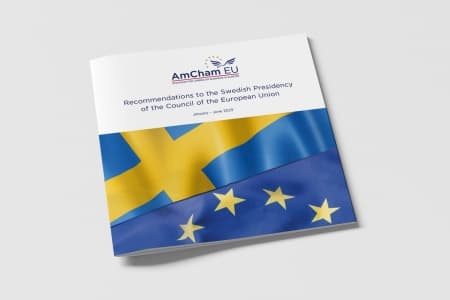
On 1 January 2023, Sweden took over the rotating Presidency of the Council of the European Union, which comes at a difficult time for the EU and the world. The volatility of the external environment is a serious concern for American companies in Europe, alongside the war in Ukraine, the energy and food crises, staggering inflation levels and the disruption of global supply chains. TheSwedish Presidencytakes on a critical task in supporting the development of an outward-looking industrial strategy in Europe, one that relies on the twin digital and green transitions.
Recommendations to the Swedish Presidency
On 1 January 2023, Sweden took over the rotating Presidency of the Council of the European Union, which comes at a difficult time for the EU and the world. The volatility of the external environment is a serious concern for American companies in Europe, alongside the war in Ukraine, the energy and food crises, staggering inflation levels and the disruption of global supply chains. TheSwedish Presidencytakes on a critical task in supporting the development of an outward-looking industrial strategy in Europe, one that relies on the twin digital and green transitions.

Our recommendations to the Swedish Presidency aim to raise issues that are vital to shaping a strong and competitive EU and provide concrete input and direction to the Presidency’s work programme over the coming six months.
AmCham EU looks forward to working closely with Sweden during its Presidency to ensure we reach our common objectives of a strong, green and digital economic recovery.
Related items
Industry coalition calls for Internal market legal basis in the Circular Economy Act
Together with industry associations representing a wide range of sectors, AmCham EU has signed a joint statement calling for the upcoming Circular Economy Act to be grounded in an internal market legal basis. The statement highlights the need for harmonised EU rules to address fragmentation in waste management systems across Member States and support the development of a functioning Single Market for secondary raw materials. It also underlines the importance of a consistent EU framework to strengthen circularity, improve waste management performance and support investment in recycling and resource efficiency.
:focal())
Closing the skills gap to restore Europe’s competitiveness
On Tuesday, 24 February, AmCham EU hosted Stefan Olsson, Deputy Director-General, Jobs, Skills and Social Policies, Directorate-General for Employment, Social Affairs and Inclusion, European Commission to discuss how closing the skills gap can strengthen Europe’s competitiveness. As shortages across sectors continue to affect productivity, investment and innovation, participants reflected on progress one year after the launch of the Union of Skills and the importance of sustained public-private cooperation. The discussion explored how Europe can build a future-ready workforce to support the green and digital transitions while addressing labour market mismatches. Aurelia Takacs (Cisco), Chair, Social Impact, Inclusion and Skills Committee, AmCham EU moderated the discussion and examined practical policy solutions to strengthen skills development, improve labour market alignment and support inclusive economic growth.
:focal())
Four years since Russia’s invasion, American business in Europe stands firmly behind Ukraine
Four years ago, Russia launched a full-scale invasion of Ukraine. On the anniversary of the invasion, the American Chamber of Commerce to the EU (AmCham EU) reiterates its condemnation of Russia’s aggression. It is a breach of international law and an assault on the values we stand for. The Ukrainian people have continued to demonstrate commendable bravery in the face of adversity and a growing humanitarian crisis.
American companies in Europe remain steadfast in their support for Ukraine’s sovereignty and are committed to the country’s reconstruction and recovery, underpinned by closer integration with the EU. Once peace is secured, the scale of the task ahead will be immense. Recent estimates from the World Bank put the cost of reconstruction and recovery at $588 billion over the next decade, underscoring both the urgency of action and the need to mobilise investment at unprecedented levels.
In the past year, policymakers on both sides of the Atlantic have launched initiatives to encourage security and future prosperity in Ukraine, not least the Ukraine Support Loan, the US-Ukraine Reconstruction Investment Fund and the Flagship European Fund for the Reconstruction of Ukraine. American businesses stand ready to support the success of these efforts, which can only fully achieve their objectives with long-term security and stability in Ukraine.
Policy priorities
Insights and advocacy driving Europe’s policy agenda. Our priorities support growth, innovation and a stronger transatlantic economy.
Membership
Connecting business and policymakers to strengthen the voice of American companies in Europe.