Rebooting the transatlantic economy: webinar

On Wednesday, 14 October over 65 participants tuned in for AmCham EU’s webinar on the impact of the COVID-19 pandemic on the transatlantic economy and paving the way to recovery with Joseph P. Quinlan, Senior Fellow, Transatlantic Leadership Network who outlined the key findings from his newly published report on ‘Rebooting the transatlantic economy’.

News
14 Oct 2020
Transatlantic
Rebooting the transatlantic economy: webinar

In his remarks, Mr Quinlan talked of the ‘perfect storm’ that has landed on the transatlantic economic partnership, with the pandemic still prevailing, an economic downturn of historic proportions, and the tense geopolitical context. However, in spite of this, growth is starting to pick back up, and policymakers have laid the foundation for recovery into 2021. He outlined numerous challenges and opportunities for the transatlantic partnership, including the rise of China, the trend towards ‘deglobalisation’, and the acceleration towards the digital transformation.

A question and answer session followed, led by Taggart Davies, Chair, Transatlantic Task Force, AmCham EU. Fielding a question on open strategic autonomy, Mr Quinlan pointed out that he felt a stronger, less dependent EU would be a more attractive prospect for American investment. With regard to the rise of China, Mr Quinlan suggested that the US and the EU must cooperate to try to bring China into the fold of multilateralism. With regard to Wall Street’s feeling about the European investment climate, Mr Quinlan pointed to the euro’s relative strengthening against the dollar to highlight that investors had been impressed with EU policymakers’ swift and decisive actions to issue mutual debt and to act as one.

For more information on a stronger transatlantic relationship, read our set of recommendations published this week.

Related items

News
12 Nov 2026

Keeping Europe open and competitive with our Executive Council

Predictability in EU-US relations and Europe’s competitiveness agenda, from simplification to European preference, were centre stage during our Executive Council Fall Plenary on Monday, 9 and Tuesday, 10 November. Our senior business leaders met with EU, US, Canadian and Member State policymakers, as well as industry and think-tank leaders, to discuss the pressures shaping investment decisions in Europe.

The group engaged with the following: Nerijus Aleksiejūnas, Permanent Representative of Lithuania to the European Union; Enrico Letta, President of the Jacques Delors Institute; Roxana Mînzatu, Executive Vice-President for Social Rights and Skills, Quality Jobs and Preparedness, European Commission; Andrew Puzder, Ambassador of the United States to the European Union; Jessika Roswall, European Commissioner for Environment, Water Resilience and a Competitive Circular Economy; Sir Jonathan Symonds, President of the European Round Table for Industry and Chair of GSK and Jonathan Wilkinson, Ambassador of Canada to the European Union. 

Throughout the two days, exchanges explored how to maintain momentum on Single Market integration, deliver meaningful regulatory simplification and strengthen the role of industry in developing skills and creating quality jobs. Discussions also touched on the changing international trade landscape, the importance of EU-US cooperation and the priorities that will shape the upcoming Lithuanian Presidency of the Council of the EU.

Learn more about our Executive Council here. 

Simplification
Transatlantic
Read more
Read more about Keeping Europe open and competitive with our Executive Council
News
9 Nov 2026

Discussing EU-US trade after the midterms with KAS and BDI

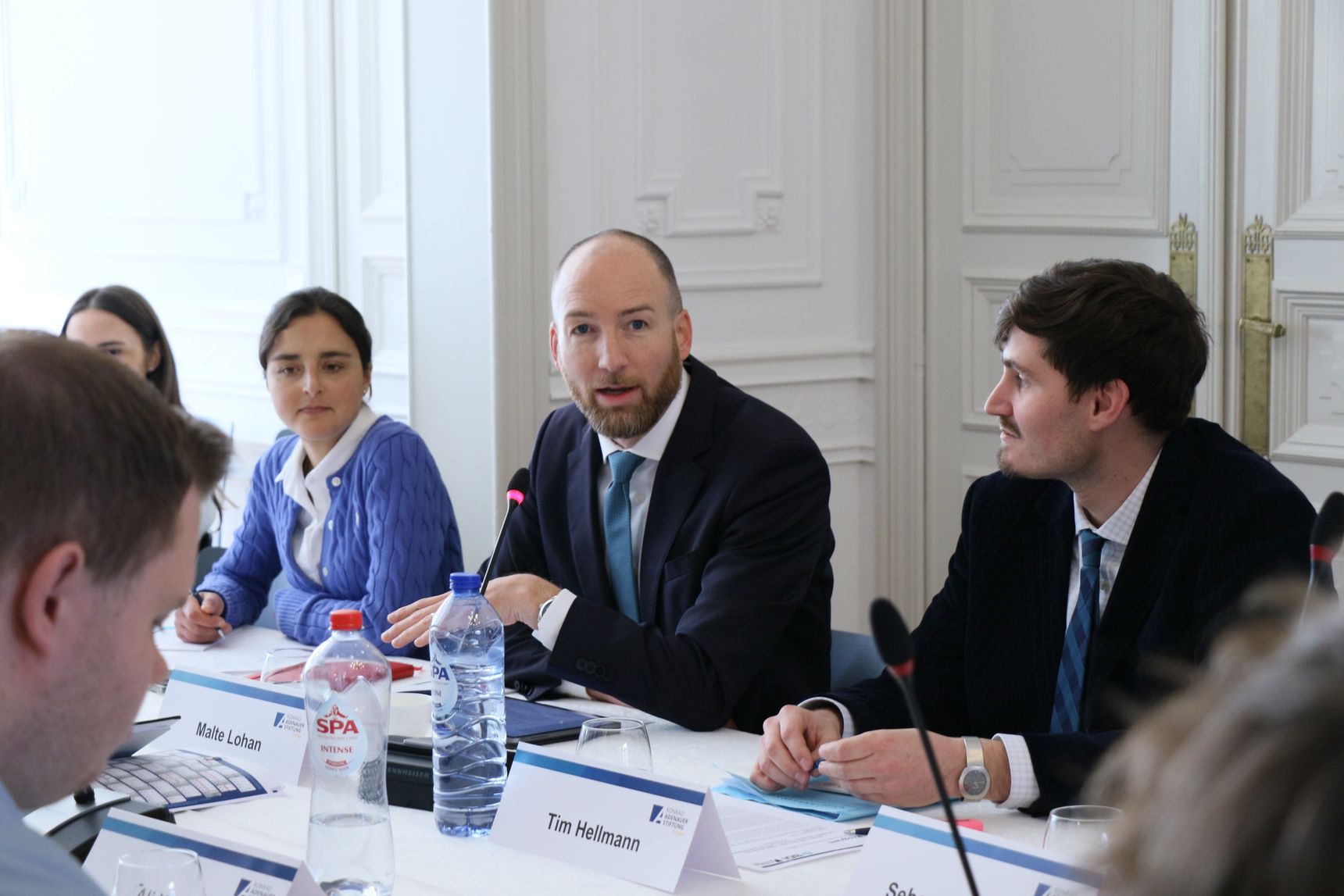
On Thursday, 5 November, Malte Lohan, CEO, AmCham EU, spoke at a discussion hosted by Konrad-Adenauer-Stiftung Europe and the Federation of German Industries (BDI) on EU-US trade relations after the US midterms. Mr Lohan stressed that elections change the conversation, though not necessarily the outcomes. While the midterms shift power on Capitol Hill, he was not sure this would extend to transatlantic relations, certainly not in the short term. He noted the Turnberry Agreement has brought much-needed predictability, but the relationship remains volatile, with flashpoints ahead that could put stability at risk. The agreement should be solidified and built on, with a move from strategic autonomy to strategic complementarity that will resonate in Washington. Exploring new avenues for partnering where interests align is worthwhile for a $9.8 trillion relationship that employs over 16 million people on both sides of the Atlantic. Learn more about the latest EU-US trade developments in the Transatlantic Economy Pulse.

Transatlantic
Read more
Read more about Discussing EU-US trade after the midterms with KAS and BDI
Publication
23 Oct 2026

The Transatlantic Economy Pulse 2026

How are companies adjusting to an evolving transatlantic trade environment? In a year so far marked by geopolitical tensions and economic uncertainty, The Transatlantic Economy Pulse identifies trade and investment trends between Europe and the US in the first half of 2026.

Transatlantic
Read more
Read more about The Transatlantic Economy Pulse 2026