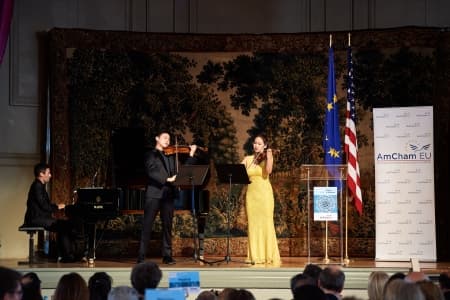
The Queen Elisabeth Competition has been active since 1937 as one of the main music competitions of world-renowned importance. Only WWII had imposed a pause to the event prior to the COVID-19 postponement of the 2020 edition. The competition is relying mainly on private donations and needs financial support more than ever to go through this exceptional ordeal. Donations are vital and will make it possible for the Queen Elisabeth Competition to organise an outstanding and awaited piano edition next year, maintaining its standard of excellence.
Queen Elisabeth Competition donations
The Queen Elisabeth Competition has been active since 1937 as one of the main music competitions of world-renowned importance. Only WWII had imposed a pause to the event prior to the COVID-19 postponement of the 2020 edition. The competition is relying mainly on private donations and needs financial support more than ever to go through this exceptional ordeal. Donations are vital and will make it possible for the Queen Elisabeth Competition to organise an outstanding and awaited piano edition next year, maintaining its standard of excellence.

AmCham EU is a long-standing supporter and a partner of the Queen Elisabeth Competition. This year, following the cancellation of our annual Gala and to express our support for the Arts in these exceptional circumstances, AmCham EU has decided to make a donation to the Queen Elisabeth Competition. Should you wish to contribute as well please click here. Donations are tax-deductible. For all details please visit the Queen Elisabeth Competition website.
For your donation to be used towards the participation of US candidates and jury members in the 2021 competition, add ‘AmCham EU’ in the payment description.
You can also keep up with the Queen Elisabeth Competition by taking a look at their summer virtual events including Flagey on Air and Sessions d'été de Tempo.
Related items
:focal())
FSR compliance: complexity undermining competitiveness
The EU proposed the Foreign Subsidies Regulation (FSR) in 2021 to address foreign subsidies distorting the Single Market. Operating as a screening instrument behind merger control, it requires companies to notify the European Commission of foreign financial contributions (FFCs) they may receive when participating in public procurement or mergers and acquisitions activity. Preventing FFCs from distorting the Single Market is an important goal – and one that must be achieved without creating its own disruptions.
:focal())
One year on from ‘Liberation Day’, the transatlantic economy still stands strong – but it needs stability
Authored by Malte Lohan, CEO, AmCham EU
:focal())
Discussing competitiveness in the agri-food sector in Barcelona
At the Alimentaria Conference in Barcelona, Edouard Coppieters, Senior Policy Adviser, AmCham EU, spoke about placing competitiveness at the centre of the European agri-food ecosystem. Taking place on Tuesday, 24 March, he outlined the role of simplification and Better Regulation principles in ensuring a stable agri-food supply chain and supporting the sector’s competitiveness. He noted that the sector operates within an international trade environment and that stakeholders across the value chain face challenges in adapting to the current legislative framework. He emphasised the need to simplify operations within the Single Market and ensure that legislation is fit for purpose rather than a box-ticking exercise. Aurélie Dufour, Europe Sustainability Engagement and Regulation Lead, Yum! Brands and Dirk Jacobs, Director-General, FoodDrinkEurope also joined the panel.
Policy priorities
Insights and advocacy driving Europe’s policy agenda. Our priorities support growth, innovation and a stronger transatlantic economy.
Membership
Connecting business and policymakers to strengthen the voice of American companies in Europe.