Pulling together today for the circular economy of tomorrow

Susan Danger, CEO, AmCham EU wrote an opinion piece on the circular economy last week. Susan makes the case for Europe’s transition to a circular economy and notes that such a change is compelling for the EU's leaders, its citizens, and in many respects for businesses. According to her, potential opportunities include: 'reduced pressures on the environment, as better waste management would imply both reduced use of resources such as energy, water, land and materials, and reduced emissions of greenhouse gases.


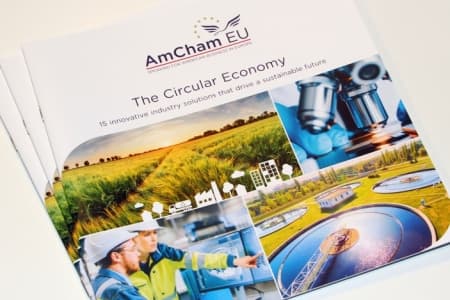
It would also mitigate the risks associated with the supply of raw materials, such as price volatility, availability and import dependency.' You can read the full piece here and for more details on AmCham EU’s member companies' actions towards sustainability, see our brochure ‘The Circular Economy: 15 innovative industry solutions that drive a sustainable future’

News
14 Jun 2020
Environment
Pulling together today for the circular economy of tomorrow

Susan Danger, CEO, AmCham EU wrote an opinion piece on the circular economy last week. Susan makes the case for Europe’s transition to a circular economy and notes that such a change is compelling for the EU's leaders, its citizens, and in many respects for businesses. According to her, potential opportunities include: 'reduced pressures on the environment, as better waste management would imply both reduced use of resources such as energy, water, land and materials, and reduced emissions of greenhouse gases.


It would also mitigate the risks associated with the supply of raw materials, such as price volatility, availability and import dependency.' You can read the full piece here and for more details on AmCham EU’s member companies' actions towards sustainability, see our brochure ‘The Circular Economy: 15 innovative industry solutions that drive a sustainable future’


Susan also highlighted that the transition to a circular economy has a number of challenges namely a lack of price signals which encourage efficient resource reuse and incentivise circular business practices as well as the upfront costs of this transition, such as building up new business models and partnerships, making large R&D investment, financing and upgrading infrastructure. 


For an in depth discussion on the subject, you can access the audio recording of our online event on 'Reflections on Europe’s circular economy and what comes next', where we welcomed Marius Vašcega, Head of Cabinet to Commissioner Virginijus Sinkevicius, European Commission as a guest speaker. The event was an opportunity to discuss the European Commission’s objectives with regard to the Circular Economy Action Plan.

Related items

News
29 Apr 2026

Revision of the Classification, Labelling and Packaging Regulation: Following a balanced Report, trilogues must secure simplification

Today, the European Parliament adopted its Omnibus VI report, including the revision of the Classification, Labelling and Packaging (CLP) Regulation, by 540 votes to 60. The outcome supports a more streamlined framework by easing the regulatory burden on value chains that rely on chemicals and sending a positive signal of the EU’s commitment to reducing unnecessary complexity.

With the Council’s position agreed in November 2025, the Parliament’s report marks the final step before trilogues, which will conclude negotiations on the targeted revision of the CLP Regulation.

The report largely aligns with the Commission’s simplification agenda and strengthens the CLP Regulation’s overall workability, especially with regards to:

  • Transition periods, setting 18 months following classification updates and allowing digital contact information to be updated on the label in line with suppliers’ regular update cycles. This better reflects supply chain realities.

  • Advertising and distance sales requirements, appropriately excluding business-to-business settings while ensuring consumers remain protected; and

  • Label legibility requirements, with more proportionate minimum font sizes and rules on background contrast, spacing and overall layout. However, further simplification is still needed to ensure sufficient flexibility for businesses.

While the report represents a constructive step forward, trilogues should address remaining constraints and clarify language that is currently difficult to interpret, including further simplification on font sizes and advertising requirements in business-to-consumer settings. These negotiations should draw on the more proportionate approaches of the Commission and the Council.

Maintaining a strong focus on simplification will be key to further alleviating administrative burdens and strengthening the EU’s resilience and competitiveness.

Environment
Read more
Read more about Revision of the Classification, Labelling and Packaging Regulation: Following a balanced Report, trilogues must secure simplification
Position Paper
29 Apr 2026

Simplifying the Classification, Labelling and Packaging Regulation: recommendations for trilogues

On 8 July 2025, the Commission presented the Omnibus VI simplification package, reopening key legislation such as the CLP Regulation, which entered into force in December 2024. The Omnibus addresses overlaps and inconsistencies that create practical challenges and, in some cases, make compliance unworkable.


Upcoming trilogues can streamline the framework and reduce unnecessary burdens. This paper sets out targeted recommendations on the positions that can achieve meaningful simplification during the inter-institutional negotiations.

Environment
Read more
Read more about Simplifying the Classification, Labelling and Packaging Regulation: recommendations for trilogues
News
20 Apr 2026

Discussing environment policy priorities with policymakers in Finland

From Monday, 13 to Wednesday, 15 April, AmCham EU travelled to Helsinki for a series of meetings with Finnish stakeholders on the future of EU environment policy. In discussions with representatives from the Finnish Ministry of Economic Affairs and Employment, the Ministry of the Environment, the European Chemicals Agency and Members of the Finnish Parliament, the delegation examined how the EU can pursue its environmental objectives and support competitiveness by delivering long-term simplification in environmental policies.

Across the meetings, one theme was evident. Europe’s environmental legislation must be more coherent and efficient across the Single Market. Members emphasised that simplification is not about lowering standards, but about avoiding unnecessary complexity while preserving a high level of environmental and human health protection and building the business case for investment in sustainable frameworks such as Circular Economy. As the EU takes forward its next environment policy initiatives, the priority should be a framework that combines ambition with legal certainty, supports investment and delivers practical outcomes across Europe.

Environment
Read more
Read more about Discussing environment policy priorities with policymakers in Finland