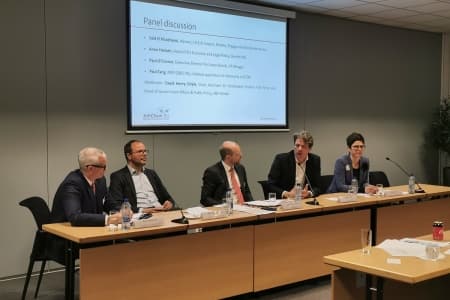
On Tuesday, 28 January 2020, AmCham EU hosted a plenary meeting organised by the Sustainable Finance Task Force. The debate took stock of the main developments in sustainable finance policy, most importantly the negotiations on the taxonomy file. The panel discussed, among others, issues related to just transition, the Green Deal as well as climate diplomacy.
The path ahead for corporate disclosure and green finance in the EU
On Tuesday, 28 January 2020, AmCham EU hosted a plenary meeting organised by the Sustainable Finance Task Force. The debate took stock of the main developments in sustainable finance policy, most importantly the negotiations on the taxonomy file. The panel discussed, among others, issues related to just transition, the Green Deal as well as climate diplomacy.

In his keynote address, Martin Spolc, Head of Unit for sustainable finance, DG FISMA, European Commission, emphasised the role of consultations with all sectors of the industry going forward and agreed that AmCham EU's three key principles (1) regulatory certainty and economic stability, (2) evidence-based policy, (3) international openness, should remain at the core of policy-makers' thinking.
The meeting also included a panel discussion featuring:
Saïd El Khadraoui, Adviser, I.D.E.A. Inspire, Debate, Engage and Accelerate Action (former EPSC)
Anne Hansen, Head of EU Economic and Legal Policy, Daimler AG
Paul O'Connor, Executive Director for Green Bonds, J.P. Morgan
Paul Tang, MEP (S&D, NL), shadow rapporteur on Taxonomy in ECON
The event was moderated by David Henry Doyle, Chair, AmCham EU Sustainable Task Force and Head of Government Affairs & Public Policy, S&P Global.
For more information, please contact Francesca Risso (FRI@amchameu.eu).
Related items
:focal())
Omnibus I: the EU shows it can deliver on simplification, but global firms need further certainty
The Omnibus I political agreement announced yesterday broadly eases the sustainability compliance and due diligence burden for businesses under the Corporate Sustainability Due Diligence Directive (CSDDD) and the Corporate Sustainability Reporting Directive (CSRD), giving much-needed certainty to businesses. It is a significant achievement for the EU’s simplification agenda and ongoing efforts to reduce the regulatory burden. Specifically, the flexibility introduced in terms of the risk-based approach and how companies need to define adverse impacts will alleviate most of the excessive burden that existed under the original CSDDD. The revised transposition timeline of CSDDD to 2029 will also give all parties the necessary time to prepare for implementation.
However, it appears that EU policymakers did not yet sufficiently tackle how these rules apply to the global activities of companies and groups – for example, by limiting the scope of the CSDDD to only those products and services with a logical link to the EU. This is a missed opportunity with far-reaching consequences that keeps legal uncertainty in place for global firms and their supply chains. This oversight on extraterritorial impact will make the CSDDD more difficult for policymakers to implement and monitor and risks creating confusing overlap with other jurisdictions’ rules.
The EU must use the next steps in the policy-making process – including implementing measures, guidance and future reviews – to fix outstanding challenges in both the CSDDD and the CSRD. In particular, clearer rules on when and how EU legislation impacts global business activities would give companies the predictability they need to invest and support sustainability investments.
:focal())
Omnibus I: Parliament delivers critical simplification yet overlooks extraterritorial impact
The European Parliament’s adoption of its negotiating position on the Omnibus I package marks a major milestone towards a simpler, more consistent and workable sustainability reporting and due diligence framework for companies operating across the Single Market. The final text, however, fails to reflect the concerns of third-country stakeholders and international businesses over extraterritorial effects.
The framework’s implementation risks creating legal uncertainty for global businesses and conflicts of law in different jurisdictions, thereby undermining the diversification of supply chains and chilling investment in the EU. Limiting the scope of the initiatives to an EU Nexus – in other words, making them apply only to those global supply chains directly linked to the EU market – will be critical to achieving sustainability and competitiveness goals.
The Omnibus I is part of a wider agenda dedicated to improving the competitiveness of the EU’s economy. The Draghi report clearly outlined the pressing urgency of addressing Europe’s competitiveness challenges as a precondition for the EU realising its wider strategic objectives. Europe must act urgently to strengthen its economy and this can only work with ambitious simplification efforts. This imperative should transcend party political lines.
As the Omnibus I now enters into trilogue discussions, policymakers must secure a strong mandate to improve the EU’s business environment.
:focal())
Keeping simplification on track
While the European Parliament’s decision to return the first simplification package on the CSDDD and the CSRD to plenary introduces further delays for Europe’s sustainability agenda, recent progress in Omnibus I reflects meaningful steps toward a more proportionate framework. Yet major concerns remain unresolved, as set out in our reaction to the report adopted by the JURI Committee. The extraterritorial reach of both directives risks creating conflicting legal obligations for companies with international footprints. This is not only a matter for US-based companies, but for all businesses with international footprints that may be subject to overlapping or conflicting legal obligations in jurisdictions outside the EU. Read more in the recommendations we’ve set out on what remains to be done if the EU wants to make these frameworks effective and workable for all.
Policy priorities
Insights and advocacy driving Europe’s policy agenda. Our priorities support growth, innovation and a stronger transatlantic economy.
Membership
Connecting business and policymakers to strengthen the voice of American companies in Europe.