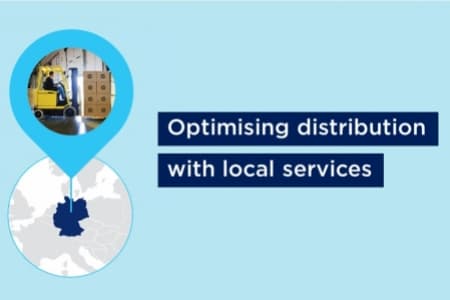
HP Inc. is a multinational information technology company that develops personal computers, printers and 3D printing solutions. Distribution centres located in Germany serve as the epicentre of the company’s European operations, with finished products arriving from its international factories, ready for shipment. Read how HP Inc.'s parterships with local businesses encourage the development of innovative solutions to specific problems.
Optimising distribution with local services
HP Inc. is a multinational information technology company that develops personal computers, printers and 3D printing solutions. Distribution centres located in Germany serve as the epicentre of the company’s European operations, with finished products arriving from its international factories, ready for shipment. Read how HP Inc.'s parterships with local businesses encourage the development of innovative solutions to specific problems.

HP Inc. contracts three distribution partners in Germany. Among these, one is a local distribution company, by the name of LGI. LGI has been working with HP Inc. for 20 years, since it was founded as a spin-off from the company itself. Originally, HP Inc. was LGI’s only customer, but nowadays the company accounts for 20% of LGI’s custom. LGI employs 300-500 people for HP Inc.-related activity. They run one of HP Inc.’s German distribution centres – operating the warehouse, providing storage solutions, packaging products, loading them into trucks and shipping them to their destination. LGI also manages inventory and returns on behalf of HP Inc.
For local suppliers, working with HP Inc. is advantageous because it provides an opportunity to find innovative solutions to specific problems. Smaller local suppliers are often more capable of providing niche services than global competitors. For example, in order to manage its logistics activity, HP Inc. enlisted the services of a local partner, which was able to offer HP Inc. a specific optimisation tool to match its particular needs. The service offering was customised to HP Inc.’s use-case to such a degree that no other global supplier on the market could rival the service.
Thanks to local suppliers, HP Inc. benefits from flexibility gains. By outsourcing, the company can reduce sunk costs in warehousing infrastructure and resources. HP Inc. can therefore focus its resources on its core competency of producing its bestin-class technology hardware.
Acknowledgement: Volker Schmitz, Global Head of Markets Supply Chain Operations
The success story of global trade lies in strong partnerships between companies of all sizes. Find out more about European ecosystems connecting small businesses with larger American companies.
Related items
:focal())
Discussing transatlantic trade with US Trade Representative Bryant Trick
On Monday, 9 February, AmCham EU met with Bryant Trick, Assistant United States Trade Representative, Europe and the Middle East. Malte Lohan, CEO and Liam Benham, Chair, opened the meeting by setting the context for the discussion and highlighting the need for transatlantic engagement at a challenging time. As efforts continue to implement the EU–US framework agreement and move forward in a constructive manner, the exchange provided an important opportunity for open dialogue.
:focal())
Increasing certainty around the €150 customs duty de minimis threshold
The Commission’s proposed transitional rules to anticipate the removal of the €150 customs duty threshold risk creating distortions and unnecessary complexity. As discussed at the Trade Contact Group in January 2026, the current approach could undermine simplification efforts and lead to an uneven playing field between businesses involved in low-value distance sales.
Co-legislators should consider targeted changes to address these risks. In particular, the temporary €3 duty and the use of the H7 simplified customs declarations should apply consistently to all distance sales below €150. H7 data requirements for simplified procedures should also remain proportionate and not exceed those of the standard H1 dataset. Finally, changes to the definition of the customs declarant should be avoided where they may create legal uncertainty or increase fraud and liability risks.
Find out more about why a proportionate and legally sound approach is essential for a workable de minimis transition.
:focal())
Full speed to net zero
The transport sector accounts for around a quarter of the EU’s total greenhouse gas emissions, with road transport responsible for the majority. As a company dependent on efficient logistics, Amazon is taking concrete steps to decarbonise its operations and support Europe’s climate ambitions. Across several Member States, the company is expanding its fleet of zero-exhaust emission vehicles, investing in electric trucks and delivering packages by lower-emission rail freight. These initiatives demonstrate how innovation in transport can combine operational efficiency with environmental responsibility. Read the full story on Invested in Europe.
Policy priorities
Insights and advocacy driving Europe’s policy agenda. Our priorities support growth, innovation and a stronger transatlantic economy.
Membership
Connecting business and policymakers to strengthen the voice of American companies in Europe.