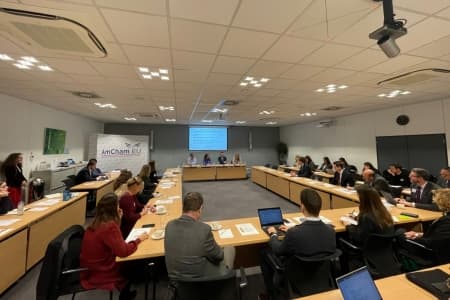
During the panel discussion members heard from Sabine Frank, Executive Director, Carbon Market Watch; Hélène Lavray, Government Affairs Leader EU-Energy and Climate, Dow; Per Stånge, Policy Adviser, Working Group Economy and Environment (ENVI), EPP. The panel was moderated by Tim Figures, Associate Director EU and Global Trade and Investment, Boston Consulting Group.
Keeping Europe green
On Tuesday, 28 February AmCham EU hosted a discussion on the Carbon Border Adjustment Mechanism (CBAM) and the need for a committed US industry in Europe to help keep both sides of the Atlantic clean for future generations. Among the speakers was Gerassimos Thomas, Director-General, Directorate-General for Taxation and Customs Union (TAXUD), European Commission who spoke over a seated luncheon. With the transition period for CBAM beginning in October 2023 it’s important that businesses have a clear environmental plan going forward. Read how Europe can go green while retaining global competitiveness.
Related items
:focal())
Publication
23 Oct 2026
The Transatlantic Economy Pulse 2026
How are companies adjusting to an evolving transatlantic trade environment? In a year so far marked by geopolitical tensions and economic uncertainty, The Transatlantic Economy Pulse identifies trade and investment trends between Europe and the US in the first half of 2026.
:focal())
Position Paper
22 Oct 2026
Industry calls for repeal of the SCIP database
AmCham EU has joined over 30 industry associations in calling on EU co-legislators to confirm the repeal of the Substances of Concern In articles as such or in complex objects (Products) (SCIP) database, as proposed in the Environmental Omnibus. SCIP costs companies around €225 million a year, yet its intended users, recyclers, barely use it. The Commission itself acknowledges that waste operators find the data unusable and most companies lack the resources to maintain millions of notifications. Repeal would remove a disproportionate reporting layer while keeping obligations for suppliers to inform customers about substances of very high concern. Any future approach should build on existing obligations, not add new ones.
:focal())
News
21 Oct 2026
Building fairer food supply chains
On Wednesday, 21 October, AmCham EU met with Pierre Bascou, Director for Sustainability and Income Support, Directorate-General for Agriculture and Rural Development, European Commission, to discuss the revision of the EU’s Unfair Trading Practices (UTP) Directive. The exchange focused on removing existing thresholds, expanding the list of prohibited practices and strengthening protection for those reporting unfair trading practices. Edouard Coppieters, Senior Policy Adviser and Kim Watts, Policy Director, AmCham EU highlighted that companies of all sizes can face unfair trading practices. Across the agri-food supply chain, operators often contend with price volatility and legal pressure, particularly where bargaining power is unequal. The revision presents an opportunity to address these imbalances, strengthen protections and ensure a level playing field for all actors across the food supply chain.
Policy priorities
Insights and advocacy driving Europe’s policy agenda. Our priorities support growth, innovation and a stronger transatlantic economy.
Membership
Connecting business and policymakers to strengthen the voice of American companies in Europe.