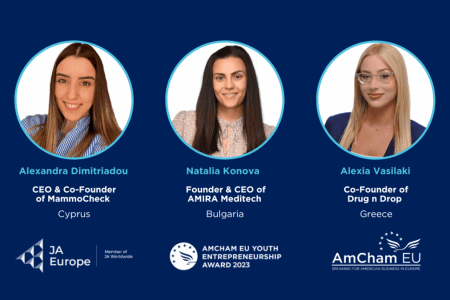
Introducing the Youth Entrepreneurship Award finalists

With the EU celebrating the European Year of Skills, AmCham EU and JA Europe are pleased to announce the three finalists for the Youth Entrepreneurship Award 2023. The award, now in its 11th edition, recognises young people’s entrepreneurial spirit and aims to foster innovation in Europe. The finalists were selected from a pool of applicants from all over Europe. The winner will be selected by a high-level jury and announced on Wednesday, 28 June at AmCham EU’s Galaevening. 

News
13 Jun 2023
Introducing the Youth Entrepreneurship Award finalists

The three outstanding finalists are: 

MammoCheck

Entrepreneur: Alexandra Dimitriadou

Country of origin: Cyprus

With MammoCheck, women have a revolutionary tool for early detection of breast cancer in the palm of their hands. Advanced thermography technology combined with artificial intelligence allows women to proactively monitor and detect changes in their breast tissue, leading to better health outcomes and a higher quality of life. With a camera added to one’s phone, anyone can perform painless and accurate breast examinations, giving them the knowledge and awareness, they need to take control of their health.  

Alexandra Dimitriadou is the Chief Executive Officer and Co-founder of MammoCheck.  


AMIRA Meditech

Entrepreneur: Natalia Konova

Country of origin: Bulgaria

To fight antimicrobial resistance, AMIRA has developed a software solution to optimise antibiotic prescriptions in hospitals. By monitoring and controlling antibiotic usage, AMIRA helps doctors save time and decreases hospitals' resources. Through one-of-a-kind prediction models and more quickly adapting to the guidelines for treating infections, AMIRA seeks to preserve the effectiveness of antibiotics and save millions of lives. The algorithm is based on latest European and national guidelines for treating infections, as well as the legal documents of the antibiotics and each hospital's unique antibiotic resistance. 

Chief Executive Officer and Co-founder Natalia Konova is a clinical pharmacologist at the Alexandrovska Hospital in Sofia, Bulgaria. She is also currently undertaking a PhD in improving the effectiveness and safety of antibiotics in hospital settings from Sofia’s Medical University’s Department of Pharmacology and Toxicology. 


Drug n Drop 

Entrepreneur: Alexia Vasilaki

Country of origin: Greece

Drug n Drop reports and communicates about pharmaceutical waste data along the supply chain to minimise medicinal waste. Through a complete smart system including hardware and software, Drug n Drop aims to optimise the production and management of medicine while managing the environmental and social issues caused by wasted medicines. It is able to produce reports and communicate them to all stakeholders of the pharmaceutical value chain. 

Alexia Vasilaki is Co-founder and Chief Technology Officer of Drug n Drop and is executive assistant to the Chief Executive Officer at Junior Achievement Europe.   


Join the conversation on social using #YEA2023

Related items

News
5 Jun 2026

Celebrating Gala 2026

Updates
Read more
Read more about Celebrating Gala 2026
News
5 Jun 2026

Maltese start-up Medilert wins AmCham EU Youth Entrepreneurship Award 2026

Social impact, inclusion and skills
Read more
Read more about Maltese start-up Medilert wins AmCham EU Youth Entrepreneurship Award 2026
News
5 Jun 2026

Tech Sovereignty Package: positive steps for energy resilience, but a risky gamble for digital competitiveness

This week the European Commission unveiled its Tech Sovereignty Package. While the Package’s energy proposals mark a significant step forward for EU energy resilience, the Cloud and AI Development Act (CADA) proposal overlooks the reality of global technology supply chains and introduces significant legal uncertainty and fragmentation for businesses.

The central question for the Tech Sovereignty Package is how to build resilience without undermining competitiveness. Concerns around overdependence on a limited number of providers, the risk of external disruption to service continuity and the long-term position of the EU’s digital industries are all legitimate. However, greater sovereignty will only be sustainable if it is built on a competitive, diverse and innovative digital ecosystem. The technologies that underpin the global digital economy are developed through highly international supply chains, with innovation spread across multiple markets.

Viewed through this lens, the individual proposals in the Package vary in the extent to which they reinforce resilience while preserving openness and competitiveness. In particular, the proposed CADA risks discriminating against providers that rely on global supply chains – both those based in Europe and those in third countries – even where they offer superior resilience.

‘An origin-based approach is too blunt for such a complex global market’, said Malte Lohan, CEO of the American Chamber of Commerce to the European Union, commenting on the Package.

‘A more credible path to achieving greater resilience and control in such an interconnected landscape is to define sovereignty in terms of outcomes: secure and reliable technologies, customer choice, strong safeguards against undue interference and a business environment that supports investment and growth. That points to a risk-based framework where the EU is open to working with trusted partners. This trust should be assessed on the basis of objective standards rather than origin alone’, Mr Lohan added.

Last year alone, US technology firms operating in Europe and their supply chains supported €1.0 trillion in EU GDP, equivalent to 5.4% of total output. The scale of this contribution underscores the need for the EU to preserve an open environment with legal clarity and proportionality in any restrictions or safeguards that would impact commercial operations.

The Package’s Strategic Roadmap for Digitalisation and AI in energy is a positive step that could help unlock the benefits of digitalisation for Europe’s energy needs, enabling faster and more flexible grids. Digitalisation provides new opportunities to strengthen the reliability and resilience of energy systems. If executed well, the roadmap could support the growing demand of Europe’s digital and AI sectors for low-carbon energy.

Ultimately, the importance of the Tech Sovereignty Package extends well beyond the technology sector itself. Manufacturers, healthcare and life sciences, financial services, mobility, energy and retail all increasingly depend on access to advanced digital technologies to innovate and compete. For the Tech Sovereignty Package to support these sectors, it must ensure companies in Europe continue to benefit from economic openness.

Digital
Read more
Read more about Tech Sovereignty Package: positive steps for energy resilience, but a risky gamble for digital competitiveness