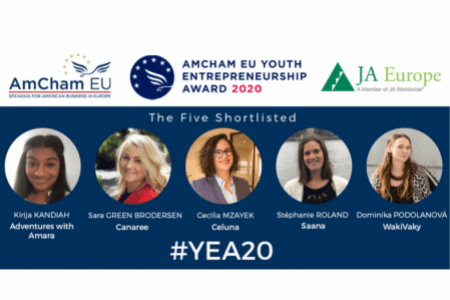
Finalists selected for the AmCham EU Youth Entrepreneurship Award 2020

AmCham EU and Junior Achievement Europe (JA Europe) are delighted to announce the finalists of the 2020 Youth Entrepreneurship Award. Candidates from across Europe were in the running for the award after participating in a JA Europe programme, making it past the initial start-up phase and creating a business concept that showed potential. The theme this year focused on female entrepreneurship.


The shortlisted start-ups pitched their companies to a high-level jury panel during an online finale on Thursday, 11 June


The five outstanding finalists are Kirija KandiahSara Green BrodersenCécilia MzayekStéphanie Roland and Dominika Podolanová

News
9 Jun 2020
Finalists selected for the AmCham EU Youth Entrepreneurship Award 2020


Adventures with Amara  

Entrepreneur: Kirija Kandiah
Country of origin: United Kingdom

Adventures with Amara - is a collection of children's books which explain complex social issues in a simple way with added digital elements. They are a team of 16 young girls who started off as a Young Enterprise team. After being regional winners, as well as winning an award for education innovation at the Global Youth Awards, they decided to pursue their business endeavours further. As a team they made a collection of three children’s books intended to be entertaining, but also dealing with complex issues, which are prevalent in society today.

Canaree

Entrepreneur: Sara Green Brodersen

Country of origin: Denmark

Canaree is a SaaS platform helping early-stage businesses understand and improve their future finances. The vision is to empower more pre-CFO start-ups to grow into great businesses. The USP is combining affordable advice and instant insights, removing the cost of using financial advisors and making it more helpful than Excel. Ultimately this will be how every company improves the viability of its business. The team combines deep knowledge of corporate finance and vast experience in building technology businesses.

Celuna/Time Ninja  

Entrepreneur: Cecilia Mzayek
Country of origin: Malta

Most students have three difficulties when it comes to their studies: they find it difficult to stay focused, stay motivated and manage their time. TimeNinja is a mobile application that tackles those problems by developing a solution that uses:  time boxing - by dividing their time into short bursts of distraction-free studying; gamification - by incorporating game elements such as points, ranks and badges to the app; artificial intelligence will be used to create personalised, dynamic study timetables that adapt to the student's individual study patterns. 

Saana  

Entrepreneur: Stéphanie Roland
Country of origin: Belgium

Today, up to 80% of cancer patients suffer from unaddressed and undiagnosed malnutrition, which endangers their quality of life, treatment follow-up and chances of remission. Saana aims to improve cancer patients' quality of life through actionable, tangible and personalised diet interventions. Saana are a team of cutting-edge researchers and experts who designed a unique personalised nutrition platform based on the latest science and a Machine Learning algorithm to enhance cancer patients' continuum of care and chances of remission.

WakiVaky  

Entrepreneur: Dominika Podolanová
Country of origin: Slovakia

WakiVaky is a young Slovak brand with an environmental and social approach. They specialise in textile waste upcycling. By making unique products they try to give a new life to excess and otherwise useless textile materials. WakiVaky work in an inter-generational team, giving freedom of creativity and self-realization to workless self-taught seamstresses. Every WakiVaky product has its own story and gains new value instead of ending up at a waste dump. They hope to change the production into a cycle, where they will be able to collect their products back from the circulation at the end of their useful life, and help them get recycled.

Find out more about their projects and about this year's award from JA Europe. 

Related items

News
5 Jun 2026

Celebrating Gala 2026

Updates
Read more
Read more about Celebrating Gala 2026
News
5 Jun 2026

Maltese start-up Medilert wins AmCham EU Youth Entrepreneurship Award 2026

Social impact, inclusion and skills
Read more
Read more about Maltese start-up Medilert wins AmCham EU Youth Entrepreneurship Award 2026
News
5 Jun 2026

Tech Sovereignty Package: positive steps for energy resilience, but a risky gamble for digital competitiveness

This week the European Commission unveiled its Tech Sovereignty Package. While the Package’s energy proposals mark a significant step forward for EU energy resilience, the Cloud and AI Development Act (CADA) proposal overlooks the reality of global technology supply chains and introduces significant legal uncertainty and fragmentation for businesses.

The central question for the Tech Sovereignty Package is how to build resilience without undermining competitiveness. Concerns around overdependence on a limited number of providers, the risk of external disruption to service continuity and the long-term position of the EU’s digital industries are all legitimate. However, greater sovereignty will only be sustainable if it is built on a competitive, diverse and innovative digital ecosystem. The technologies that underpin the global digital economy are developed through highly international supply chains, with innovation spread across multiple markets.

Viewed through this lens, the individual proposals in the Package vary in the extent to which they reinforce resilience while preserving openness and competitiveness. In particular, the proposed CADA risks discriminating against providers that rely on global supply chains – both those based in Europe and those in third countries – even where they offer superior resilience.

‘An origin-based approach is too blunt for such a complex global market’, said Malte Lohan, CEO of the American Chamber of Commerce to the European Union, commenting on the Package.

‘A more credible path to achieving greater resilience and control in such an interconnected landscape is to define sovereignty in terms of outcomes: secure and reliable technologies, customer choice, strong safeguards against undue interference and a business environment that supports investment and growth. That points to a risk-based framework where the EU is open to working with trusted partners. This trust should be assessed on the basis of objective standards rather than origin alone’, Mr Lohan added.

Last year alone, US technology firms operating in Europe and their supply chains supported €1.0 trillion in EU GDP, equivalent to 5.4% of total output. The scale of this contribution underscores the need for the EU to preserve an open environment with legal clarity and proportionality in any restrictions or safeguards that would impact commercial operations.

The Package’s Strategic Roadmap for Digitalisation and AI in energy is a positive step that could help unlock the benefits of digitalisation for Europe’s energy needs, enabling faster and more flexible grids. Digitalisation provides new opportunities to strengthen the reliability and resilience of energy systems. If executed well, the roadmap could support the growing demand of Europe’s digital and AI sectors for low-carbon energy.

Ultimately, the importance of the Tech Sovereignty Package extends well beyond the technology sector itself. Manufacturers, healthcare and life sciences, financial services, mobility, energy and retail all increasingly depend on access to advanced digital technologies to innovate and compete. For the Tech Sovereignty Package to support these sectors, it must ensure companies in Europe continue to benefit from economic openness.

Digital
Read more
Read more about Tech Sovereignty Package: positive steps for energy resilience, but a risky gamble for digital competitiveness