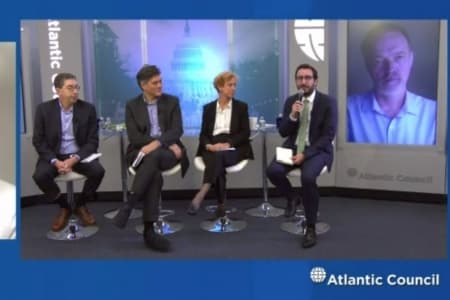
This was the question posed to the panellists at the Atlantic Council's latest panel on Wednesday, 9 November in Washington, DC. The discussion examined the recent history of EU digital policy, from cybersecurity and data regulations to the promotion of digital innovations and competitiveness. Representing the transatlantic business perspective was Thibaut L’Ortye, Director of Public Affairs, AmCham EU, who emphasised the importance of cooperation in building a thriving digital economy.
Is Europe fit for the digital age?
This was the question posed to the panellists at the Atlantic Council's latest panel on Wednesday, 9 November in Washington, DC. The discussion examined the recent history of EU digital policy, from cybersecurity and data regulations to the promotion of digital innovations and competitiveness. Representing the transatlantic business perspective was Thibaut L’Ortye, Director of Public Affairs, AmCham EU, who emphasised the importance of cooperation in building a thriving digital economy.

Moderated by Mark Scott, Chief Technology Correspondent, POLITICO, the panel also featured:
Fran Burwell, Distinguished Fellow, Atlantic Council
Peter Harrell, Senior Director for International Economic and Competitiveness, White House National Security Council
Kenneth Propp, Senior Fellow, Atlantic Council
Werner Stengg, Cabinet Expert, Cabinet of Executive Vice-President Margrethe Vestager, European Commission
For more on the future of digital policy and transatlantic cooperation, register for our 10th Annual Transatlantic Digital Economy Conference on Tuesday, 29 November.
Related items
:focal())
EU-US critical minerals agreement: mutually beneficial transatlantic cooperation in action
The new EU-US strategic partnership on critical minerals marks a positive step forward for the transatlantic relationship, demonstrating how EU-US cooperation can deliver benefits for businesses on both sides of the Atlantic. Critical minerals sit at the heart of modern technologies and industrial value chains, essential to products like semiconductors and future energy technologies. This strategic partnership will help provide American and European companies with a more secure supply of these inputs. More broadly, the agreement can support the EU and US economies in reducing strategic dependencies in global critical minerals trade – a shared challenge.
Beyond critical minerals, the strategic partnership points to an opportunity for a new chapter in EU-US cooperation built around shared economic and strategic priorities. The two sides have a greater impact when using their combined weight to address shared challenges. Pursuing the kind of cooperation outlined in the strategic partnership should be a priority as the two sides build on the August 2025 EU-US Joint Statement, with further opportunities for coordination on issues such as securing industrial supply chains for AI development, tackling non-market trading practices and bolstering transatlantic cyber resilience.
:focal())
Navigating Europe’s defence landscape
On Wednesday, 16 April, AmCham EU met with Michael J. Vaccaro, Acting Principal Deputy Assistant Secretary, Bureau of Political-Military Affairs, Directorate of Defense Trade Controls, US Department of State. The exchange with members focused on transatlantic defence industrial cooperation, regulatory issues shaping European Defence Markets and the ability of US companies to support European rearmament. Malte Lohan, CEO, AmCham EU also highlighted the importance of an open policy environment across the Atlantic to support cooperation and enable companies to contribute to Europe’s security and defence industrial base.
:focal())
Industry calls for ambitious and simplified implementation of the AI Act
Together with 14 other associations, AmCham EU has signed a joint statement on the European Commission’s Digital Omnibus on AI, calling for a clear, simple and innovation-friendly implementation of the AI Act. Co-legislators should swiftly reach an agreement on an ambitious final text that keeps simplification at its core. Measures to streamline overlaps with existing EU legislation and improve legal certainty are essential, alongside targeted adjustments to ensure the framework remains practical. This includes extending grace periods for generative AI labelling requirements, ensuring greater legal clarity for AI systems entering the EU market, preserving the risk-based approach of the AI Act by exempting non high-risk systems from registration, and supporting fixed compliance deadlines for high-risk systems.
Learn how the EU can support a clear and innovation friendly framework in the joint statement.
Policy priorities
Insights and advocacy driving Europe’s policy agenda. Our priorities support growth, innovation and a stronger transatlantic economy.
Membership
Connecting business and policymakers to strengthen the voice of American companies in Europe.