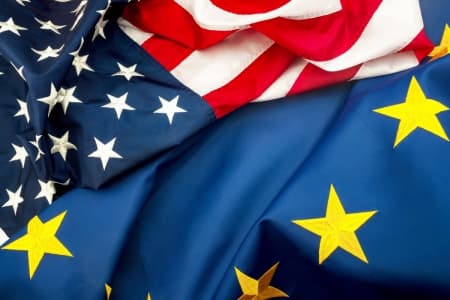
EU and US to launch new dialogue on security and defence

The American Chamber of Commerce to the EU (AmCham EU) welcomes the launch of the EU-US dedicated dialogue on security and defence that will take place on 22 April 2022 following its initial announcement during the EU-US Summit in June 2021. The dialogue comes at a pivotal moment for transatlantic security and will serve as a valuable forum for exploring closer cooperation in the field of security and defence.

News
20 Apr 2022
EU and US to launch new dialogue on security and defence

AmCham EU identifies several areas which could form the basis for future discussion:  

  1. Transatlantic Defence Industrial Cooperation (TADIC): The capability and interoperability of our collective armed forces should be at the core of this dialogue. The EU and the US should explore ways to coordinate in an efficient manner respective R&D and acquisition priorities in order to reinforce collective defence.

  2. Complementarity with existing initiatives: The dialogue should seek to complement existing efforts aimed at strengthening the transatlantic security and defence relationship, such as the ongoing negotiations between the European Defence Agency and the US Department of Defence on the establishment of an Administrative Arrangement and the important work of the Trade and Technology Council (TTC) in the area of export controls.

  3. Cybersecurity: The dialogue on security and defence should include cooperation on cybersecurity. The structured exchange of information, joint horizon scanning and conflict analysis on cyber would be key in the fight against cyber threats and to help ensure alignment on the relationship with strategic competitors. 

  4. Climate change: The dialogue should be a forum to build on the transatlantic momentum and leadership on climate change. Operational effectiveness, sustainability and energy security are intrinsically linked and should be addressed at the highest level. A particular focus on the introduction of sustainable aviation fuel, advanced technologies and information sharing across sectors can help address the defence and security challenges related to climate change.

  5. Space: The dialogue should focus on international cooperation and support opportunities to embed defence and security in all space systems. Both sides should specifically also consider how to best develop a space cooperation framework with NATO.

AmCham EU welcomes the ambition of both sides to take these discussions forward. AmCham EU is committed to supporting this dialogue and strengthening the transatlantic relationship, which provides jobs, prosperity and security in the EU and the US.

Related items

News
27 Jul 2026

Turnberry Deal has brought a degree of predictability to transatlantic trade and investment, anniversary survey finds

Transatlantic
Read more
Read more about Turnberry Deal has brought a degree of predictability to transatlantic trade and investment, anniversary survey finds
Position Paper
24 Jul 2026

Integrating extraterritoriality into CS3D guidance

The European Commission’s forthcoming guidance on the Corporate Sustainability Due Diligence Directive (CS3D) should:

  • allow companies to voluntarily prioritise chains of activities with a meaningful connection, which should be further defined in the guidance, to the EU or based on a global risk-based approach in cases where companies have global integrated supply chains;

  • recognise that companies may face conflicting or overlapping legal requirements between EU and third-country legislation, particularly in relation to information gathering, audits, data transfers, supplier disengagement and cooperation with authorities;

  • clarify how companies should document and manage circumstances in which third-country law restricts or prevents a due diligence measure;

  • recognise interactions with competent local authorities, regulatory inspections, permits, licences and other official approvals as potentially relevant sources of due diligence information; and

  • protect companies from liability where they have followed a reasonable, documented and good-faith process, including where another stakeholder might have prioritised risks or selected due diligence measures differently.

  • If these measures are included in the guidance, they would help the CS3D deliver meaningful and effective due diligence, rather than an exhaustive mapping of every global business relationship. Flexibility, proportionality and legal certainty can help companies progressively develop credible global systems while directing resources towards the most significant risks and the areas where they have the greatest ability to achieve positive outcomes.

Learn more in our contribution and paper.

Corporate sustainability
Read more
Read more about Integrating extraterritoriality into CS3D guidance
News
22 Jul 2026

Banking Competitiveness Report: Single Market integration and openness must drive reform

The European Commission’s Banking Competitiveness Report comes at a critical moment for Europe’s investment agenda. Closing Europe’s investment gap requires a banking sector able to mobilise capital at the scale the Savings and Investments Union demands. This is dependent on a Single Market that is not only competitive and integrated but open for all banks operating in the EU to act as facilitators of investment. The report provides a window of opportunity to anchor that openness at the centre of the competitiveness agenda.

The report correctly identifies a set of barriers holding back Europe’s banking competitiveness, both in the regulatory framework and in the way that framework is supervised. Undue complexity and divergent national implementation continue to raise the cost of financing for European households and businesses, underlining the need for an ambitious banking omnibus that simplifies rules and delivers greater consistency across the EU. At the same time, the report is right to call for a more proportionate, risk-focused supervisory culture that examines whether burdensome practices are weakening the attractiveness of Europe’s banking ecosystem. A new banking competitiveness agenda should build on both priorities: simpler, more coherent rules and supervision that enables internationally active banks to support investment.

Internationally active banks, including third-country groups with a substantial European footprint, are central to delivering this agenda. These institutions channel global capital to European companies, underpin the liquidity and depth of EU capital markets and help international investors finance opportunities in Europe. Europe remains a strategic market for these firms, and their investment demonstrates confidence in European growth, European companies and European opportunity.

The test of genuine integration is whether a banking group can serve customers across the Single Market without rebuilding its operations in each Member State. The report recognises that divergent national application of EU rules discourages banks from offering pan-European services and consequently results in costly duplication and regulatory burden across jurisdictions. A more competitive framework would enable European and international institutions to thrive in Europe, offering clients choice and a full suite of payment and banking services across the Single Market.

Coherent implementation will determine whether these reforms enhance competitiveness. Where the framework adapts international standards to EU specificities, the test should be whether the result preserves a level playing field for banks competing in global markets and remains consistent with the standards those banks apply across jurisdictions.

Financial services
Read more
Read more about Banking Competitiveness Report: Single Market integration and openness must drive reform