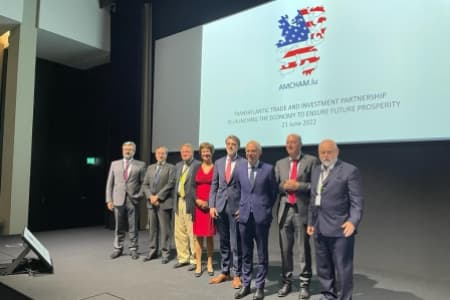
What is the future of the transatlantic economic relationship? That was the question Susan Danger, CEO, AmCham EU looked to address in her remarks during the event organised by AmCham Luxembourg, together with Deloitte and the Luxembourg American Chamber of Commerce on Tuesday, 21 June. Cooperation and collaboration were key themes throughout her remarks, underscoring their importance in generating economic growth.
Discussing transatlantic trade and investment in Luxembourg
What is the future of the transatlantic economic relationship? That was the question Susan Danger, CEO, AmCham EU looked to address in her remarks during the event organised by AmCham Luxembourg, together with Deloitte and the Luxembourg American Chamber of Commerce on Tuesday, 21 June. Cooperation and collaboration were key themes throughout her remarks, underscoring their importance in generating economic growth.

She continued by strongly condemning the war in Ukraine and praised the close collaboration between the EU and the US in confronting common challenges. She went on to discuss how AmCham EU, as well as the AmChams in Europe network, supports the EU-US Trade and Technology Council (TTC) as a forum for regulatory and legislative cooperation.
In the spirit of cooperation, AmCham EU and the US Chamber of Commerce, with the support of AmCham Luxembourg and other AmChams, produced the Transatlantic Economy Report 2022. Researched and written independently by Johns Hopkins University researchers, the report confirms what the speakers were highlighting – that the transatlantic relationship is not only resilient, but more important than ever.
The event featured comments from speakers including Daniel S. Hamilton, Senior Fellow, Johns Hopkins University SAIS Foreign Policy Institute (FPI); Casey Mace, Chargé d’Affaires, US Embassy in Luxembourg; John Psaila, CEO, Deloitte Luxembourg; and Paul Schonenberg, Chairman and CEO, AmCham Luxembourg. The tenor of the evening was optimistic, as speakers emphasised the resilience of transatlantic trade and investment in the face of recent crises. In order to push progress forward, however, many of the speakers called on the EU to complete the Single Market, and for the US to remain a reliable, multilaterally minded partner.
Related items
:focal())
Administrative cooperation for a simplified tax environment
The evaluation of the Directive on Administrative Cooperation (DAC) 1-9 can help enhance tax transparency, improve the Single Market and boost Europe’s competitiveness by decluttering tax policy. By ensuring that DAC includes fixed standards and mandating greater transparency for DAC data, lawmakers can improve its functionality. Likewise, by exempting Pillar 2 companies (including those subject to the ‘side-by-side’ safe harbour) from DAC 6 and revisiting the administrative requirements and outcomes of reporting under DAC 6, the Anti-Tax Avoidance Directive (ATAD), the Pillar 2 Directive and the Public Country by Country Reporting (pCbCR) Directive, lawmakers can minimise additional costs for companies and tax authorities alike while maintaining the integrity of the tax system.
:focal())
Bridging pay gaps through transparency
At the European Association Summit & Awards 2026, Maximiliano Santy, Senior Director of Operations, AmCham EU, spoke at a session organised by the European Society of Association Executives Finance & HR Community on salary transparency and the gender pay gap. Taking place on Thursday, 26 March, he outlined the implications of the EU Pay Transparency Directive for organisations and highlighted the importance of objective, transparent criteria in addressing pay disparities. He also emphasised the need to align compensation practices with legal requirements while supporting fairness, accountability and trust across the workplace. Natalie Bastiaens, Partner, Tax and Legal Services; Kathleen Bracke, Managing Associate, Social Legal, BDO and Martina Schusterova, Director, Energy Traders Europe also joined the panel.
:focal())
MC14: deep concern over e-commerce moratorium deadlock
The American Chamber of Commerce to the EU (AmCham EU) is deeply concerned by World Trade Organization members’ failure to reach agreement on the moratorium on E-Commerce at the 14th Ministerial Conference (MC14) in Cameroon. The absence of an agreement undermines legal certainty for businesses and consumers worldwide. This deadlock further underscores the need for significant WTO reform.
Since its introduction, the moratorium on customs duties on electronic transmissions has played a vital role in enabling the global digital economy by ensuring the smooth cross-border exchange of digital goods and services. In an increasingly digitalised global economy, predictability remains essential for companies of all sizes operating across borders.
WTO members must now renew efforts to re-instate the moratorium at the next General Council meeting as a matter of priority. Delivering such an outcome would strengthen the multilateral trading system and better reflect the realities of modern trade.
Policy priorities
Insights and advocacy driving Europe’s policy agenda. Our priorities support growth, innovation and a stronger transatlantic economy.
Membership
Connecting business and policymakers to strengthen the voice of American companies in Europe.