The details of data
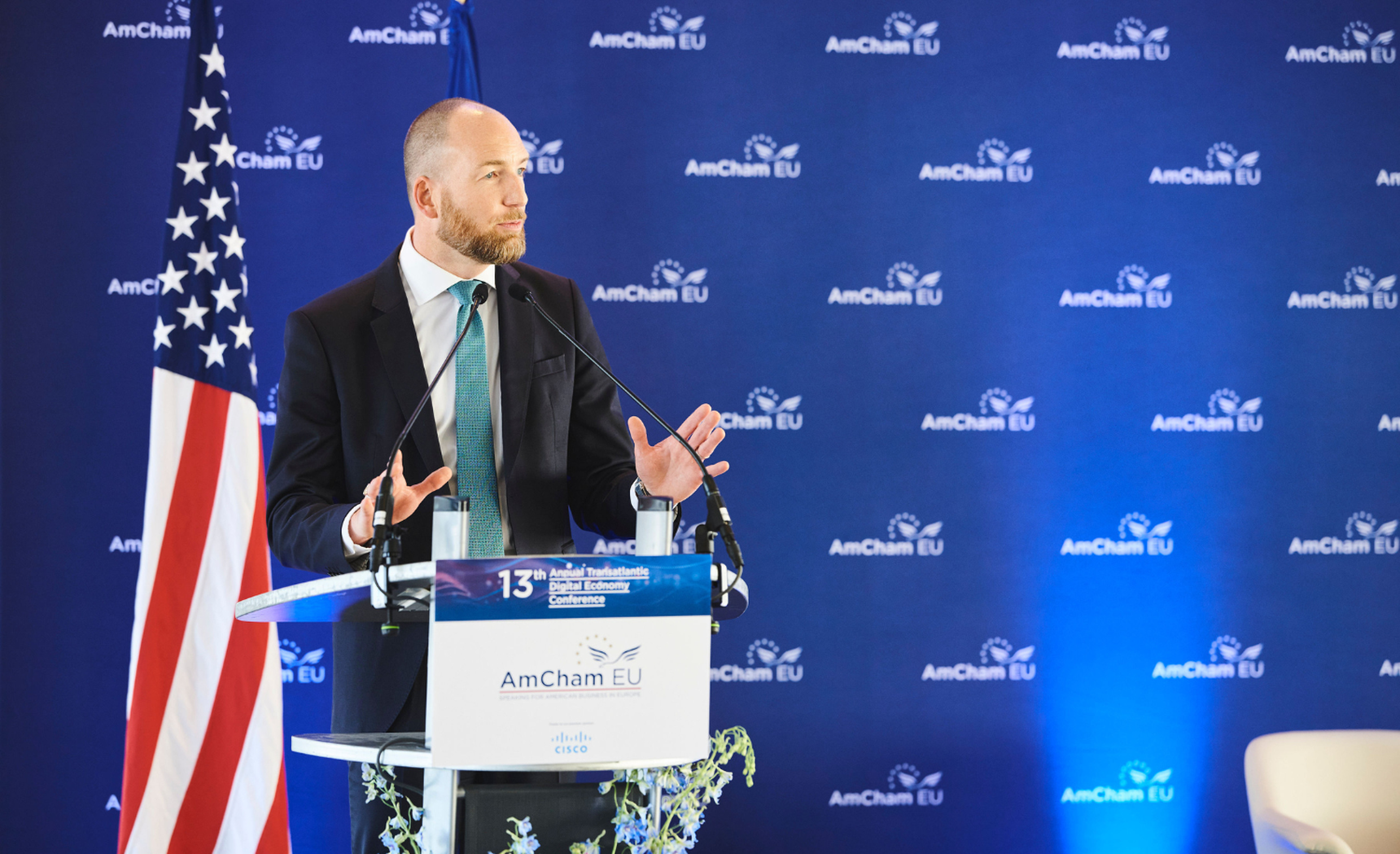
What can Europe and the US do to build closer ties through data? Our panel discussion on Thursday, 1 June moderated by Tanguy Van Overstraeten, Issue Lead, Privacy and Data Flows, AmCham EU and Partner, Linklaters explored this question and more. Participants heard why an effective framework for transatlantic data flows is needed from Bruno Gencarelli, Head of Unit, International Affairs and Data Flows, Directorate-General for Justice, European Commission; Aaron Held, Commercial Officer, Digital Policy, Health Policy, Artificial Intelligence Policy, US Mission to the EU and Gwendal Legrand, Deputy Head of the European Data Protection Board Secretariat, European Data Protection Board.

Related items
Digital Economy Conference 2026: in review
AmCham EU’s 13th Annual Transatlantic Digital Economy Conference took place on Thursday, 5 November, under the theme Cutting through complexity. The event brought together policymakers, regulators and industry leaders to discuss how clear, workable frameworks and closer EU-US cooperation can bring more coherence to the digital landscape and support economic growth.

Making CADA’s sovereignty framework work for Europe
The success of the Cloud and AI Development Act (CADA) will depend on whether its sovereignty framework strengthens Europe’s resilience and competitiveness without restricting access to the technologies, providers and operating models needed to support the bloc’s digital transformation. As currently envisaged, several elements of CADA introduce origin-based restrictions that are not necessarily linked to genuine sovereignty, security or resilience risks. These measures could reduce competition, increase costs and slow cloud and AI adoption – ultimately working against CADA’s underlying objectives.
A sovereignty framework built on objective, risk-based criteria will better support Europe’s competitiveness, resilience and digital transformation than one based on origin, ownership or nationality.

Branching out with AI
Meta’s open-source Canopy Height Maps helped the European Commission’s Joint Research Centre improve its 2020 Global Forest Cover map, demonstrating how artificial intelligence can strengthen Europe’s ability to monitor forests and advance climate and biodiversity goals. Developed with the World Resources Institute, the maps use Meta’s DINO self-supervised computer vision model to estimate tree height from satellite imagery. This helped researchers apply the five-metre threshold used in many international forest definitions and better distinguish forests from other tree-covered land, including agricultural tree crops. The resulting product, available through the EU Forest Observatory, provides one of the most comprehensive open views of global forest cover. Read more on Invested in Europe.
Policy priorities
Insights and advocacy driving Europe’s policy agenda. Our priorities support growth, innovation and a stronger transatlantic economy.
Membership
Connecting business and policymakers to strengthen the voice of American companies in Europe.