#CyberSecMonth – enhancing Europe's cyber resilience
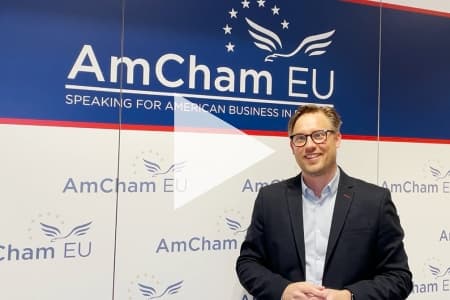
With European Cybersecurity Month coming to a close, we are taking a closer look at one of the key cybersecurity issues worth following in Brussels, the Directive on Security of Network and Information systems (NIS 2 Directive). Florian Pennings (Microsoft), Issue Lead, Cybersecurity, Digital Economy Committee, AmCham EU shared his insights on how the NIS 2 can help enhance Europe's cyber resilience.
Related items
:focal())
A greener Emerald Isle, a more future-ready Éire
Amazon has been active in Ireland for more than 20 years, investing in its operations, supporting small and medium-sized enterprises and contributing to communities across the country. Through recent projects in energy and education, the company is helping Ireland advance its climate and digital skills ambitions. In partnership with EnergyCloud Ireland, Amazon is supporting 500 families in Fingal with free tanks of hot water powered by surplus renewable energy. At the same time, the company is donating digital technology kits to every primary school in Ireland, helping teachers bring coding, computational thinking and digital literacy into the classroom. These initiatives show how private sector collaboration can support greener homes, stronger schools and a more future-ready Ireland. Read the full story on Invested in Europe.
:focal())
Branching out with AI
Meta’s open-source Canopy Height Maps helped the European Commission’s Joint Research Centre improve its 2020 Global Forest Cover map, demonstrating how artificial intelligence can strengthen Europe’s ability to monitor forests and advance climate and biodiversity goals. Developed with the World Resources Institute, the maps use Meta’s DINO self-supervised computer vision model to estimate tree height from satellite imagery. This helped researchers apply the five-metre threshold used in many international forest definitions and better distinguish forests from other tree-covered land, including agricultural tree crops. The resulting product, available through the EU Forest Observatory, provides one of the most comprehensive open views of global forest cover. Read more on Invested in Europe.
:focal())
Advancing skills for Europe’s AI transition
On Tuesday, 30 June, AmCham EU hosted a roundtable exploring strategies for preparing Europe’s workforce for the age of artificial intelligence (AI). Members and policymakers analysed how AI is changing roles across sectors and how employers, governments and education providers can respond. Joined by Idoia Mendia, MEP (ES, S&D) and Mario Nava, Director-General, Directorate-General for Employment, Social Affairs and Inclusion, European Commission, the conversation focused on digital and data skills, as well as expanding AI literacy across organisations. Participants also discussed reskilling and public-private cooperation to support a more inclusive labour market. In addition, members shared best practices from their companies and pointed to the need for policy frameworks that support lifelong learning and skills-based hiring. As AI becomes part of everyday work, Europe must close the skills gap to strengthen competitiveness and prepare people for the future of work.
Policy priorities
Insights and advocacy driving Europe’s policy agenda. Our priorities support growth, innovation and a stronger transatlantic economy.
Membership
Connecting business and policymakers to strengthen the voice of American companies in Europe.