Commitment and action to deliver on the EU forest protection objective

The EU Green Deal promotes halting deforestation and ecosystem degradation that result from unsustainable agricultural practices.  

Find out how Cargill is taking action in its cocoa, palm oil and soy supply chains in order to achieve the company’s commitment of 100% deforestation-and conversion-free supply chains by 2030. 

Learn more at The Green Way and join the conversation on Twitter with #EUGreenWay

News
5 Oct 2021
Agriculture and food , Environment
Commitment and action to deliver on the EU forest protection objective

The EU Green Deal promotes halting deforestation and ecosystem degradation that result from unsustainable agricultural practices.  

Find out how Cargill is taking action in its cocoa, palm oil and soy supply chains in order to achieve the company’s commitment of 100% deforestation-and conversion-free supply chains by 2030. 

Learn more at The Green Way and join the conversation on Twitter with #EUGreenWay

The EU Green Deal promotes imported products and value chains that do not involve deforestation and forest degradation.

For over a decade, Cargill has been addressing deforestation in its supply chains and working with farmers, governments, customers, environmental organisations and members of the communities in which the company operates in order to find practical and scalable solutions.

Cargill is committed to transform its agricultural supply chain to be deforestation- and conversion-free through prioritised policies and time-bound action plans, as outlined in Cargill’s Policy on Forests, and is a strong advocate for the industry to join pre-competitively in support of multi-stakeholder efforts to address deforestation on landscape level interventions.

Each supply chain is unique, and Cargill leverages its size, expertise and supply chain capabilities in a variety of ways to create a more sustainable, food-secure future. Cargill is taking action in its cocoa, palm oil and soy supply chains in order to achieve help the company’s commitment of 100% deforestation-and conversion-free supply chains by 2030.

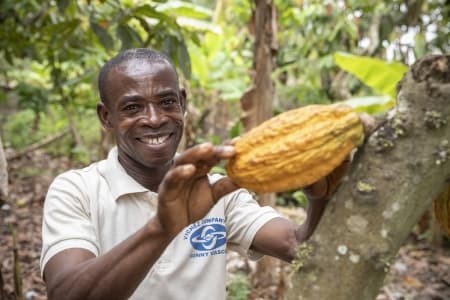
Cocoa – Cargill’s Protect Our Planet Strategic Action Plan is the company’s strategic action plan to eliminate deforestation from the cocoa supply chain. It outlines concrete actions to achieve 100 percent cocoa bean traceability, to expand programmes to grow more cocoa on less land and to support farmers to effectively include agroforestry and conservation practices on their farm. Cargill is also one of the original signatories of the industry’s Cocoa and Forests Initiative (CFI) committed to no further conversion of any forestland and ending deforestation in Ghana and Côte d’Ivoire. All signatories are committed to annual reporting on progress. These are our Annual CFI Progress Reports: 2019 and 2020.

Palm Oil – Cargill is committed to producing and sourcing palm oil in an economical, environmentally sustainable and socially responsible manner and is working toward a 100% transparent, traceable and sustainable palm supply chain. Cargill’s commitment is embodied in the philosophy of ‘No Deforestation, No Peat and No Exploitation’. The company is taking action to increase transparency, improve engagement with stakeholders, verify progress and help transform the industry. Cargill’s Policy on Sustainable Palm OilForest Policy and Human Rights Commitment govern the company’s actions in this regard.

Soy – Cargill has been working to end deforestation related to soy production for decades. This work started in the Brazilian Amazon with the Soy Moratorium and continued through the development of Cargill’s Policy on South American Soy, which captures our commitment to a transparent and sustainable South American soy supply chain. Cargill’s Soy Action Plan – South America Origins, in support of the company’s Sustainable Soy Policy, is an important component of the comprehensive actions that Cargill is taking across supply chains to increase transparency and advance the company’s sustainability commitments. For more information see the 2020 Soy Progress Report.

About Cargill

Cargill’s team of 155,000 professionals in 70 countries draws together the worlds of food, agriculture, nutrition and risk management. For more than 155 years, Cargill has helped farmers grow more, connecting them to broader markets. Cargill is continuously developing products that give consumers just what they are seeking, advancing nutrition, food safety and sustainability. And Cargill helps all of its partners innovate and manage risk, so they can nourish the world again tomorrow.

Read more on Cargill’s commitment to protect forests and end deforestation
Read more on how Cargill is transforming its supply chain
Read more on Cargill’s partnerships with farmers around the world
Visit Sustainability and Corporate responsibility at Cargill | Cargill for more information

Related items

News
11 Dec 2025

Environmental Omnibus proposal would simplify regulatory landscape

The European Commission’s Environmental Omnibus proposal is a positive first step towards reducing the administrative and regulatory burdens on businesses operating in the EU. Key measures such as streamlining permitting, simplifying industrial emissions reporting, removing the SCIP database and easing Extended Producer Responsibility schemes would help create more efficient and harmonised processes across the EU. Additionally, the proposal’s indication of upcoming work on the Circular Economy Act and the swift implementation of the Packaging and Packaging Waste Regulation would further support a simplified regulatory environment.

By improving efficiency and predictability, the proposal would help foster a stable, investment-driven market in Europe and reinforce the case for sustainable practices. To fully deliver on the potential to reduce burdens for business, co-legislators must now move the Environmental Omnibus across the finish line. AmCham EU stands ready to serve as a resource in their efforts. These simplification initiatives in environmental regulation are crucial to maintaining Europe’s global standing as a hub for business and innovation. 

The Environmental Omnibus proposal is part of the Commission’s simplification agenda and follows its proposed Chemicals Omnibus, which introduced related environmental simplifications in July 2025. These important initiatives continue to drive efforts to cut red tape, reduce regulatory burdens and enhance the EU’s competitiveness.

Environment
Simplification
Read more
Read more about Environmental Omnibus proposal would simplify regulatory landscape
News
9 Dec 2025

Omnibus and the EU’s drive for simplification

On Tuesday, 9 December, AmCham EU hosted a discussion on the Food and Feed Omnibus and its role in simplifying Europe’s agri-food legislation. The conversation explored how a more coherent, innovation-friendly framework can reduce complexity and ease the administrative burden across the value chain. The discussion also underlined the importance of aligning regulation with scientific and technological progress, while reinforcing Europe’s competitiveness and strategic autonomy. Effective collaboration between policymakers and industry remains essential to ensure the Omnibus delivers practical improvements for operators throughout the agri-food sector.

During the panel, participants heard from Tyler Babcock, Senior Agricultural Attaché, US Mission to the European Union; Dr Eugene Kevin Foley-Friel, Agriculture Attaché, Permanent Representation of Ireland to the European Union and Astrid Sofie Vestergaard Nielsen, Food Attaché, Permanent Representation of Denmark to the European Union. The discussion was moderated by David Mills (Mondelēz International), Chair, Communications Group; Member of the Board of Directors and Vice-Chair, Agriculture & Food Committee, AmCham EU.

Agriculture and food
Read more
Read more about Omnibus and the EU’s drive for simplification
News
5 Dec 2025

Building Europe’s water future, together

Water resilience is becoming increasingly urgent, with global demand expected to exceed supply by 40% by 2030. For over two decades, Coca-Cola in Europe has worked to address this challenge through partnerships with more than 30 non-governmental organisations on over 100 projects across the continent. These initiatives range from restoring wetlands in the Danube Basin to supporting water-smart farming in Spain and Sicily. In a new report, Scaling for Impact, developed with GlobeScan, Coca-Cola Europe outlines key success factors for effective water stewardship partnerships. Discover how the company is helping to build a more resilient water future through collaboration and innovation on Invested in Europe. 

Environment
Read more
Read more about Building Europe’s water future, together