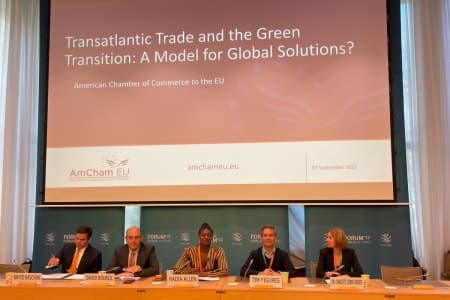
Two weeks ago, an AmCham EU delegation was represented at the 2022 World Trade Organization (WTO) Public Forum in Geneva. The Public Forum brings together delegates from across the globe to discuss the most pressing challenges and opportunities for the global trading system. On the heels of the WTO’s 12th Ministerial Conference (MC12) which took place in June, the Public Forum provided a platform for over 3000 participants to deliberate on how trade can help build a more sustainable and inclusive economic recovery.
AmCham EU at the WTO Public Forum 2022
Two weeks ago, an AmCham EU delegation was represented at the 2022 World Trade Organization (WTO) Public Forum in Geneva. The Public Forum brings together delegates from across the globe to discuss the most pressing challenges and opportunities for the global trading system. On the heels of the WTO’s 12th Ministerial Conference (MC12) which took place in June, the Public Forum provided a platform for over 3000 participants to deliberate on how trade can help build a more sustainable and inclusive economic recovery.

The Forum featured 144 sessions including a panel organised by AmCham EU. The panel, moderated by Nadia Allen, Associate Policy Manager, AmCham EU, included speakers Bryce Baschuk, Reporter, Bloomberg News, David Boublil; Deputy Head of Unit, Directorate-General for Taxation and Customs Union, European Commission; Tim Figures, Associate Director, EU and Global Trade and Investment, Boston Consulting Group; and Charlotte Sieber-Gasser, Senior Researcher and Lecturer, Centre for Trade and Economic Integration, Graduate Institute for International and Development Studies. The discussion explored how transatlantic trade can help accelerate the transition toward a more sustainable economy. While the global trading system faces many challenges, there remains significant opportunity to further align shared objectives to achieve climate neutrality by 2050.
AmCham EU is a strong supporter of a rules-based trading system and will continue to be a constructive partner in reaching sustainability objectives. Continuing a dialogue with key stakeholders will be critical in the coming months and years. The delegation met with Angela Ellard, Deputy Director General, WTO; Jeremy Green, Deputy Head of Mission, Australian Representation to the WTO; Naoki Hikota, Minister, Japanese Representation to the WTO; Clare Kelly, New Zealand Permanent Representative to the WTO and João Aguiar Machado, Ambassador and Permanent Representative of the European Union to the WTO.
Click here for more info on the panel.
Click here for more on our position on the WTO and WTO reform.
Related items
:focal())
Building the transatlantic relationship directly in DC
From Monday, 20 to Wednesday, 22 April, AmCham EU joined the AmChams in Europe network for a delegation visit to Washington, DC. As part of the programme, delegates met with representatives from the US Department of Commerce, the US Department of State, congressional offices and the US Chamber of Commerce. AmCham EU specifically also engaged with the Office of the United States Trade Representative, US Members of the House and staffers, the EU Delegation to the US, the European Parliament Liaison Office and other business organisations.
Discussions focused on the implementation of the EU-US Framework Agreement and its role in supporting a more predictable transatlantic trade and investment relationship. The deal remains the most realistic route to a more constructive climate for companies operating across the Atlantic. The EU-US strategic partnership on critical minerals points to the potential for further EU-US cooperation in areas that benefit businesses on both sides of the Atlantic.
:focal())
Revision of the Classification, Labelling and Packaging Regulation: Following a balanced Report, trilogues must secure simplification
Today, the European Parliament adopted its Omnibus VI report, including the revision of the Classification, Labelling and Packaging (CLP) Regulation, by 540 votes to 60. The outcome supports a more streamlined framework by easing the regulatory burden on value chains that rely on chemicals and sending a positive signal of the EU’s commitment to reducing unnecessary complexity.
With the Council’s position agreed in November 2025, the Parliament’s report marks the final step before trilogues, which will conclude negotiations on the targeted revision of the CLP Regulation.
The report largely aligns with the Commission’s simplification agenda and strengthens the CLP Regulation’s overall workability, especially with regards to:
Transition periods, setting 18 months following classification updates and allowing digital contact information to be updated on the label in line with suppliers’ regular update cycles. This better reflects supply chain realities.
Advertising and distance sales requirements, appropriately excluding business-to-business settings while ensuring consumers remain protected; and
Label legibility requirements, with more proportionate minimum font sizes and rules on background contrast, spacing and overall layout. However, further simplification is still needed to ensure sufficient flexibility for businesses.
While the report represents a constructive step forward, trilogues should address remaining constraints and clarify language that is currently difficult to interpret, including further simplification on font sizes and advertising requirements in business-to-consumer settings. These negotiations should draw on the more proportionate approaches of the Commission and the Council.
Maintaining a strong focus on simplification will be key to further alleviating administrative burdens and strengthening the EU’s resilience and competitiveness.
:focal())
Simplifying the Classification, Labelling and Packaging Regulation: recommendations for trilogues
On 8 July 2025, the Commission presented the Omnibus VI simplification package, reopening key legislation such as the CLP Regulation, which entered into force in December 2024. The Omnibus addresses overlaps and inconsistencies that create practical challenges and, in some cases, make compliance unworkable.
Upcoming trilogues can streamline the framework and reduce unnecessary burdens. This paper sets out targeted recommendations on the positions that can achieve meaningful simplification during the inter-institutional negotiations.
Policy priorities
Insights and advocacy driving Europe’s policy agenda. Our priorities support growth, innovation and a stronger transatlantic economy.
Membership
Connecting business and policymakers to strengthen the voice of American companies in Europe.