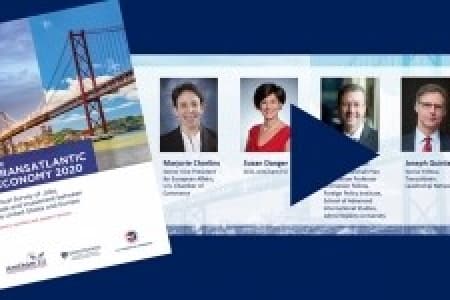
On Thursday, 26 March 2020, the American Chamber of Commerce to the EU (AmCham EU) and the US Chamber of Commerce hosted an online event to mark the launch of our Transatlantic Economy 2020 report. To watch the event again, click here.
AmCham EU and US Chamber of Commerce launch Transatlantic Economy 2020 report
On Thursday, 26 March 2020, the American Chamber of Commerce to the EU (AmCham EU) and the US Chamber of Commerce hosted an online event to mark the launch of our Transatlantic Economy 2020 report. To watch the event again, click here.

The launch featured a presentation of the report by its authors Dan Hamilton, Austrian Marshall Plan Foundation Professor and Senior Fellow, Foreign Policy Institute, School of Advanced International Studies, Johns Hopkins University and Joseph Quinlan, Senior Fellow, Transatlantic Leadership Network.
Susan Danger, CEO, AmCham EU, emphasised the importance of transatlantic cooperation and bold government action to address the ongoing COVID-19 crisis and its ripple effects on the economy. Marjorie Chorlins, Senior Vice President for European Affairs, U.S. Chamber of Commerce, stressed that both the EU and the US should work together to get through longstanding trade irritants. Most importantly, she called on both sides to demonstrate common leadership.
The authors outlined that we are living in unprecedented times for the global economy. They emphasised that at times like these, the EU-US partnership becomes even more important. They went on to demonstrate that while trade deficits in goods tend to get a lot of media scrutiny, it is investment flows that reveal the true level of interconnectedness of economies. In the case of the transatlantic economy, investment in each other’s markets is the largest in the world, dwarfing investments by China into the EU and the US.
A question and answer session followed the presentation, touching upon the impact of COVID-19 for the future of the transatlantic relationship; the US rescue measures; opportunities to advance the EU-US trade agenda; and the impact of Brexit. It was moderated by Thibaut L’Ortye, Associate Director of Public Affairs, AmCham EU.
Related items
:focal())
Highlighting the importance of EU-US cooperation in Lisbon
On Tuesday 27 January, Malte Lohan, CEO, AmCham EU, took part in AmCham Portugal’s Transatlantic Business Summit in Lisbon, Portugal to discuss Europe’s economic resilience in a rapidly changing geopolitical environment. His speech underlined that the EU-US relationship remains the world’s largest and most consequential economic partnership. He also covered the need to strengthen the Single Market, restore Europe’s competitiveness and avoid fragmentation that risks undermining growth. Economic resilience relies on predictability, openness and a stable transatlantic trade and investment environment.
:focal())
Discussing defence with the US Ambassadors to the EU and NATO
On Thursday, 29 January, AmCham EU hosted a roundtable focused on defence policy with Andrew Puzder, US Ambassador to the European Union and Matthew Whitaker, US Ambassador to NATO. With senior leaders from US companies active in Europe’s defence markets, the discussion focused on the evolving defence policy landscape at the EU and NATO and the importance of transatlantic industrial cooperation in responding to today’s security challenges. Participants exchanged views on how openness of EU regulation, procurement and funding initiatives can better support speed, scale and interoperability among NATO Allies while building on the strengths of the transatlantic defence industrial base.
Keeping the implementation of the EU-US deal on course
Ahead of the Committee on International Trade’s (INTA) meeting in the European Parliament on Monday, 26 January 2026, AmCham EU reiterates its call to advance the Commission’s tariff reduction proposals as part of the wider EU-US Framework Agreement. We understand MEPs’ caution following a week of renewed transatlantic tensions, but do not see the tariff reduction proposals as the right avenue for addressing these issues. The Framework Agreement remains the best available option for securing a more positive, productive EU-US trade and investment climate that helps businesses plan ahead.
As part of the Agreement, the EU and the US made a range of initial commitments. Last September, the US took its first step by updating its tariff schedule on EU products. The two tariff reduction proposals are how the EU shows its commitment to follow suit. This is just the start of the longer-term process of implementing the deal. Later, there will be opportunities to address other issues important to businesses on both sides of the Atlantic. A functioning EU-US economic relationship is critical to millions of American and European businesses and livelihoods.
Policy priorities
Insights and advocacy driving Europe’s policy agenda. Our priorities support growth, innovation and a stronger transatlantic economy.
Membership
Connecting business and policymakers to strengthen the voice of American companies in Europe.