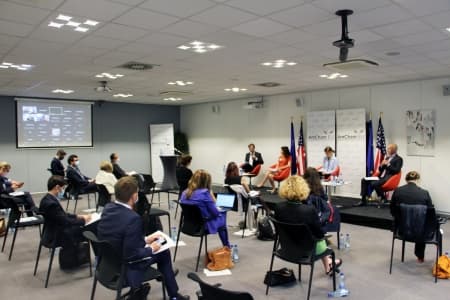
On Tuesday, 21 September, AmCham EU hosted a plenary meeting on trade and external affairs. Ahead of the 12th WTO Ministerial Conference and in the context of renewed EU-US cooperation through the Trade and Technology Council, the plenary meeting discussed the role of the EU-US relationship in the future of the WTO and the global trading system.
After COVID-19: what is the future of the global trade network?
On Tuesday, 21 September, AmCham EU hosted a plenary meeting on trade and external affairs. Ahead of the 12th WTO Ministerial Conference and in the context of renewed EU-US cooperation through the Trade and Technology Council, the plenary meeting discussed the role of the EU-US relationship in the future of the WTO and the global trading system.

The plenary commenced with a panel on the impact of COVID-19 on the global trading system, moderated by Florian Wastl, Director Public Affairs Europe, Mars Incorporated and Vice-Chair of the Trade and External Affairs Committee at AmCham EU. The panel featured representatives from both sides of the Atlantic including Peter Chase, Senior Fellow, German Marshall Fund; Christina Falcone, Vice-president of Public Affairs, UPS; Erland Herfindahl, Senior Trade Representative, US Mission to the EU and Polina Khomenko, Policy Coordinator, WTO Policy and Negotiations, European Commission. Discussion centred around the need for an ambitious transatlantic vision and the initiatives underway for WTO reform.
The panel was followed by a keynote address delivered by Angela Ellard, Deputy Director-General of the World Trade Organisation focused on WTO reform and the organisation’s priorities. A stronger EU-US relationship was identified as the key driver to sustain and strengthen the WTO. The 12th WTO Ministerial Conference, taking place in November of this year, was earmarked as an opportunity for the EU and the US to demonstrate their leadership. These include, fisheries subsidies, vaccine distribution equity and internal reforms on issues such as the appellate body and the role of the secretariat.
The plenary demonstrated the vast array of challenges which, with increased cooperation on both sides of the Atlantic, can move towards resolution. The current momentum for transatlantic cooperation should be harnessed in order to achieve tangible results in EU-US international coordination and regulatory cooperation.
AmCham EU has been actively supporting these efforts through the publication of our position paper on emerging areas for EU-US cooperation, our study on rebooting the transatlantic economy and our platform Thriving Together dedicated to exploring the depths of the transatlantic relationship.
Related items
:focal())
Exploring transatlantic ties at AmCham Luxembourg
On Tuesday 2 December, Thibaut L’Ortye, Senior Director of Public Affairs, AmCham EU presented The Transatlantic Economy 2025 report at AmCham Luxembourg’s Transatlantic Trade and Investment event. Stacey Feinberg, US Ambassador to Luxembourg highlighted the strong ties between Luxembourg and the US, with over 150,000 people employed thanks to the partnership. During his section, Mr L’Ortye presented the results of the report, with a particular focus on the resiliency of the EU-US relationship. Despite differing views on certain issues, the transatlantic partnership remains the most integrated in the world, directly responsible for 16 million jobs and one third of global GDP.
:focal())
AmCham EU reaches record 169 members
AmCham EU is pleased to announce a new record in membership, closing the year with 169 member companies. This milestone highlights the continued commitment of US businesses operating in Europe and the collective effort to strengthen the transatlantic relationship. We thank all our members for their trust and engagement. We look forward to continued collaboration in 2026. Hear more on this milestone from Malte Lohan, CEO, AmCham EU here.
:focal())
STEMming the skills gap
By 2035, high-tech roles will make up a significant share of employment across the EU, yet many young people still lack the digital skills needed to succeed. Amazon is helping bridge this gap through initiatives in Poland and Spain. In Warsaw, the company supports STEM Kindloteka, a modern hub offering young people free, interactive workshops in coding, robotics and virtual reality. In Spain, Amazon is working with the Ministry of Education, Vocational Training and Sports to train 500,000 students in digital and technological skills by 2027. These efforts strengthen Europe’s talent pipeline and support long-term competitiveness. Learn more about Amazon’s commitment to digital skills development on Invested in Europe.
Policy priorities
Insights and advocacy driving Europe’s policy agenda. Our priorities support growth, innovation and a stronger transatlantic economy.
Membership
Connecting business and policymakers to strengthen the voice of American companies in Europe.