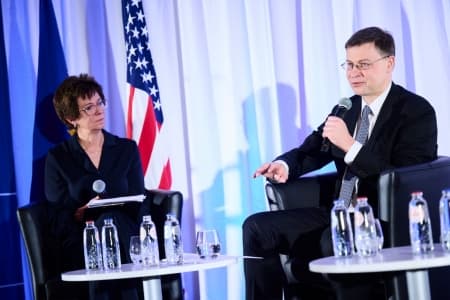
This year’s Transatlantic Conference, themed ‘Shared values, shared impact: the power of the transatlantic relationship’ served to spark dialogues on the importance of a strong and united transatlantic relationship, especially in the context of the war in Ukraine. The conference took place on Thursday, 24 March 2021 and featured speakers from both sides of the Atlantic. As an opening speech, US Secretary of Commerce Gina Raimondo reiterated the importance of a shared response against Russia’s aggression, but noted that the spark of a revitalised transatlantic cooperation had been lit months back.
Transatlantic Conference 2022
This year’s Transatlantic Conference, themed ‘Shared values, shared impact: the power of the transatlantic relationship’ served to spark dialogues on the importance of a strong and united transatlantic relationship, especially in the context of the war in Ukraine. The conference took place on Thursday, 24 March 2021 and featured speakers from both sides of the Atlantic. As an opening speech, US Secretary of Commerce Gina Raimondo reiterated the importance of a shared response against Russia’s aggression, but noted that the spark of a revitalised transatlantic cooperation had been lit months back.

Following Secretary Raimondo’s remarks, Daniel Hamilton and Joseph Quinlan presented the key findings of the Transatlantic Economy 2022 report, the annual survey of transatlantic jobs, trade and investment. This year’s edition features new insights into how the war in Ukraine affects the transatlantic relationship, the impact of the COVID-19 pandemic, prospects for the recovery, global supply chain issues, relations with China and the transatlantic energy economy. Research for the report was conducted independently at John Hopkins University’s School of Advanced International Studies and the Transatlantic Leadership Network, in partnership with the U.S. Chamber of Commerce. You can read the report here or take a look at the Thriving Together platform.
The conference included a series of panel discussions, diving into key priorities for the transatlantic relationship. First off was a conversation focused on how the EU and the US can set global artificial intelligence (AI) standards. The panellists reiterated that transatlantic partners must work to foster AI uptake while balancing trust and innovation. As a final intervention before lunch, Carol B. Tomé, CEO, UPS, outlined some of the key opportunities for EU-US leadership. Over lunch, Mark Gitenstein, US Ambassador to the EU, shared his insights on the state of transatlantic relations in a conversation with Susan Danger, CEO, AmCham EU.
Two sessions followed in the afternoon. A panel addressed the impact of trade on the green transition, including a wide range of issues ranging from how Ukraine’s war is impacting the energy market to how transatlantic partners can jointly work on a WTO-compliant Carbon Border Adjustment Mechanism (CBAM). The final panel of the day focused on the importance of shared values in the EU-US relationship.
The conference closed with a fireside conversation between Ambassador Katherine Tai, US Trade Representative, and Valdis Dombrovskis, Executive Vice-President for an Economy that Works for People, European Commission. EVP Dombrovksis is also the winner of this year’s Transatlantic Business Award. They covered a range of issues, including the recent transatlantic response to the invasion of Ukraine, the next deliverables for the Trade and Technology Council, ways to further advance the EU-US partnership and the need for overall transatlantic cooperation based on common values.
Related items
:focal())
Building the transatlantic relationship directly in DC
From Monday, 20 to Wednesday, 22 April, AmCham EU joined the AmChams in Europe network for a delegation visit to Washington, DC. As part of the programme, delegates met with representatives from the US Department of Commerce, the US Department of State, congressional offices and the US Chamber of Commerce. AmCham EU specifically also engaged with the Office of the United States Trade Representative, US Members of the House and staffers, the EU Delegation to the US, the European Parliament Liaison Office and other business organisations.
Discussions focused on the implementation of the EU-US Framework Agreement and its role in supporting a more predictable transatlantic trade and investment relationship. The deal remains the most realistic route to a more constructive climate for companies operating across the Atlantic. The EU-US strategic partnership on critical minerals points to the potential for further EU-US cooperation in areas that benefit businesses on both sides of the Atlantic.
:focal())
EU-US critical minerals agreement: mutually beneficial transatlantic cooperation in action
The new EU-US strategic partnership on critical minerals marks a positive step forward for the transatlantic relationship, demonstrating how EU-US cooperation can deliver benefits for businesses on both sides of the Atlantic. Critical minerals sit at the heart of modern technologies and industrial value chains, essential to products like semiconductors and future energy technologies. This strategic partnership will help provide American and European companies with a more secure supply of these inputs. More broadly, the agreement can support the EU and US economies in reducing strategic dependencies in global critical minerals trade – a shared challenge.
Beyond critical minerals, the strategic partnership points to an opportunity for a new chapter in EU-US cooperation built around shared economic and strategic priorities. The two sides have a greater impact when using their combined weight to address shared challenges. Pursuing the kind of cooperation outlined in the strategic partnership should be a priority as the two sides build on the August 2025 EU-US Joint Statement, with further opportunities for coordination on issues such as securing industrial supply chains for AI development, tackling non-market trading practices and bolstering transatlantic cyber resilience.
:focal())
Navigating Europe’s defence landscape
On Wednesday, 16 April, AmCham EU met with Michael J. Vaccaro, Acting Principal Deputy Assistant Secretary, Bureau of Political-Military Affairs, Directorate of Defense Trade Controls, US Department of State. The exchange with members focused on transatlantic defence industrial cooperation, regulatory issues shaping European Defence Markets and the ability of US companies to support European rearmament. Malte Lohan, CEO, AmCham EU also highlighted the importance of an open policy environment across the Atlantic to support cooperation and enable companies to contribute to Europe’s security and defence industrial base.
Policy priorities
Insights and advocacy driving Europe’s policy agenda. Our priorities support growth, innovation and a stronger transatlantic economy.
Membership
Connecting business and policymakers to strengthen the voice of American companies in Europe.