Pulling together today for the circular economy of tomorrow

Susan Danger, CEO, AmCham EU wrote an opinion piece on the circular economy last week. Susan makes the case for Europe’s transition to a circular economy and notes that such a change is compelling for the EU's leaders, its citizens, and in many respects for businesses. According to her, potential opportunities include: 'reduced pressures on the environment, as better waste management would imply both reduced use of resources such as energy, water, land and materials, and reduced emissions of greenhouse gases.


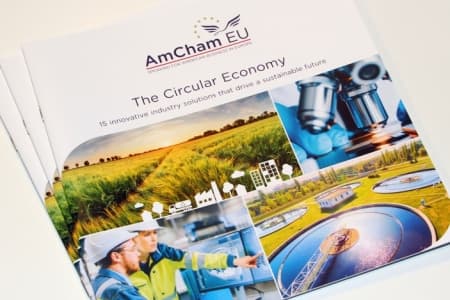
It would also mitigate the risks associated with the supply of raw materials, such as price volatility, availability and import dependency.' You can read the full piece here and for more details on AmCham EU’s member companies' actions towards sustainability, see our brochure ‘The Circular Economy: 15 innovative industry solutions that drive a sustainable future’

News
14 Jun 2020
Environment
Pulling together today for the circular economy of tomorrow

Susan Danger, CEO, AmCham EU wrote an opinion piece on the circular economy last week. Susan makes the case for Europe’s transition to a circular economy and notes that such a change is compelling for the EU's leaders, its citizens, and in many respects for businesses. According to her, potential opportunities include: 'reduced pressures on the environment, as better waste management would imply both reduced use of resources such as energy, water, land and materials, and reduced emissions of greenhouse gases.


It would also mitigate the risks associated with the supply of raw materials, such as price volatility, availability and import dependency.' You can read the full piece here and for more details on AmCham EU’s member companies' actions towards sustainability, see our brochure ‘The Circular Economy: 15 innovative industry solutions that drive a sustainable future’


Susan also highlighted that the transition to a circular economy has a number of challenges namely a lack of price signals which encourage efficient resource reuse and incentivise circular business practices as well as the upfront costs of this transition, such as building up new business models and partnerships, making large R&D investment, financing and upgrading infrastructure. 


For an in depth discussion on the subject, you can access the audio recording of our online event on 'Reflections on Europe’s circular economy and what comes next', where we welcomed Marius Vašcega, Head of Cabinet to Commissioner Virginijus Sinkevicius, European Commission as a guest speaker. The event was an opportunity to discuss the European Commission’s objectives with regard to the Circular Economy Action Plan.

Related items

News
21 Jan 2026

Reduce, reuse, reinsulate

Construction and demolition waste accounts for more than a third of all waste generated in the EU, much of which ends up in landfills. Nearly 30 years ago, Paroc, a subsidiary of Owens Corning, began to help change this trajectory by launching one of the first stone wool recycling programmes in Sweden. Through the REWOOL system, stone wool offcuts from production and construction sites are collected, sorted and recycled into new insulation products. This approach supports circular economy business models, reduces reliance on virgin raw materials and improves building sustainability ratings. Customer demand continues to grow as REWOOL expands into new markets. Read the full story on Invested in Europe. 

Environment
Read more
Read more about Reduce, reuse, reinsulate
News
16 Jan 2026

REACH universal PFAS restriction proposal

Although the European Chemicals Agency’s updated Background Document improves the universal per and polyfluoroalkyl substances restriction, it disregards PFAS’ diverse properties and uses, fails to adequately apply the Registration, Evaluation, Authorisation and Restriction of Chemicals Regulation’s risk-based principles, proposes arbitrary general exemption timelines that do not reflect individual sectors’ realities, threatens to cause major disruptions across European supply chains and creates regulatory uncertainty, discouraging investment and innovation within the EU.

Environment
Read more
Read more about REACH universal PFAS restriction proposal
News
11 Dec 2025

Environmental Omnibus proposal would simplify regulatory landscape

The European Commission’s Environmental Omnibus proposal is a positive first step towards reducing the administrative and regulatory burdens on businesses operating in the EU. Key measures such as streamlining permitting, simplifying industrial emissions reporting, removing the SCIP database and easing Extended Producer Responsibility schemes would help create more efficient and harmonised processes across the EU. Additionally, the proposal’s indication of upcoming work on the Circular Economy Act and the swift implementation of the Packaging and Packaging Waste Regulation would further support a simplified regulatory environment.

By improving efficiency and predictability, the proposal would help foster a stable, investment-driven market in Europe and reinforce the case for sustainable practices. To fully deliver on the potential to reduce burdens for business, co-legislators must now move the Environmental Omnibus across the finish line. AmCham EU stands ready to serve as a resource in their efforts. These simplification initiatives in environmental regulation are crucial to maintaining Europe’s global standing as a hub for business and innovation. 

The Environmental Omnibus proposal is part of the Commission’s simplification agenda and follows its proposed Chemicals Omnibus, which introduced related environmental simplifications in July 2025. These important initiatives continue to drive efforts to cut red tape, reduce regulatory burdens and enhance the EU’s competitiveness.

Environment
Simplification
Read more
Read more about Environmental Omnibus proposal would simplify regulatory landscape