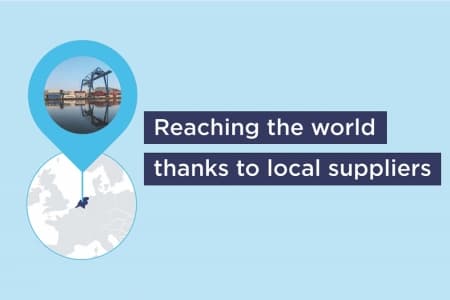
The power of local suppliers: more than shipping partners

The Van Berkel Group is located in Veghel, a town in the North Brabant region of the Netherlands. The company, founded in 1955 as a family company in agriculture, has expanded and diversified into many new sectors. In 2003, Van Berkel Logistics was established, with shipping services starting up in 2005, in the form of container transportation by barge from Veghel to Rotterdam and Antwerp. Read how Van Berkel managed to grow exponentially and leverage the power of exports by collaborating with Mars. 

News
23 Feb 2022
The power of local suppliers: more than shipping partners

Back then the company would ship 3000 containers per year. Fast forward to 2020, and that figure sits at 52 000 per year. The family company has grown to 210 employees across the whole group, with 90 employees dedicated to its logistics branch. Van Berkel’s collaboration with Mars began in 2013. Mars represents an important client for the logistics company, with orders for around 5000 container shipments per year. Of these, 60% are ‘deep sea’ shipments across the globe, versus 40% ‘short sea’ locations. However, Van Berkel’s partnership with Mars goes beyond simply shipping. Van Berkel is integrated into Mars factory proce, and the ‘make and ship’ principle ensures that whatever Mars produces can go directly into a container, which will be shipped on demand. Van Berkel’s service offering also encompasses quality control of containers. Thanks to Van Berkel’s logistics services, Mars products are able to reach consumers around the world who can enjoy the familiar taste of their renowned confectionery.

Acknowledgement: Michel van Dijk, Director, Van Berkel Logistics

The success story of global trade also lies in strong partnerships between companies of all sizes. Find out more about European ecosystems connecting small businesses with larger American companies. 

Related items

News
7 Jul 2026

Branching out with AI

Meta’s open-source Canopy Height Maps helped the European Commission’s Joint Research Centre improve its 2020 Global Forest Cover map, demonstrating how artificial intelligence can strengthen Europe’s ability to monitor forests and advance climate and biodiversity goals. Developed with the World Resources Institute, the maps use Meta’s DINO self-supervised computer vision model to estimate tree height from satellite imagery. This helped researchers apply the five-metre threshold used in many international forest definitions and better distinguish forests from other tree-covered land, including agricultural tree crops. The resulting product, available through the EU Forest Observatory, provides one of the most comprehensive open views of global forest cover. Read more on Invested in Europe.

Digital
Read more
Read more about Branching out with AI
Blog
3 Jul 2026

The transatlantic relationship at 250 years: a shared history and a forged future

Authored by Malte Lohan, CEO, AmCham EU

Transatlantic
Read more
Read more about The transatlantic relationship at 250 years: a shared history and a forged future
News
3 Jul 2026

Advancing skills for Europe’s AI transition

On Tuesday, 30 June, AmCham EU hosted a roundtable exploring strategies for preparing Europe’s workforce for the age of artificial intelligence (AI). Members and policymakers analysed how AI is changing roles across sectors and how employers, governments and education providers can respond. Joined by Idoia Mendia, MEP (ES, S&D) and Mario Nava, Director-General, Directorate-General for Employment, Social Affairs and Inclusion, European Commission, the conversation focused on digital and data skills, as well as expanding AI literacy across organisations. Participants also discussed reskilling and public-private cooperation to support a more inclusive labour market. In addition, members shared best practices from their companies and pointed to the need for policy frameworks that support lifelong learning and skills-based hiring. As AI becomes part of everyday work, Europe must close the skills gap to strengthen competitiveness and prepare people for the future of work.

Social impact, inclusion and skills
Read more
Read more about Advancing skills for Europe’s AI transition