Fostering innovation through collaborative partnerships

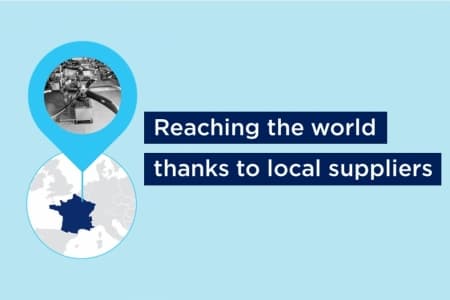
Despite only having 10,000 inhabitants, Figeac in south-west France is home to a whole ecosystem of aerospace companies and suppliers. Collins Aerospace, a Raytheon Technologies company, is one of them. Its Ratier-Figeac unit is an internationally renowned centre of excellence for propellers. Collins Aerospace RatierFigeac employs 1,200 people in four key business segments. Its main undertaking is propellers, which account for about 60% of the Ratier-Figeac unit’s activities. 60% of its total global expenditure on local suppliers is in France. Discover their success story.

News
27 Feb 2022
Fostering innovation through collaborative partnerships

Collins Aerospace Ratier-Figeac calls on hundreds of local suppliers in the French market. Their overall reactivity; their geographic proximity; and their agile and innovative dynamic are all valued assets for Collins Aerospace. By working with suppliers, Collins Aerospace support an estimated 600 jobs in France on top of its direct employees.

A specific example of an outsourced service is propeller painting. Collins Aerospace Ratier-Figeac contracts the services of two local suppliers to perform the finishing and painting of their propeller blades within a lead time of 3 days. Traditionally competitors, the two companies have recently teamed up to collaborate on a technological innovation in their sandblasting processes before painting the blades. They have partnered up to automatise the process of sandblasting, adding even greater quality and efficiency to their collective service. For local suppliers such as the paint shops in Figeac, working with Collins Aerospace is a great opportunity: It is a well-known brand, with a focus on producing the highest quality. As the example of the paint shops attests, Collins Aerospace provides support to local suppliers to achieve the levels of service demanded. In turn, Collins Aerospace counts on its suppliers to deliver its reputed equipment.

*A Raytheon Technologies company
Acknowledgement: Patrick Derbois, Director of Supply Chains, Collins Propeller Systems

The success story of global trade lies in strong partnerships between companies of all sizes. Find out more about European ecosystems connecting small businesses with larger American companies. 

Related items

News
7 Jul 2026

Branching out with AI

Meta’s open-source Canopy Height Maps helped the European Commission’s Joint Research Centre improve its 2020 Global Forest Cover map, demonstrating how artificial intelligence can strengthen Europe’s ability to monitor forests and advance climate and biodiversity goals. Developed with the World Resources Institute, the maps use Meta’s DINO self-supervised computer vision model to estimate tree height from satellite imagery. This helped researchers apply the five-metre threshold used in many international forest definitions and better distinguish forests from other tree-covered land, including agricultural tree crops. The resulting product, available through the EU Forest Observatory, provides one of the most comprehensive open views of global forest cover. Read more on Invested in Europe.

Digital
Read more
Read more about Branching out with AI
Blog
3 Jul 2026

The transatlantic relationship at 250 years: a shared history and a forged future

Authored by Malte Lohan, CEO, AmCham EU

Transatlantic
Read more
Read more about The transatlantic relationship at 250 years: a shared history and a forged future
News
3 Jul 2026

Advancing skills for Europe’s AI transition

On Tuesday, 30 June, AmCham EU hosted a roundtable exploring strategies for preparing Europe’s workforce for the age of artificial intelligence (AI). Members and policymakers analysed how AI is changing roles across sectors and how employers, governments and education providers can respond. Joined by Idoia Mendia, MEP (ES, S&D) and Mario Nava, Director-General, Directorate-General for Employment, Social Affairs and Inclusion, European Commission, the conversation focused on digital and data skills, as well as expanding AI literacy across organisations. Participants also discussed reskilling and public-private cooperation to support a more inclusive labour market. In addition, members shared best practices from their companies and pointed to the need for policy frameworks that support lifelong learning and skills-based hiring. As AI becomes part of everyday work, Europe must close the skills gap to strengthen competitiveness and prepare people for the future of work.

Social impact, inclusion and skills
Read more
Read more about Advancing skills for Europe’s AI transition