Commitment and action to deliver on the EU forest protection objective

The EU Green Deal promotes halting deforestation and ecosystem degradation that result from unsustainable agricultural practices.  

Find out how Cargill is taking action in its cocoa, palm oil and soy supply chains in order to achieve the company’s commitment of 100% deforestation-and conversion-free supply chains by 2030. 

Learn more at The Green Way and join the conversation on Twitter with #EUGreenWay

News
5 Oct 2021
Agriculture and food , Environment
Commitment and action to deliver on the EU forest protection objective

The EU Green Deal promotes halting deforestation and ecosystem degradation that result from unsustainable agricultural practices.  

Find out how Cargill is taking action in its cocoa, palm oil and soy supply chains in order to achieve the company’s commitment of 100% deforestation-and conversion-free supply chains by 2030. 

Learn more at The Green Way and join the conversation on Twitter with #EUGreenWay

The EU Green Deal promotes imported products and value chains that do not involve deforestation and forest degradation.

For over a decade, Cargill has been addressing deforestation in its supply chains and working with farmers, governments, customers, environmental organisations and members of the communities in which the company operates in order to find practical and scalable solutions.

Cargill is committed to transform its agricultural supply chain to be deforestation- and conversion-free through prioritised policies and time-bound action plans, as outlined in Cargill’s Policy on Forests, and is a strong advocate for the industry to join pre-competitively in support of multi-stakeholder efforts to address deforestation on landscape level interventions.

Each supply chain is unique, and Cargill leverages its size, expertise and supply chain capabilities in a variety of ways to create a more sustainable, food-secure future. Cargill is taking action in its cocoa, palm oil and soy supply chains in order to achieve help the company’s commitment of 100% deforestation-and conversion-free supply chains by 2030.

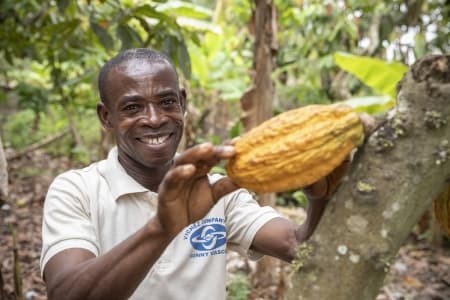
Cocoa – Cargill’s Protect Our Planet Strategic Action Plan is the company’s strategic action plan to eliminate deforestation from the cocoa supply chain. It outlines concrete actions to achieve 100 percent cocoa bean traceability, to expand programmes to grow more cocoa on less land and to support farmers to effectively include agroforestry and conservation practices on their farm. Cargill is also one of the original signatories of the industry’s Cocoa and Forests Initiative (CFI) committed to no further conversion of any forestland and ending deforestation in Ghana and Côte d’Ivoire. All signatories are committed to annual reporting on progress. These are our Annual CFI Progress Reports: 2019 and 2020.

Palm Oil – Cargill is committed to producing and sourcing palm oil in an economical, environmentally sustainable and socially responsible manner and is working toward a 100% transparent, traceable and sustainable palm supply chain. Cargill’s commitment is embodied in the philosophy of ‘No Deforestation, No Peat and No Exploitation’. The company is taking action to increase transparency, improve engagement with stakeholders, verify progress and help transform the industry. Cargill’s Policy on Sustainable Palm OilForest Policy and Human Rights Commitment govern the company’s actions in this regard.

Soy – Cargill has been working to end deforestation related to soy production for decades. This work started in the Brazilian Amazon with the Soy Moratorium and continued through the development of Cargill’s Policy on South American Soy, which captures our commitment to a transparent and sustainable South American soy supply chain. Cargill’s Soy Action Plan – South America Origins, in support of the company’s Sustainable Soy Policy, is an important component of the comprehensive actions that Cargill is taking across supply chains to increase transparency and advance the company’s sustainability commitments. For more information see the 2020 Soy Progress Report.

About Cargill

Cargill’s team of 155,000 professionals in 70 countries draws together the worlds of food, agriculture, nutrition and risk management. For more than 155 years, Cargill has helped farmers grow more, connecting them to broader markets. Cargill is continuously developing products that give consumers just what they are seeking, advancing nutrition, food safety and sustainability. And Cargill helps all of its partners innovate and manage risk, so they can nourish the world again tomorrow.

Read more on Cargill’s commitment to protect forests and end deforestation
Read more on how Cargill is transforming its supply chain
Read more on Cargill’s partnerships with farmers around the world
Visit Sustainability and Corporate responsibility at Cargill | Cargill for more information

Related items

News
29 Apr 2026

Revision of the Classification, Labelling and Packaging Regulation: Following a balanced Report, trilogues must secure simplification

Today, the European Parliament adopted its Omnibus VI report, including the revision of the Classification, Labelling and Packaging (CLP) Regulation, by 540 votes to 60. The outcome supports a more streamlined framework by easing the regulatory burden on value chains that rely on chemicals and sending a positive signal of the EU’s commitment to reducing unnecessary complexity.

With the Council’s position agreed in November 2025, the Parliament’s report marks the final step before trilogues, which will conclude negotiations on the targeted revision of the CLP Regulation.

The report largely aligns with the Commission’s simplification agenda and strengthens the CLP Regulation’s overall workability, especially with regards to:

  • Transition periods, setting 18 months following classification updates and allowing digital contact information to be updated on the label in line with suppliers’ regular update cycles. This better reflects supply chain realities.

  • Advertising and distance sales requirements, appropriately excluding business-to-business settings while ensuring consumers remain protected; and

  • Label legibility requirements, with more proportionate minimum font sizes and rules on background contrast, spacing and overall layout. However, further simplification is still needed to ensure sufficient flexibility for businesses.

While the report represents a constructive step forward, trilogues should address remaining constraints and clarify language that is currently difficult to interpret, including further simplification on font sizes and advertising requirements in business-to-consumer settings. These negotiations should draw on the more proportionate approaches of the Commission and the Council.

Maintaining a strong focus on simplification will be key to further alleviating administrative burdens and strengthening the EU’s resilience and competitiveness.

Environment
Read more
Read more about Revision of the Classification, Labelling and Packaging Regulation: Following a balanced Report, trilogues must secure simplification
Position Paper
29 Apr 2026

Simplifying the Classification, Labelling and Packaging Regulation: recommendations for trilogues

On 8 July 2025, the Commission presented the Omnibus VI simplification package, reopening key legislation such as the CLP Regulation, which entered into force in December 2024. The Omnibus addresses overlaps and inconsistencies that create practical challenges and, in some cases, make compliance unworkable.


Upcoming trilogues can streamline the framework and reduce unnecessary burdens. This paper sets out targeted recommendations on the positions that can achieve meaningful simplification during the inter-institutional negotiations.

Environment
Read more
Read more about Simplifying the Classification, Labelling and Packaging Regulation: recommendations for trilogues
News
20 Apr 2026

Discussing environment policy priorities with policymakers in Finland

From Monday, 13 to Wednesday, 15 April, AmCham EU travelled to Helsinki for a series of meetings with Finnish stakeholders on the future of EU environment policy. In discussions with representatives from the Finnish Ministry of Economic Affairs and Employment, the Ministry of the Environment, the European Chemicals Agency and Members of the Finnish Parliament, the delegation examined how the EU can pursue its environmental objectives and support competitiveness by delivering long-term simplification in environmental policies.

Across the meetings, one theme was evident. Europe’s environmental legislation must be more coherent and efficient across the Single Market. Members emphasised that simplification is not about lowering standards, but about avoiding unnecessary complexity while preserving a high level of environmental and human health protection and building the business case for investment in sustainable frameworks such as Circular Economy. As the EU takes forward its next environment policy initiatives, the priority should be a framework that combines ambition with legal certainty, supports investment and delivers practical outcomes across Europe.

Environment
Read more
Read more about Discussing environment policy priorities with policymakers in Finland